Get Full Government Meeting Transcripts, Videos, & Alerts Forever!
Get email alerts on the Automated Traffic Safety Cameras topic
No spam. Unsubscribe anytime.
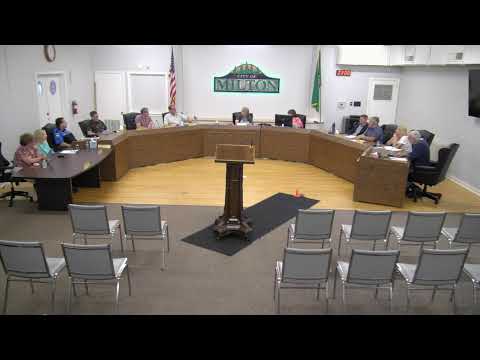
Milton council creates dedicated fund for automated traffic cameras and amends 2025 budget
Summary
Milton City Council on Aug. 4 adopted an ordinance creating a special revenue fund for the city's automated traffic safety camera program and approved a related budget amendment that moves camera revenues out of the general fund and aligns ARPA reporting; the council voted 7-0 on both items.
On Aug. 4, the Milton City Council voted 7-0 to create a special revenue fund to hold revenues and expenditures from the city’s automated traffic safety camera program and separately approved a budget amendment that moves the camera monies and other line items into new fund codes. The council adopted Ordinance No. 2117-25 (fund creation) and Ordinance No. 2118-25 (2025 budget amendment) after staff presentations and public comment.
City staff said the fund is necessary because state law limits how camera program revenues can be used. Interim Director Robek told council, "Because use of the automated traffic safety camera program revenues is legally restricted, it is recommended that the program revenues and expenditures be accounted for in a special revenue fund." The staff presentation cited Revised Code of Washington (RCW) 46.63.022 as the statute that narrows allowable uses to program costs and traffic-safety activities. The agenda bill listed eligible uses including crosswalks, sidewalks, bicycle lanes, rumble strips, warning and guidance signage, curb extensions, roundabouts, speed humps, median islands and illumination.
Council members discussed visibility and accountability for the receipts. Council member Hall said, "I like having separate fund. It's easier to explain to the residents where the money is going. It's clear." Council member Seeder moved to adopt the budget amendment; Council member Peretti seconded that motion.
Council members and members of the public also discussed timing and implementation. City staff reported the physical camera systems have been installed and that the city is finalizing administrative steps, vendor coordination and court paperwork; staff did not provide a firm activation date. Council members repeatedly requested a clear timetable and a minimum public-notice period. Council members and staff described a standard implementation practice of an initial warning or amnesty period before fines begin; staff said that the city will use reader boards, its website, social media and mailed notices to inform drivers and that the city will apply a 30-day warning/education period when it begins enforcement.
On enforcement procedures, the council heard questions from residents. Staff outlined collection consequences for unpaid violations and indicated administrative remedies include collections and a registration hold that can prevent vehicle re-registration.
Council members also discussed camera placement. One member said the city has nine camera units in the contract but that multiple cameras can be installed at an intersection (for approaches and stop lines), which explains different camera counts seen in the field. Staff said any future camera additions or relocations would be brought back to council for review and ratification and that cameras may only be installed where engineering or crash data identify hazardous conditions, consistent with state law.
The budget amendment (Ordinance No. 2118-25) was described by staff as largely an internal reclassification: it moves automated camera revenues and expenditures from the general fund to the newly created special revenue fund and aligns American Rescue Plan Act (ARPA/SLFRF) items with the city’s compliance reporting. Staff also noted one substantive change to accommodate a late Microsoft licensing renewal that requires recognizing two years of licensing costs in 2025.
Public comment at the council meeting included residents who supported camera deployment in school zones and requested cameras at specific corridors; others asked about consequences for unpaid fines. The council approved both ordinances on voice votes, carried 7-0.
What the council decided: Ordinance No. 2117-25 creating the Automated Traffic Safety Camera Fund — adopted, 7-0. Ordinance No. 2118-25, Budget Amendment No. 3 — adopted, 7-0.
Next steps noted by staff: finish court and vendor approvals, begin an advertised 30-day warning period when activation is ready, and return to council for any proposed additional camera locations or relocations.
(Reporting note: direct quotations and attributions are from the meeting transcript. Where staff provided timing estimates, staff described the activation date as pending final court and vendor approvals and did not commit to a specific calendar date.)