Get Full Government Meeting Transcripts, Videos, & Alerts Forever!
Get email alerts on the Personal Property Tax topic
No spam. Unsubscribe anytime.
Salem committee recommends $1,000 personal-property tax exemption to aid about 187 small businesses
Summary
The Salem Committee on Administration and Finance voted unanimously to recommend the city adopt Massachusetts General Law Chapter 59 Section 5, Clause 54, exempting personal property accounts valued under $1,000 from local taxation; staff said 187 accounts would be affected and the fiscal impact is minimal.
SALEM, Mass. — The City of Salem Committee on Administration and Finance voted unanimously Wednesday to recommend that the full City Council accept Massachusetts General Law Chapter 59 Section 5, Clause 54 and set a minimum taxable value for personal property at $1,000, a move that staff said would exempt about 187 small-business accounts from local personal property taxation.
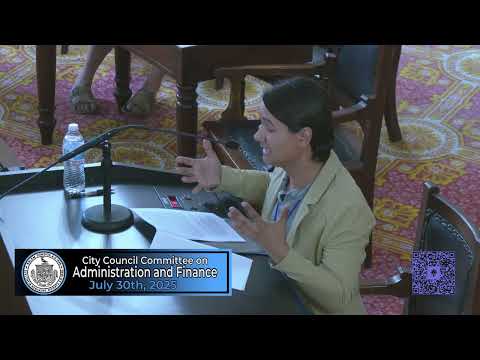
The recommendation, made during a Committee of the Whole session, was introduced by Chair Merkel and backed by data presented by Steven Cortez, the city’s director of assessing. Chair Merkel said the order “is to adopt a section of mass general law that will provide a measure of tax relief for an estimated 187 small businesses here in Salem.”
Cortez told the committee that personal property includes “anything tangible and movable that isn't part of land or building,” such as furniture, office equipment, and machinery, and explained the administration and valuation process for such accounts. He said there were 187 personal property accounts in Salem with taxable value below $1,000, with a combined assessed value of approximately $97,900. At the city’s FY25 commercial tax rate, Cortez said the revenue shifted to larger commercial, industrial, and personal-property (CIP) accounts would be about $2,214.50 — a change he described as “minimal” relative to the CIP tax base.
The presentation cited state law that allows municipalities to set a local minimum taxable value for personal property accounts up to $10,000. Cortez said the exemption would become effective upon majority vote of the city council. He also told the committee that about 230 Massachusetts municipalities — roughly 65% of communities — have adopted some version of a small-account exemption, with many using the $1,000 threshold.
Committee members emphasized the exemption’s administrative benefits as well as the direct relief to small businesses. Councilor Davis moved to recommend adoption; Councilor Hopworth seconded. Chair Merkel stated, “Let the record show I see 2 hands plus my own voting in favor,” and the committee’s motion carried unanimously.
Cortez outlined other operational reasons for the change: the city’s cost to bill and collect many very small accounts can exceed the revenue they generate, and personal property tax lacks some enforcement mechanisms available for real estate tax (for example, no automatic lien on the asset). He explained standard processes available to taxpayers who dispute assessments — including filing the annual "form of list," inspection requests, and the formal abatement process in January — and noted that failure to comply with required filings can limit abatement rights.
Committee members asked about outreach; Cortez said the assessing department maintains a list of property owners for accounts under $1,000 and can notify them if the council adopts the exemption. Members also noted the city is in a revaluation year and said that timing made bringing the exemption forward more urgent if officials wanted micro and small businesses to benefit during the upcoming cycle.
The committee’s recommendation is advisory; the measure must be approved by a majority of the full City Council to take effect. Committee members discussed scheduling a council vote in August to act on the recommendation. The committee also asked staff to provide stakeholder notice and to monitor how the exemption affects administrative workload and taxable value distribution if adopted.
The meeting closed after the vote; the committee also thanked Cortez for preparing the analysis and noted prior staff and budget transitions that affected timing of the proposal.