Get Full Government Meeting Transcripts, Videos, & Alerts Forever!
Get email alerts on the Hazing Policy topic
No spam. Unsubscribe anytime.
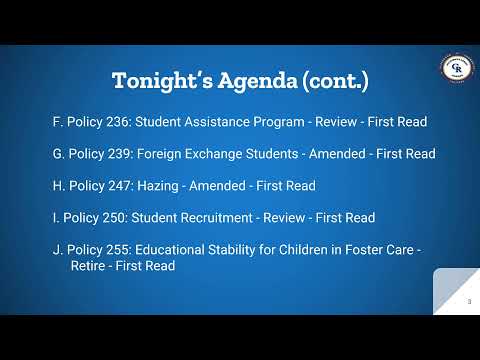
Council Rock rewrites hazing policy to reflect Pennsylvania's Timothy J. Piazza law
Summary
The district rewrote its hazing policy to reflect Pennsylvania's 2018 Timothy J. Piazza anti-hazing law, adding definitions, investigative steps, interim protections and parent-notification requirements.
The Council Rock School District policy committee presented a substantial rewrite of the district's hazing policy during its Aug. 4 meeting to incorporate requirements from the Timothy J. Piazza anti-hazing law enacted in Pennsylvania in November 2018.
Why it matters: the statute added comprehensive requirements for secondary and higher-education institutions addressing definitions of hazing and aggravated hazing; required complaint and investigation procedures; interim protective measures; a safe-harbor mitigation provision for students who seek timely medical help for victims; and mandated parent notification for those involved when appropriate.
Details: staff said the rewrite is extensive because the law took effect shortly after the district's previous policy adoption, creating new duties. The updated policy adds definitions (organizational v. individual hazing), identifies aggravated hazing, outlines investigative and complaint processes, requires interim steps to protect complainants during an investigation, and provides for referrals to law enforcement where appropriate. The policy also highlights protections against retaliation and clarifies that adults (coaches, advisors, volunteers, employees) must not condone or ignore hazing.
Board members asked whether local incidents had occurred; staff said they were not aware of recent district incidents but noted the policy covers student-on-student conduct, organizational membership, and potential adult involvement. Members discussed the need for discretion where minor, innocuous newcomer activities exist and urged attention to proportionality in disciplinary response.
Outcome: the committee reviewed the rewrite and indicated the item would proceed as part of the consent first-read process for subsequent board consideration.