Get Full Government Meeting Transcripts, Videos, & Alerts Forever!
Get email alerts on the Waste To Energy topic
No spam. Unsubscribe anytime.
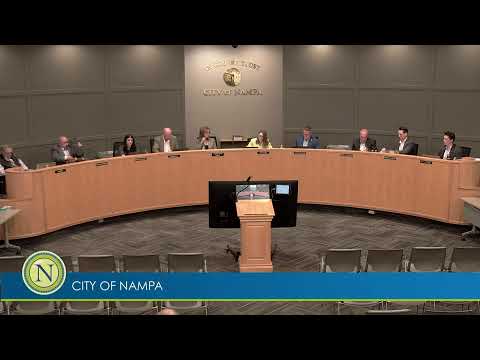
Nampa council approves lease and demonstration funding for refurbished NRGX bioreactor
Summary
The Nampa City Council authorized a lease-purchase agreement and a separate demonstration project to test a refurbished NRGX IE-60 bioreactor at the wastewater plant, approving upfront escrow and demonstration-cost funding while members pressed staff on financing, performance guarantees and operational risks.
The Nampa City Council voted to authorize a lease-purchase agreement and to fund a short demonstration for a refurbished NRGX IE-60 bioreactor that city staff says would convert wastewater biosolids and wood feedstock into fuel, electricity and carbon products.
Senior Public Works Director Tom Points told the council the recommended lease arrangement would require an upfront escrow deposit and a first-month payment that together push initial city commitments to “no more than $1,382,000,” and that the leasing schedule includes monthly rental payments and a balloon payment at the end of the 42-month agreement. Points said the demonstration — a separate, smaller authorization the council approved — will let staff verify actual gas volumes and methane content from Nampa’s feedstock before committing to later phases.
The vote to authorize the mayor to sign the lease-purchase agreement with Commercial Funding Partners passed 4–2 (Mills, Everfield, Anguilla and Reynolds in favor; Rodriguez and Griffin opposed). The separate motion to allow the senior director of public works to proceed with the demonstration project in the amount of $181,418 passed 5–1 (Griffin opposed).
Why it matters: City staff presented the demonstration as a required step before committing to a multi-phase program projected by proponents to cost up to $30 million if fully built. The project is pitched as a way to increase wastewater-plant energy resilience, reduce biosolids volume and produce new revenue streams — power sales, carbon product sales and possibly pipeline-quality methane. But councilors pressed staff on cost, lender terms and vendor stability before approving the initial commitments.
What the council authorized and why staff pushed for a demo Tom Points told the council that the loan/lease lender required an escrow deposit that would cover roughly the last nine months of payments plus the first-month lease payment; that total escrow-plus-first-month arrangement is the reason the initial cash ask is larger than staff had first expected. Points said staff modeled project revenues under conservative assumptions (using only the plant’s biosolids and no grants) and that those models still showed a payback in about six to eight years, but that the demonstration step is needed to validate actual gas volumes, methane content and carbon yields from Nampa’s feedstock.
Points said: “Return on investment looks pretty good through all the phases of the project,” and stressed the demonstration will test real-world performance rather than rely only on paper modeling.
Finance, risks and safeguards discussed Council and staff discussed several financial details at length: the lease term is 42 months; monthly rental was presented as $138,200; there is a balloon payment of roughly 12% (about $600,000) due at the end of the lease. Staff and the city’s advisors said the effective initial note rate from the lease provider is relatively high (staff and advisors referenced roughly a 13% rate) because the lender is taking on perceived startup and nonstandard equipment risk. Staff and the city’s financial adviser said the city can refinance later — once the machine has demonstrated performance — and there is no prepayment penalty, although the balloon amount still would be due whether paid early or on schedule.
City staff said money for the initial payment would come from a reallocation of Headworks project funds in the Water Renewal enterprise (about $18 million was allocated to Headworks, roughly $4 million has been spent to date). Staff also reported NRGX offered to put three months of payments into escrow as a good-faith contribution and agreed in concept to a buyback clause: if the equipment does not meet specified performance criteria during the demo, NRGX would repurchase the unit.
Vendor provenance and technical claims Bobby Yankeney, representing NRGX, told council the underlying thermal-conversion technology has a 20–26 year deployment history and that Integrated Energy (now part of the NRGX holding group) is the original operator of that technology. Yankeney said NRGX is a newly formed holding company consolidating several existing technology firms and that the specific thermal converter technology is well established in other deployments, including some U.S. military installations.
Points and others described the planned technology process as pyrolysis/thermal conversion (operating in a low-oxygen, indirect-heat environment) that would convert dried biosolids and wood into syngas for power generation and carbon byproducts (biochar/granular carbon). Staff said the machine can operate at up to 60 dry tons per day but Nampa would begin testing at a lower feed rate — modeled conservatively at 10 tons per day for initial ROI calculations given current biosolids supply — and that the wastewater plant has the physical capacity to accept higher feed rates later.
Council concerns and conditions Councilors pressed staff on multiple items before voting: the relatively high effective interest/balloon payment, the need for a binding buyback/repurchase agreement, the lender’s escrow requirement tied to Idaho’s appropriation rules, and vendor longevity. Staff said a draft letter of intent and buyback language had been shared with the vendor but the vendor had only just received those materials and had not fully responded.
Council asked that buyback and performance-language be finalized before moving beyond the demonstration phase; staff said the demonstration authorization is precisely to establish measurable performance metrics (methane percentage, gas volumes, carbon content) and that those metrics would be the basis for any next-phase commitment.
Key financial and technical numbers (clarifying details) - Initial escrow requested by the lender (to cover roughly last 9 months of payments): approximately $1,200,000 (source: Tom Points) - First-month lease payment: $138,200 (source: lease rate sheet included in packet) - Not-to-exceed initial cash commitment cited by staff: $1,382,000 (escrow + first month) (source: staff report) - Lease term: 42 months (source: staff presentation) - Monthly lease payment cited: $138,200 (source: rate sheet) - Balloon payment at lease end: ~12% (about $600,000) (source: staff presentation) - Effective note/lease rate discussed: ~13% (staff/advisor commentary) - Demonstration contract authorized: $181,418 (approved separately) - Full multi‑phase project estimate (all phases combined): about $30,000,000 (staff presentation) - Machine throughput: up to 60 dry tons/day capacity; staff modeled worst-case at 10 tpd given current biosolids supply; plant could accept more feedstock later (source: Tom Points) - Conservative modeled ROI (no grants, only Nampa biosolids): 6–8 years (staff analysis)
What’s next Staff will execute the demo procurement and begin test runs; they said they will pursue permits (air permits, DEQ coordination) and finalize buyback and escrow language with NRGX. Staff and the city’s financial advisers also said they would continue to pursue refinancing and other lower-cost debt options after the demonstration, and would seek additional partners and possible grants before scaling to later phases.
Quotes Senior Public Works Director Tom Points: “Return on investment looks pretty good through all the phases of the project.” NRGX owner Bobby Yankeney: “We’ve agreed to buy back the unit. That’s not an issue.”
Ending Council approved the two distinct authorizations needed to proceed: (1) the lease-purchase authorization that allows the city to take delivery of the refurbished converter under the financial terms presented, and (2) the smaller demonstration authorization that funds the initial, site-specific testing intended to prove throughput, gas quality and carbon yields before the city commits to larger capital phases. Staff will return with finalized performance language, detailed buyback/LOI terms and a timeline for the demonstration and permitting steps.