Get Full Government Meeting Transcripts, Videos, & Alerts Forever!
Get email alerts on the Juvenile Court Guardianship topic
No spam. Unsubscribe anytime.
Court orders continued QRTP placement and ongoing jurisdiction while SSI is pursued in Britney Shea case
Summary
At a permanency review in Lenawee County Probate & Juvenile Court, the judge admitted a 124‑page court report, found Britney Shea requires continued treatment at a QRTP, authorized continued department support, and set the next review for Nov. 3 while parties pursue Social Security benefits and adult guardianship.
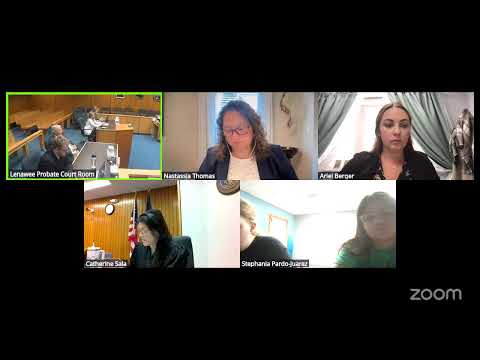
Lenawee County Probate & Juvenile Court held a permanency review in case number 09-072NA concerning Britney Shea, and the judge ordered continuation of her current placement and court jurisdiction while Social Security benefits are pursued.
The court admitted the department's court report into evidence and found that Shea continues to “need that supported level of care at the QRTP level,” ordering that supports from the Department of Health and Human Services be authorized and continued through the next review period. The judge also said the court’s order will reflect that “no reasonable efforts towards reunification will be necessary or engage with the parents.” The next permanency review was scheduled for Monday, Nov. 3, at 10:30 a.m.
Why it matters: the hearing resolved short-term custody and funding questions while the parties await state/federal disability determinations that will affect payment and a plan for adult guardianship. Department staff and counsel told the court they will keep the case open while applying for Social Security benefits to avoid a funding gap.
Department social worker Brenda Burgess, a foster care worker for the department, told the court that she supports pursuing an adult guardianship but that the department has been advised not to petition for guardianship until Social Security income (SSI) is in place because “the department will stop paying for her placement” once a guardian is appointed. Burgess told the court, “It does take 7 to 8 months,” referring to the SSI application timeline, and said the department has applied for benefits and is seeking an appropriate placement with community partners.
Attorney Michael McFarland, identified in the record as “attorney guardian life,” said he supports pursuing Social Security first and then a guardianship so there is no funding interruption. Britney Shea’s court-appointed attorney, Carson Howard, and counsel for the department, Sasha Thomas, participated in the review; other participants included Ariel Berger (on behalf of April Shea), Michael Brooks (representing father Richard Shea), and clinician Stephanie Pardo Juarez from Wedgwood, who reported on Shea’s response to placement planning.
Court staff and attorneys confirmed there was no objection to admitting the report; parties noted the report totaled 124 pages. The judge credited Burgess’s recent work on the case and said the department’s supports and the services put into place will be reflected in the forthcoming order.
The court explicitly left jurisdiction open so the department will continue to fund Shea’s placement while benefits are pending; department counsel stated the agency will continue paying for the placement until Shea turns 20 if the court agrees to keep the case open. The record did not identify the proposed guardian by name or provide a specific placement provider; CMH and department staff said they were still locating placements and contacting agencies that had indicated possible openings.
Discussion items before the court included: (1) whether to petition now for an adult guardianship versus waiting until Social Security benefits are active; (2) the timeline for SSI/SSDI processing and the risk of a funding gap; and (3) continuing monitored contact between Shea and family with limits if communications become inappropriate. The judge directed that the court’s next permanency review occur Nov. 3 at 10:30 a.m.
The record shows the court’s orders will authorize continued QRTP-level care and supports, maintain court jurisdiction through the next review, and state that reunification efforts with parents are not required at this time. Details about the proposed guardian and the specific placement provider were not specified in the hearing record.