Get Full Government Meeting Transcripts, Videos, & Alerts Forever!
Get email alerts on the Property Taxes topic
No spam. Unsubscribe anytime.
Kerr County assessor outlines 2025 tax-rate formulas; residents urge cuts after disaster
Summary
At a special Kerr County Court meeting Aug. 4, Tax Assessor-Collector Bob Reeves explained the county's 2025 property-tax calculations and presented no-new-revenue and voter-approval benchmark rates. Residents urged the court to lower rates and reject an earlier-discussed emergency 8% increase.
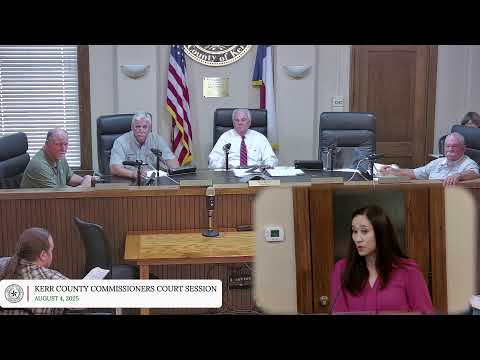
Kerr County Court met in a special session Monday, Aug. 4, and heard a presentation from Tax Assessor-Collector Bob Reeves on the 2025 property-tax calculations used to produce the county's no-new-revenue and voter-approval benchmark rates.
Reeves told the court, "The no new revenue rate, as I said, I'm 99.9% certain, is 0.4024." He explained the "no new revenue" figure compares the same properties across two years and adjusts for market appreciation and changes such as newly granted agricultural valuation. On possible ceilings, Reeves gave the voter-approval rate as "0.4867 per $100" if the court uses the 3.5% factor, and 0.4601 under an emergency calculation.
The technical definitions mattered to residents at the meeting. Terry Hall of Liberty in Action said elected officials should lower tax rates rather than consider an 8% disaster rate, telling the court, "We really we really need you to lower the rates." Another commenter, Jacob Wellness of Jeffrey Scott Road, urged the court to consider business impacts: "whatever y'all end on, remember, if you raise rates on business, it means the price of it literally everything we buy locally goes up."
Why this matters: Reeves said the county's no-new-revenue calculation affects only county taxes, not independent taxing entities such as school districts or municipalities. He noted that some exemptions and freezes apply countywide (for example, certain homestead freezes for residents over 65), but other entities'rates remain separate.
Reeves provided numerical examples to show effects on taxpayers. He said the no-new-revenue scenario would raise the average homeowner's county tax by about $74, calculated on an average home value he placed at roughly $303,160. He added that "for every 1¢ that you adopt a rate above the no new revenue rate, it's about a $39 increase in your taxes." Reeves also noted a roughly "nickel" of banked increments (foregone revenue from prior years) that the county may use under state law; he warned that some of those banked increments will roll off next year and could reduce available margin in future cycles.
Public commenters pressed the court over timing and perceived fairness in a disaster year. Hall said judges in other counties had expressed reluctance to impose large disaster surcharges and asked Kerr County to adopt that approach. The County Judge responded that the court had not decided to adopt an emergency 8% increase and that Reeves was asked to prepare numbers for full information.
What happened next: Item 1.1 closed after audience comment and follow-up questions; the court moved on to other agenda items. Reeves said he intended to proofread and then file the calculations with the court. No tax-rate ordinance or final vote on a tax rate occurred at the meeting.
Ending: The court kept the tax discussion in a fact-finding phase and did not adopt a final tax rate on Aug. 4. Commissioners and staff said they would return with more calculations at upcoming budget workshops and hearings.