Get Full Government Meeting Transcripts, Videos, & Alerts Forever!
Get email alerts on the Property Taxes Millage topic
No spam. Unsubscribe anytime.
Milton holds first of three public hearings on proposed FY2026 millage; advertised rate 4.193 mills
Summary
Milton City Council on Aug. 4 held the first of three required public hearings on an ordinance to set the city's FY2026 ad valorem tax (millage) rate, with staff presenting an advertised rate of 4.193 mills and explaining how that rate was calculated and would affect typical residential tax bills.
Milton City Council on Aug. 4 held the first of three required public hearings on an ordinance to set the city's FY2026 ad valorem tax (millage) rate, with staff presenting an advertised rate of 4.193 mills and explaining how that rate was calculated and would affect typical residential tax bills.
Deputy City Manager Bernadette Arbel, who presented the staff analysis, told the council that "staff has advertised a millage rate of 4.193 mills, which supports a proposed balanced budget." She explained that because the advertised rate exceeds the computed rollback rate, state law requires three public hearings; the council scheduled the remaining hearings for Aug. 4 at 6 p.m. and Aug. 11 after the work session.
The presentation laid out three millage scenarios: the current rate of 4.389 mills, the advertised rate of 4.193 mills, and the calculated rollback rate of 3.923 mills. Arbel said the current legal cap is 4.731 mills and noted the city's separate bond (green space) millage, which is not included in that cap. Based on current digest figures, staff forecast a bond millage of about 0.31 mills to cover FY2026 debt-service; Arbel noted the bond millage has been roughly 0.356 and 0.364 mills in prior years.
Staff also quantified revenue impacts: the current millage of 4.389 mills would yield roughly $2.0 million more in year-1 revenues than the rollback rate, while the advertised 4.193-mill rate is about $1.1 million above the rollback. Property-tax collections were presented using assumed first-year collection rates of 97% for real property, 65% for personal property and 70% for motor vehicles, consistent with historical budgeting practices.
Arbel reviewed how exemptions affect taxable bills. Milton's common exemptions include a basic homestead exemption (used in the presentation as $15,000), a $25,000 65-plus exemption that applies to both maintenance/operating and bond taxes, and a full-value exemption for certain disabled taxpayers with a threshold now noted as $100,000. She emphasized that the floating homestead exemption (which applies to a primary residence and up to five contiguous acres) is often misunderstood and that "it is very, very important for everyone to understand that your adjusted base value is not available to you on your bill or on those assessment notices," meaning residents must contact Fulton County to obtain that adjusted base value.
Using a worked example, staff showed how to compute the floating exemption: taxable (assessed) value (40% of fair-market value) minus the adjusted base value equals the floating homestead exemption. Arbel said the adjusted base value grows each year by the CPI or 3%, whichever is lower, and that differences in base-year treatment and additions to property (barns, additions, acreage beyond five acres) can change how the exemption applies. During questions, Council Member Jan Jacobus asked, "Why did that assessed taxable value jump so much from '23 to '24, thus impacting the floating exemption?" Arbel replied that the county sets fair-market values and that staff could not in every case explain a specific parcel's change without county detail.
Arbel described an agricultural valuation program staff said many Milton property owners use (presented in the meeting as "CUBA") that revalues qualifying parcels by land use rather than market value; she stated the county indicated a minimum qualifying size of 10 acres and a maximum of 2,000 acres and that the program typically requires a 10-year commitment to maintain the qualifying use.
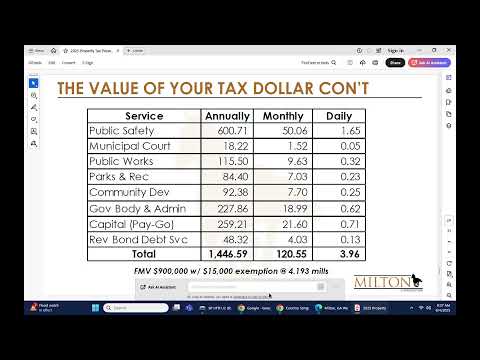
The presentation included a breakdown of how a homeowner's tax dollars at the advertised 4.193 rate would be spent by function, with public safety accounting for roughly 42% of property taxes in the example. Staff also summarized the general-fund forecast, PAYGo requests and that property taxes represent about 35% of recurring revenues in the FY2026 forecast.
Procedural actions: Councilor Verhoeff moved to approve the "first presentation" for the ordinance; Councilor Jan Jacobus seconded, and the council approved that motion unanimously. No motion to adopt a millage rate was made during the meeting; the council will consider adoption after the required additional hearings and after staff completes the forthcoming budget workshop and any required additional advertisements if council chooses a rate above 4.193 mills.
The public hearing opened for comment and no public speakers were recorded; the hearing was closed and the item returned to the council for later action. Staff said they will bring the full proposed budget to the council at the scheduled budget workshop and again at the Aug. 11 meeting when council will have the opportunity to adopt a millage rate.
(Reporting note: all quotes and attributions come from the council meeting presentation and roll call on Aug. 4, 2025.)