
Hudson advances adaptive‑signal and safety projects; council approves consent package to seek CMAQ funds
Get AI-powered insights, summaries, and transcripts
Subscribe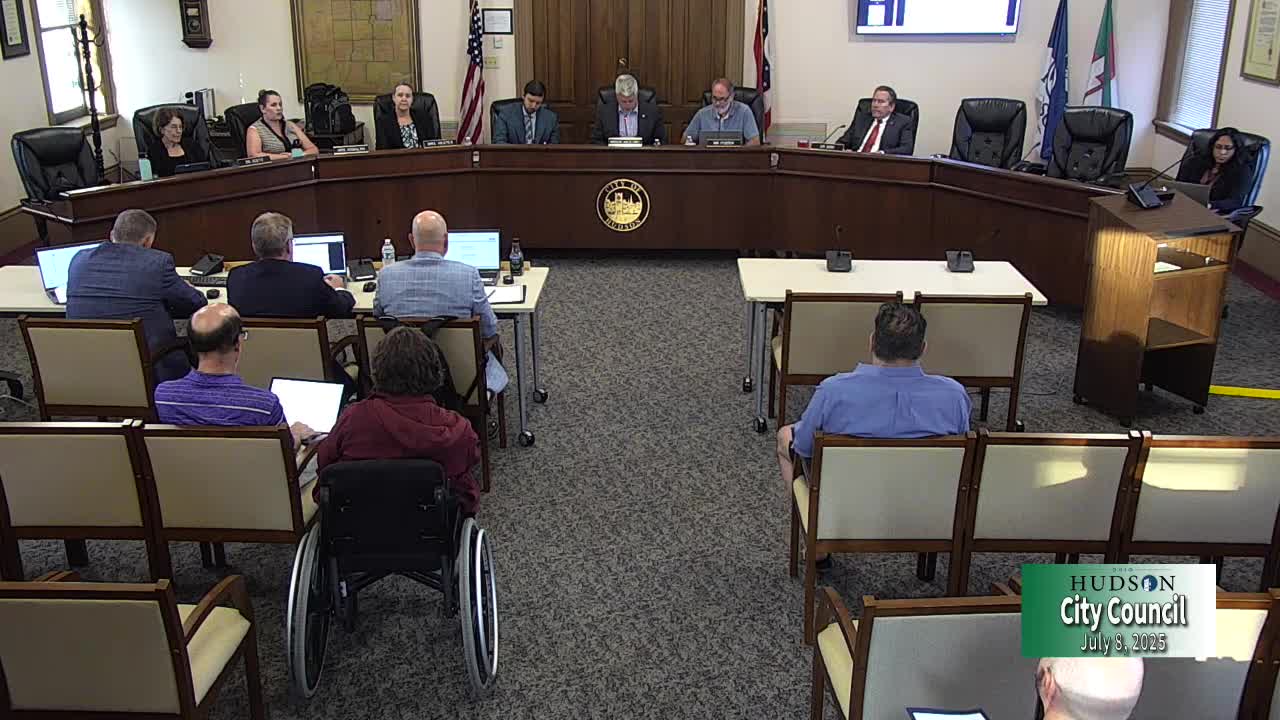
Summary
City council approved a consent agenda that included a resolution to apply for CMAQ funds for adaptive signals phase 2, and staff reported multiple transportation grants including a recent ODOT grant and a larger adaptive‑signal grant previously awarded.
Hudson City Council approved a consent agenda at its July 8 regular meeting that includes a resolution authorizing the city manager to apply for federal Congestion Mitigation and Air Quality (CMAQ) funds through the Akron Metropolitan Area Transportation Study (AMATS) to construct adaptive signals phase 2 outside downtown.
City Manager Tom Sheridan reported several transportation funding updates during the meeting. He said the city “did receive about 2,400,000.0 in a grant from ODOT for that” (adaptive signals) and earlier referenced an ODOT grant of $300,000 for work at the Seasons Road and Allen Road intersection in Stow. The CMAQ application on the consent agenda (item 25‑97) is intended to support construction of the adaptive signals phase 2 for areas outside the downtown core.
Why this matters: Adaptive traffic signals can reduce congestion and improve emergency response routing; securing CMAQ funds would provide federal support for construction beyond downtown. Council also placed related traffic‑safety work on the agenda: a professional services contract for a Stow Road/Hudson‑Aurora Road/Hudson High School traffic safety study (item 25‑98) and a cost‑sharing agreement with Hudson City Schools for that study (item 25‑99).
Council action taken: Council voted to suspend the rules to consider the consent agenda and then passed the consent agenda by roll call, each by a 5–0 vote. The meeting record shows Councilor Byrd moved to suspend the rules; the motion was seconded by Council President Foster. The motion to approve the consent agenda was moved by Council President Foster and seconded by Councilor Byrd; the consent agenda passed 5–0.
Next steps: If CMAQ funds are awarded, the city manager will manage contract procurement and project implementation. The traffic safety study will proceed under a professional‑services agreement with GPD Group, and a separate stormwater easement resolution and a Hudson Kiwanis grant acceptance for parks were also included on the consent agenda.
Ending: Council approved the consent agenda at the July 8 meeting, advancing applications and contracts that could move the city’s adaptive signals and safety projects into design and construction.