
Charter commission proposes term limits, board consolidations and changes to recall, suspension and pay rules
Get AI-powered insights, summaries, and transcripts
Subscribe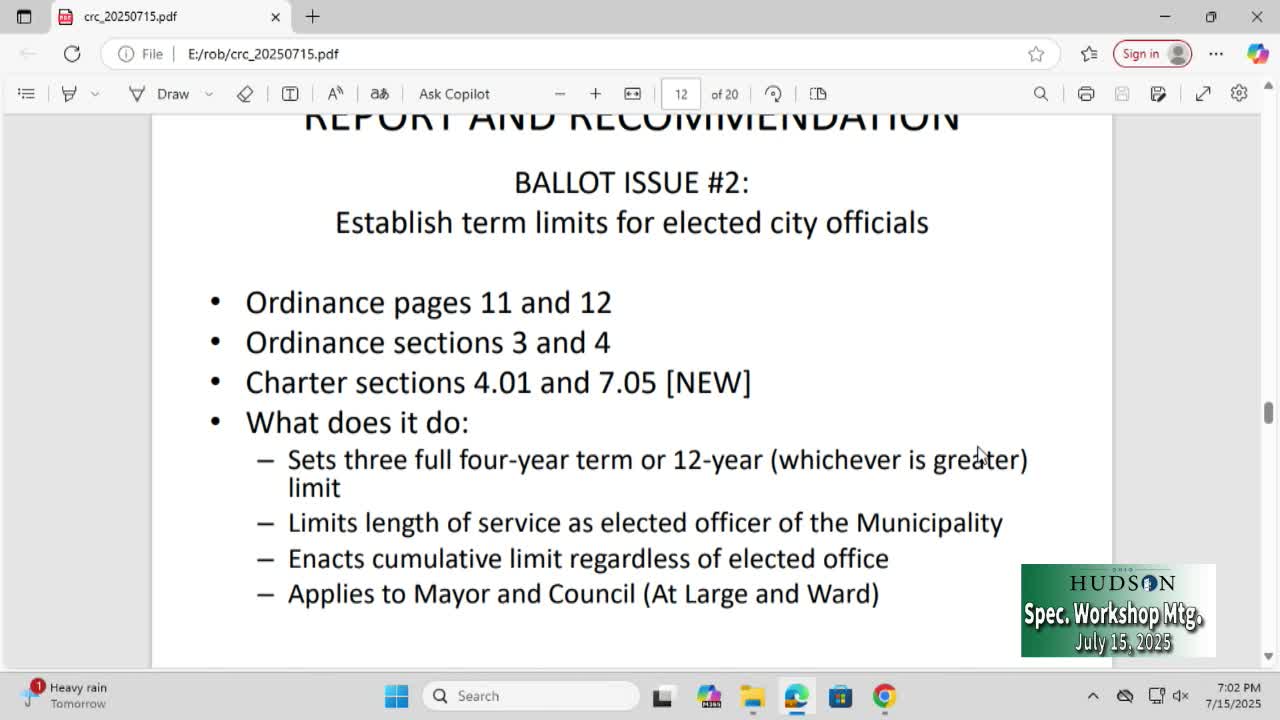
Summary
Hudson’s Charter Review Commission recommended multiple governance changes July 15 that would alter how elected officials and advisory boards serve, how recalls are initiated, and how the city handles suspension and council pay.
Hudson’s Charter Review Commission recommended multiple governance changes July 15 that would alter how elected officials and advisory boards serve, how recalls are initiated, and how the city handles suspension and council pay.
At the workshop, Rob Kegler, chairman of the Charter Review Commission, summarized the package and said the commission grouped the changes into one large administrative item and seven distinct ballot issues so voters could decide measures individually. “The largest of the ballot issues is the general administrative changes ballot issue,” Kegler said, and the commission provided individual fact sheets for each proposal.
Term limits for elected officials and volunteers: the commission proposed a limit of three full four‑year terms — a 12‑year cumulative limit — for mayor and council, with the implementation date tied to post‑2029 elections. For appointed boards and commissions, the commission recommended replacing language that referenced consecutive service with a per‑board 12‑year cap so that service limits apply to each board individually.
Consolidation and new chartered boards: ballot issue 7 would consolidate the existing chartered Park Board, Cemetery Board, and Tree Commission and fold into that new Park and Natural Resource Board the purposes and powers of the separately created Environmental Awareness Committee. The consolidated board would have an odd number of members, between seven and 11, and preserve a current charter requirement that voters must approve conversions of park land to non‑park uses. Ballot issue 6 would add the city’s ordinance‑created Military and Veterans Commission into the charter without changing its duties.
Recall threshold and council salary: the commission recommended changing the denominator used to calculate a recall petition threshold from “electors who voted in the most recent gubernatorial election” to “electors who voted in the most recent municipal election,” leaving the 25% numerator in place. On compensation, the commission proposed replacing the current per‑meeting $80 structure with a monthly amount tied to the threshold needed to qualify for a full month of service credit under the Ohio Public Employees Retirement System; the commission did not set a specific dollar figure in the proposed charter text.
Suspension language: councilmembers raised questions about a two‑word change in section 5.02 on suspension of the city manager — removing the qualifier “just” before “cause.” Councilmember Gutz asked for clarity, saying, “So, that word cause then is the same meaning as just cause, which is for misconduct, performance issues, poor documentation, that kind of thing. So, should that be spelled out more? Because that's pretty vague.” City solicitor Marshall Pitchford and commission members said the change was meant to align the charter wording with general Ohio employment law and not to reduce the standard for suspension; Pitchford stated the standard remains consistent with existing case law.
Why it matters: those proposals would change who can serve, for how long, and how the city structures advisory bodies; they could affect recruitment and institutional knowledge for boards and commissions and influence voter control over city land and levy recipients. Councilmembers said the proposals warrant more public explanation and follow‑up work; several asked the commission to return to a workshop to answer technical questions and to ensure residents have clear voter materials before November.
What’s next: if approved by voters, changes consolidating boards would become effective after a transition period (the commission proposed making consolidation effective in January 2027 to allow for staggered appointments). Councilmembers debated whether council could send amendments back to the commission; the solicitor advised the commission’s recommendations were final under the charter’s timing provisions but that council could place competing language on the ballot if five members support it.