Get Full Government Meeting Transcripts, Videos, & Alerts Forever!
Get email alerts on the Courts Caseloads topic
No spam. Unsubscribe anytime.
62B District Court reports surge in filings; judge urges planning for more judges and space
Summary
The judge of the 62B District Court told the Kentwood City Commission that filings rose sharply in 2024, driven by civil and OWI cases, and said a weighted caseload study supports requests for more judicial resources and courthouse space.
Judge (62B District Court) presented the court's 2024 annual report to the Kentwood City Commission on July 15, reporting a marked increase in filings and urging planning for additional judicial resources.
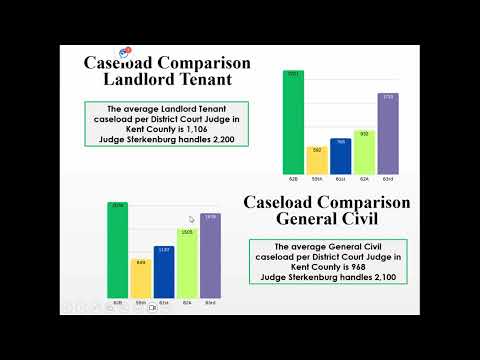
The judge said, “In 2024, we saw over 2,000 more cases filed than we saw in the year 2023,” and highlighted that general civil filings rose nearly 50% from about 1,300 in 2023 to about 2,100 in 2024. She added that drunk-driving cases were up 36% and that civil infractions make up roughly 40% of the court's caseload.
The surge has left 62B with the heaviest per-judge caseload among nearby district courts, the judge said. She told commissioners the court participated in a weighted caseload study with the state court administrative office (SCALE) and expects to request increases in staffing and space once that report is finalized. “We are going to have to grow to meet the need,” she said.
Nut graf: The city court's caseload growth—driven by increases in general civil (largely debt-collection) filings and OWI matters—has prompted the judge to seek a strategic plan with the city that could include an additional courtroom, expanded magistrate duties, and potentially another judge, subject to funding and SCALE recommendations.
Court programs and performance: The judge reported that the court's grant-funded problem-solving courts remain active: the hybrid drug-and-alcohol sobriety court has a reported graduate recidivism under 2 percent, and the domestic-violence court has grown from seven to 14 participants since launch. She noted the court conducts in-house substance evaluations for defendants and that many probationers achieve extended sobriety because of supervision and services.
On performance metrics reported by the state court administrative office, the judge said misdemeanor case disposition within the 63-day guideline has declined to 63 percent but that 91 percent of cases are disposed within the maximum guideline of 126 days, consistent with statewide averages. General civil and landlord-tenant disposition rates met or exceeded recommended timelines.
Magistrate vacancy and operational strain: The judge said the court's magistrate position has been vacant since December and that magistrate duties historically covered substantial on-call work (search-warrant warrants, late-night proceedings) and some small-claims hearing time. She said visiting judges cover some dockets (a visiting judge sat for her 46.5 days in 2024) but called that a temporary measure and noted the magistrate role is currently limited to roughly 8—to—10 hours per week when filled.
Remote proceedings and backlog mitigation: The judge described ongoing use of remote hearings for many civil matters in line with updated court rules and said about 20 percent of the court's cases proceed remotely. She also described administrative changes, such as referring small-claims to mediation early, to reduce in-court time.
Funding and next steps: The judge and commissioners discussed court funding as a statewide problem. The judge identified national opioid settlement funds as one possible revenue source to discuss in future planning and said SCALE's resource analysis will inform a formal request to the city for staffing and facility changes. Commissioners asked for a dedicated meeting after the SCALE review and some toured the courthouse in advance.
Ending: The judge invited commissioners to observe court dockets (many proceedings are available remotely) and asked for the commission's partnership in strategic planning once the weighted-caseload findings are final. No formal city action was taken at the July 15 meeting; the judge indicated requests for staffing and space will follow after the SCALE report.