City describes scooter rules, operator tech and 311/dashboard upgrades at workshop
Summary
Staff reviewed scooter operator rules and new app- and AI-based parking/geofence enforcement, and 311 and IT staff outlined steps to provide service-request updates and a data dashboard for targeted enforcement.
Transportation and service-innovation staff described the city’s approach to shared electric scooters, how operators use geofencing and in‑app enforcement and how 311 and IT improvements will give callers better follow-up on complaints.
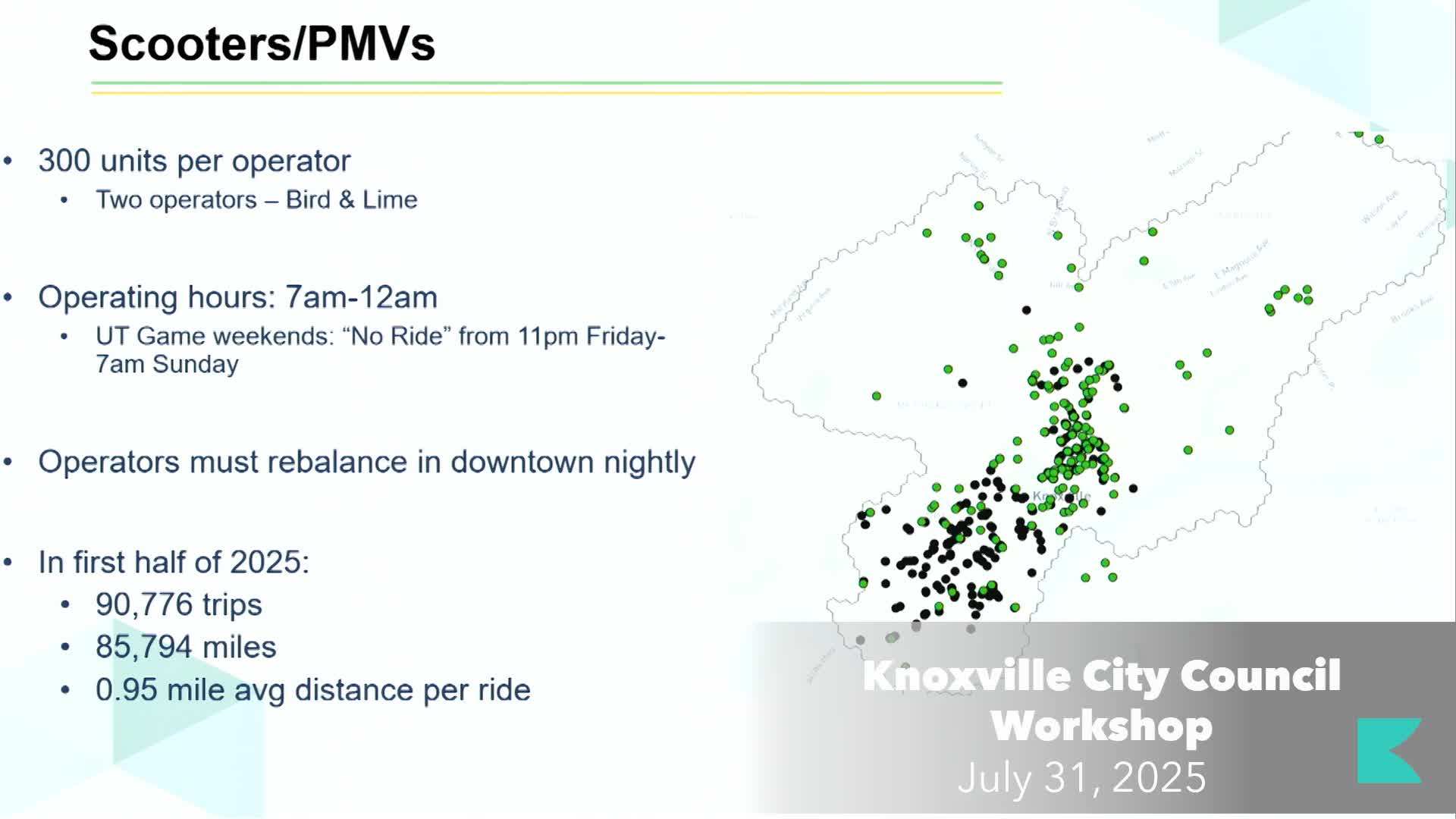
John Livengood, transportation engineer, and Chad West summarized scooter operations: two operators — Bird (black dots on the city map) and Lime (green dots) — operate under city agreements with standard hours from 7 a.m. to midnight and a no‑ride geofence on University of Tennessee game weekends (no ride from 11 a.m. Friday to 7 a.m. Sunday). Staff said first‑half 2025 usage included roughly 90,000 trips and about 85,000 miles, with an average ride of a little under one mile.
On enforcement, staff described new operator features that use machine learning and geofencing to prevent improper parking and riding in restricted zones. West described an AI‑assisted validation that will prevent riders from ending a trip if a scooter is parked in a restricted location and generates in‑app prompts and emails to remind riders of proper parking. Staff emphasized geofence accuracy can vary and that in‑app systems are being improved to reduce sidewalk riding and improperly parked scooters.
311 and IT improvements: Russ Jensen, director of 311, and Carter Hall described current service-request workflows. Every caller receives a service‑request number and can view a request’s workflow in an online portal; callers who provide contact information can use that number to ask 311 for updates. Jensen said staff are evaluating automated follow-up messages and that the city has budgeted work on a new website and a data dashboard that can overlay 311 complaints, police data and code enforcement for targeted sweeps.
Ending: Council members urged continued improvements to geofencing and rider controls and supported automated 311 follow-up so complainants can see outcomes without calling back; staff said upgrades and dashboard work are underway.