
Knoxville staff outline property-maintenance enforcement, timelines and limits at council workshop
Get AI-powered insights, summaries, and transcripts
Subscribe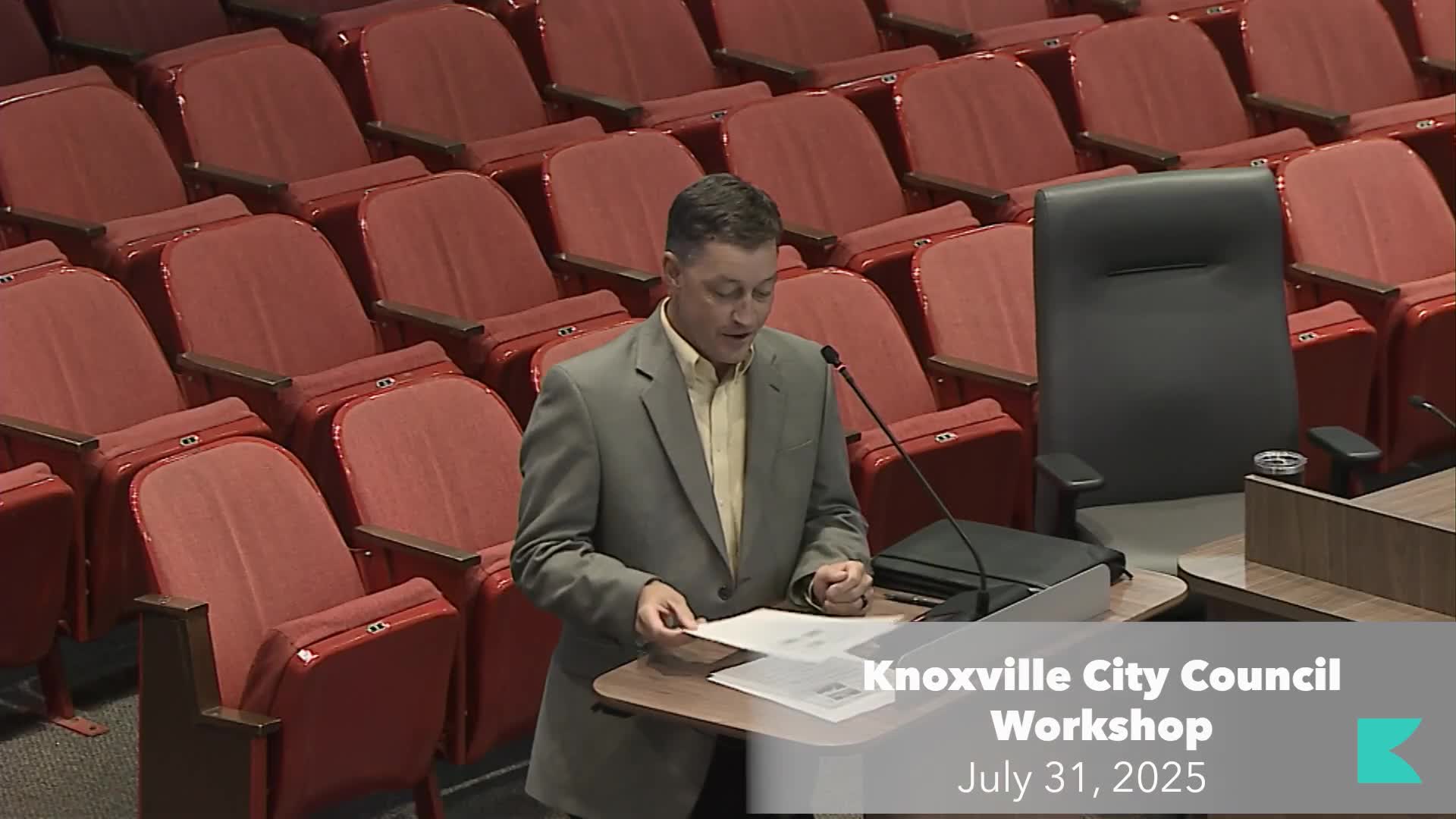
Summary
City staff told Knoxville City Council members that codes enforcement prioritizes health and safety, uses education first and relies on a mix of notices, liens and limited fines; staff outlined correction windows, data gaps and recent demolition trends.
Knoxville deputy chief operating officer Chad West told the City Council at a workshop that the city’s neighborhood codes program focuses on health and safety and on “identify[ing] and deter[ing] disinvestment” by addressing dirty and overgrown lots, inoperable vehicles, dilapidated housing and solid-waste violations. “The biggest thing that we are here to do from a codes enforcement stance is, to address safety and health issues,” West said. He said the office emphasizes education as the first enforcement step.
The presentation laid out typical compliance timelines and tools. West said property owners generally have seven days to correct an inoperable-vehicle issue on private property and 48 hours to remove a vehicle on public property. He described other common timeframes: 10 days for correcting dirty or overgrown lots and 30–120 days for many structure-repair orders depending on severity. “If it’s on private property, it’s 7 days,” West said. Scott Elder, codes enforcement section manager, explained the practical threshold for an “inoperable” vehicle: it must meet two listed criteria such as broken windows, flat tires or other defects before enforcement will proceed. “There’s there’s no limit on how many cars you can actually have as long as they’re functioning,” Elder said.
Why it matters: council members said frustrated neighbors often ask about pace and deterrence. Councilwoman Fugate pressed staff on fines and follow-up; West said state law caps most zoning- and code-related fines at $50 per day. Staff described other enforcement options beyond daily fines, including liens on properties and a code “lane” process that can build fees and penalties for structural problems; Laura Frost, speaking about liens, said they “seem to work better for, structural property.”
Staff described how the city now pursues layered enforcement on high-profile or long-running problem properties. West and other staff said they coordinate more with permitting, the police department and fire department and can pursue demolition or condemnation when a property is an active public-safety risk. West said the city has seen far fewer demolitions than during the 2010 housing downturn: “we’ve done 14” demolitions this year, four of them accessory structures, compared with roughly 130 in 2010.
Data and process details: staff said one complaint can generate multiple inspections and that improved software now schedules re-inspections automatically. West gave 2025 midyear volumes as background: roughly 3,200 dirty/overgrown-lot complaints and thousands of inspections across codes and zoning, noting the city’s IT team is working to separate public-versus-private-property tallies and produce clearer, district-level data. Russ Jensen, director of 311, and Carter Hall, deputy director of the Center for Service Innovation, outlined caller tools: every 311 service request produces a service-request number; requesters who provide contact information can view the request’s workflow online and use the number to get updates. Jensen said staff are evaluating automated follow-up messages for callers.
Discussion vs. decision: the session was informational; no ordinance or fines policy changes were proposed or voted on. Council members asked staff to return with more district-level breakdowns, counts of invoices/citations issued and clearer data on how often liens or fee invoices are used to resolve cases. West said staff can provide those figures on request.
Ending: Council members and staff emphasized continued use of education as the first enforcement tool, while also pursuing targeted, multi-department responses for chronic or high-risk properties. West said that callers should continue to use 311 to start the enforcement timeline and to help the city measure performance.