
Reenactors portray Washington, highlight Battle of Chelsea Creek and smallpox inoculation at Chelsea event
Get AI-powered insights, summaries, and transcripts
Subscribe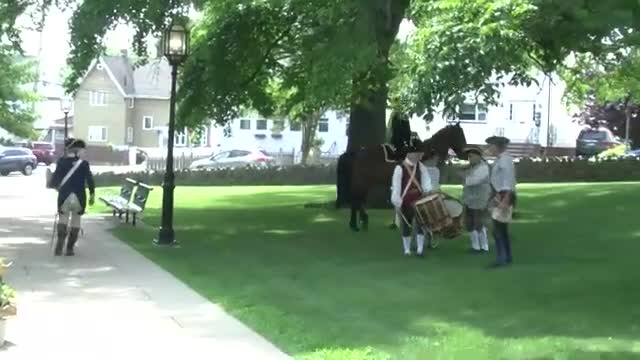
Summary
Reenactors and City of Chelsea staff held an afternoon event featuring portrayals of Gen. George Washington and other Revolutionary-era figures, a maritime display by Glover's Marblehead Regiment, and explanations of the Battle of Chelsea Creek and early inoculation efforts.
An afternoon historical event in Chelsea brought reenactors and families to a neighborhood park for “Washington return to Chelsea,” a living-history program that presented portrayals of Gen. George Washington, Col. Joseph Reed and members of Glover’s Marblehead Regiment and explained local Revolutionary War episodes such as the Battle of Chelsea Creek.
The event was organized by the City of Chelsea arts office. Nourdes Alvarez, Arts and Culture and Creative Economy Manager for the City of Chelsea, opened the program and thanked the City Council and attendees. “Welcome to Washington return to Chelsea event,” Alvarez said, inviting visitors to a historical tour and noting refreshments and community activities tied to the program.
Organizers and reenactors framed the program as both education and commemoration. A reenactor portraying Gen. George Washington described Continental Army efforts to build defenses around Boston and Cambridge, saying, “We have some 14,000 men working very diligently to complete these fortifications,” and characterizing the defensive arc as roughly 12 miles from the Mystic River through Cambridge to Roxbury. A separate reenactor portraying Col. Joseph Reed and another representing Glover’s Marblehead Regiment discussed local actions including the Battle of Chelsea Creek and maritime operations against the British schooner Diana.
Reenactors and presenters explained key episodes the program highlighted: the seizure and burning of the British ship Diana after it ran aground in local marshes during the Battle of Chelsea Creek; the seizure of armaments and denial of forage to British forces; and the wider set of early 1775 engagements that organizers called a “triumvirate” alongside Lexington and Concord and the later Bunker Hill fighting. A reenactor representing Glover’s Marblehead Regiment said colonists suffered no known deaths in the Chelsea Creek action: “Not a single man killed that we know of.” The reenactors cautioned that some contemporary casualty estimates cited in period retellings—“up to a few 100”—are likely overstated, but they did not provide a precise modern estimate.
Event presenters also discussed public-health practices in the Continental Army. The Washington portrayer described an order to inoculate troops against smallpox and said the inoculations were being carried out in small groups because of the illness the procedure provoked. “It is vital, that we have…inoculation,” the portrayer said, explaining the decision as a measure to protect the army from a disease he described as “raging throughout our new country.”
The program included demonstrations of period music and signaling. A musician explained that drums and fifes functioned as a form of battlefield communication for colonial forces, and attendees saw a maritime display explaining sailors’ seamanship and the skills used in combined land-and-sea operations.
City staff provided event logistics and community outreach: Alvarez noted a historical tour would begin at 3 p.m. and announced free refreshments and a nearby community offer at Chelsea Cat Botanicals. The program featured questions from attendees; an audience member asked about encampment conditions and the Washington portrayer answered with described details about hut construction and troop accommodations used at the time.
The event did not include formal municipal actions or votes. Organizers framed it as a cultural and educational program intended to commemorate local Revolutionary-era history and provide public interpretation of wartime logistics, maritime operations and early public-health measures.
Local names and places referenced during presentations included Glover’s Marblehead Regiment, the schooner Diana, Prospect Hill, Fort Ticonderoga, Bunker Hill, Roxbury and Medford; presenters also referenced historical figures such as Thomas Nelson of Virginia and a local informant named Sarah Bradley who, per the reenactor narrative, smuggled information in and out of Boston in the period.
The city arts office and volunteer reenactors said the event aimed to highlight Chelsea’s historical role in 1775 and to provide families and school groups a close-up view of how local residents and militia participated in the early Revolutionary conflict.