
Escambia school board adopts tentative 2025-26 millage, $856.1 million tentative budget after heated debate
Get AI-powered insights, summaries, and transcripts
Subscribe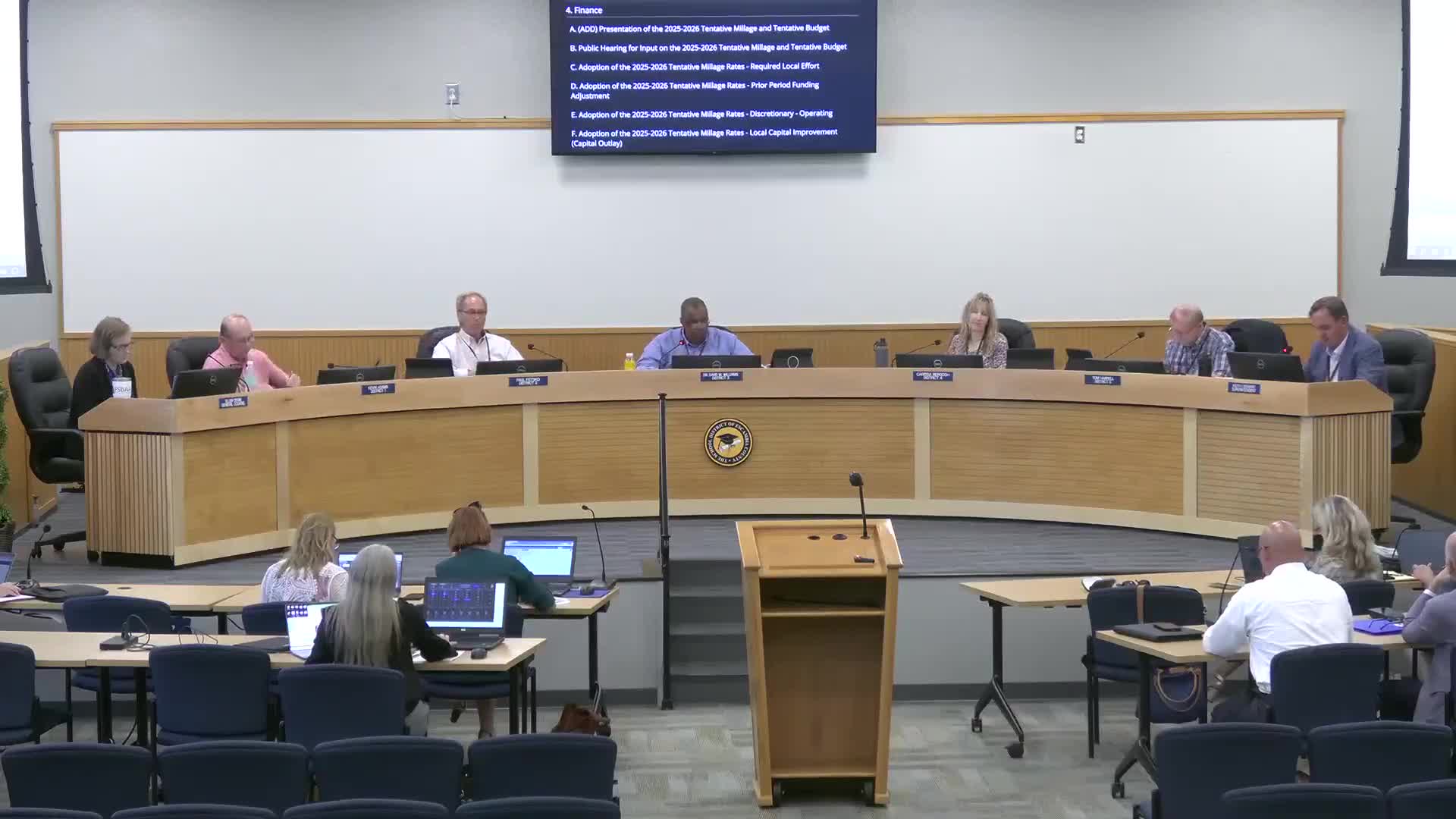
Summary
At a July 31 special meeting, the Escambia County School Board adopted tentative millage rates and a tentative $856,115,363 budget for 2025–26 after a debate among board members about raising local taxes, rightsizing staff and addressing declining enrollment. Most items passed, several by 4–1 votes.
Escambia County School Board members voted on July 31 to adopt tentative millage rates and a tentative total budget of $856,115,363 for the 2025–26 fiscal year, after several board members debated whether to raise local property taxes to maintain employee pay and services amid state funding declines.
The board approved a series of tentative millage and budget items during the special meeting, including a discretionary operating millage of 0.748 and a general fund tentative budget of $400,849,570. Multiple items were approved with votes of either 5–0 or 4–1 depending on the line item; the capital improvement millage and the tentative total budget each passed 4–1.
Board members who supported the millage and budget said the increase would give the district flexibility to maintain employee salaries and benefits and to avoid disruptive staffing vacancies when the school year begins. “I too am gonna support this. I am… pleased to see the growth of our district moving in such a positive manner,” said Board Member Burgos, who said she wanted to preserve momentum in student achievement and staff retention. Chief transportation official Dennis told the board the district had adjusted routing to ensure buses would run on the first day: “we have every route covered for the first day of school…we have 10 additional drivers in the pipeline.” Human-resources leader Crosstag said teacher hiring was strong: “We do not have all of them filled, but…this is the best we’ve filled in 10 years.”
Members who opposed or questioned the tax increases repeatedly urged the board to pursue “rightsizing” — aligning school staffing and facilities with falling enrollment — rather than raising local property taxes. Several speakers said enrollment declines and one-time federal stimulus positions (ESSER/CRRSA-era staffing) had changed the district’s staffing needs and that long-term solutions such as reconfiguration could take a year or more to implement. The board discussed holding vacant administrative positions and placing displaced employees into existing vacancies to reduce layoffs.
The board also voted on other tentative fund totals reported during the meeting: special revenue for other federal programs $45,477,800; capital projects funds $228,760,928 (approved 4–1); debt service fund $87,520,207; internal service funds $58,678,000; and special revenue food services (approved 5–0). The board adopted Resolution 2026-01 (tentative millage rate) and Resolution 2026-02 (tentative budget) during the meeting.
Board members repeatedly said much of the district’s revenue and several millage components are set by the state. As one board member explained when voting on the prior-period funding adjustment, “the only thing this board can change is that 1.5 millage. Everything else is set by the state.” Several members said state funding reductions and a decline in full-time-equivalent (FTE) enrollment produced the current budget strain.
Administrators told the board some cost pressures included increased retirement benefits and other mandated costs that could absorb much of the incremental revenue. Board members who supported the tentative millage argued that without additional local revenue the district could see staff reductions or an inability to maintain improvements in student outcomes and staff recruitment. Members who opposed the increases emphasized the need for a multi-step rightsizing plan to align staffing with enrollment and minimize long-term tax increases.
The board noted timing constraints: teachers report back the week after the meeting and students begin classes in August, so officials said they wanted to avoid immediate vacancies that would force classrooms to run with long-term substitutes. Board members said further operational changes and any reconfiguration would begin in January and could take 12–18 months to implement.
Less-critical agenda items — the board’s routine approval of prior-period funding adjustments, adoption of federal-grant budgets (CRRSA/GEER, ESSER) and passage of several special-revenue and capital fund motions — were handled consecutively during the meeting after the millage discussion. The board adjourned after brief operational updates on transportation readiness and final personnel remarks.