
Francis Howell R-III board retreat centers on governance, communications and open-meeting rules
Get AI-powered insights, summaries, and transcripts
Subscribe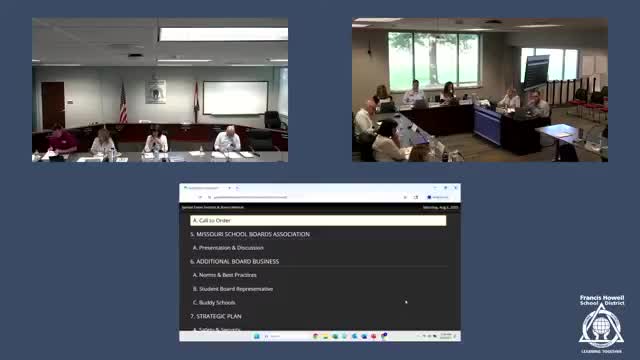
Summary
At a weekend retreat, the Francis Howell R-III Board of Education and outside trainers reviewed collective authority, responses to public and staff concerns, a centralized board email protocol, and Sunshine Law limits on member-to-member discussions.
The Francis Howell R-III Board of Education held a retreat on Aug. 2, 2025, focused on governance best practices, communications protocols and state open-meeting rules, administrators and outside trainers said.
Board members, the district’s interim superintendent and trainers from the Missouri School Boards Association reviewed the board’s legal authority to act only as a body, recommended a centralized process for responding to public and staff concerns, and outlined limits the Missouri Sunshine Law imposes on member-to-member communications, presenters said.
Missouri School Boards Association (MSBA) Director of Board Development John Downs told the board that ‘‘authority rests with the board in legal session and no individual board member has legal authority,’’ and urged members to defer investigations and operational tasks to district staff so the board can remain at a governance level.
The training explained why board members who act singly can compromise due process, undermine staff trust and create the appearance of bias. ‘‘Board members should not be investigating anything — that’s the whole reason you hire these people,’’ a participant in the training summarized from the presentation. Trainers used real-life scenarios — for example a viral social post about alleged bullying — to show how an individual public post or private action can disrupt district processes.
Trainer Susan Goldhammer, MSBA’s chief law and policy counsel, emphasized the Sunshine Law’s default presumption of openness. ‘‘When in doubt, it is open,’’ she told the board, summarizing the state statute’s requirement that meetings, votes, deliberations and records be accessible to the public unless a specific exception applies.
A large portion of the retreat focused on operationalizing the board’s communication with the public and with staff. Board members and administration discussed these concrete steps that they agreed to take or to study further:
- Create a single board email address (e.g., board@francishowell.k12.mo.us) so members of the public can contact the board without trying to identify seven individual addresses. That account would generate an automated acknowledgement and be routed to designated district staff for triage.
- Designate the board president as the primary responder for board-level inquiries, with the superintendent and the board secretary copied as appropriate; responses to the public would be blind-carbon-copied to the rest of the board so members know the matter has been acknowledged without creating an inadvertent discussion thread that could violate the Sunshine Law.
- Use automated acknowledgements on individual board-member accounts that direct senders to the single board email and set an expectation for a response window (the board discussed 24–48 hours as a baseline for acknowledgment).
Board members raised practical concerns: automatic messages, ‘‘reply-all’’ hazards that create de facto meetings, and the need for clarity about which matters are governance-level and which are operational. Staff recommended funneling most questions through the superintendent and cabinet so district personnel can resolve or research issues before they appear on a public agenda.
The retreat also covered protocols for handling constituent complaints and staff concerns. Trainers recommended that board members acknowledge a complainant empathetically, then redirect the person to the correct operational level (teacher, principal, assistant superintendent, superintendent) and copy the superintendent when a concern needs district attention. For personnel matters and personal complaints the district’s regulation requires that records be filed with the superintendent rather than pursued informally by individual board members, presenters said.
On agenda-setting, the board discussed a standard timeline for members to request items: aim to present agenda requests at least two weeks before a meeting so the superintendent and president can review policy, legal and staffing implications. The trainers warned about last-minute additions that could force rushed decisions or create Sunshine Law issues if members start deliberating outside a posted meeting.
Members also discussed meeting-management techniques to ensure all voices are heard. The board tentatively agreed to pilot time-limited speaking rounds on some discussion items: an initial two-minute turn per member, followed by one-minute rebuttals, with an overall topic time cap (members suggested 15–20 minutes for many items).
Votes at the retreat: the special open session that preceded the retreat included routine procedural actions. The board approved the meeting agenda for Aug. 2, 2025, approved the consent agenda, and adjourned the special open session by voice votes; the transcript records these motions and that each passed by voice vote.
Board members said the training was timed to help the new board — most members took office in April 2025 — align on communication norms as the district begins a new school year under interim superintendent Mark Delaney. ‘‘There’s a lot of listening that needs to happen; we still have to direct people to the chain of command,’’ Delaney said when trainers described typical constituent and staff complaint flows.
The trainers promised to deliver the slides and to help draft proposed language for the board email acknowledgement and for a written communications protocol for board review and formal adoption.
The retreat adjourned after the governance session; trainers and administrators said follow-up meetings would convert the retreat discussion into concrete protocols and written procedures.