
Council transmits amended Channel District density bonus change after Planning Commission vote
Get AI-powered insights, summaries, and transcripts
Subscribe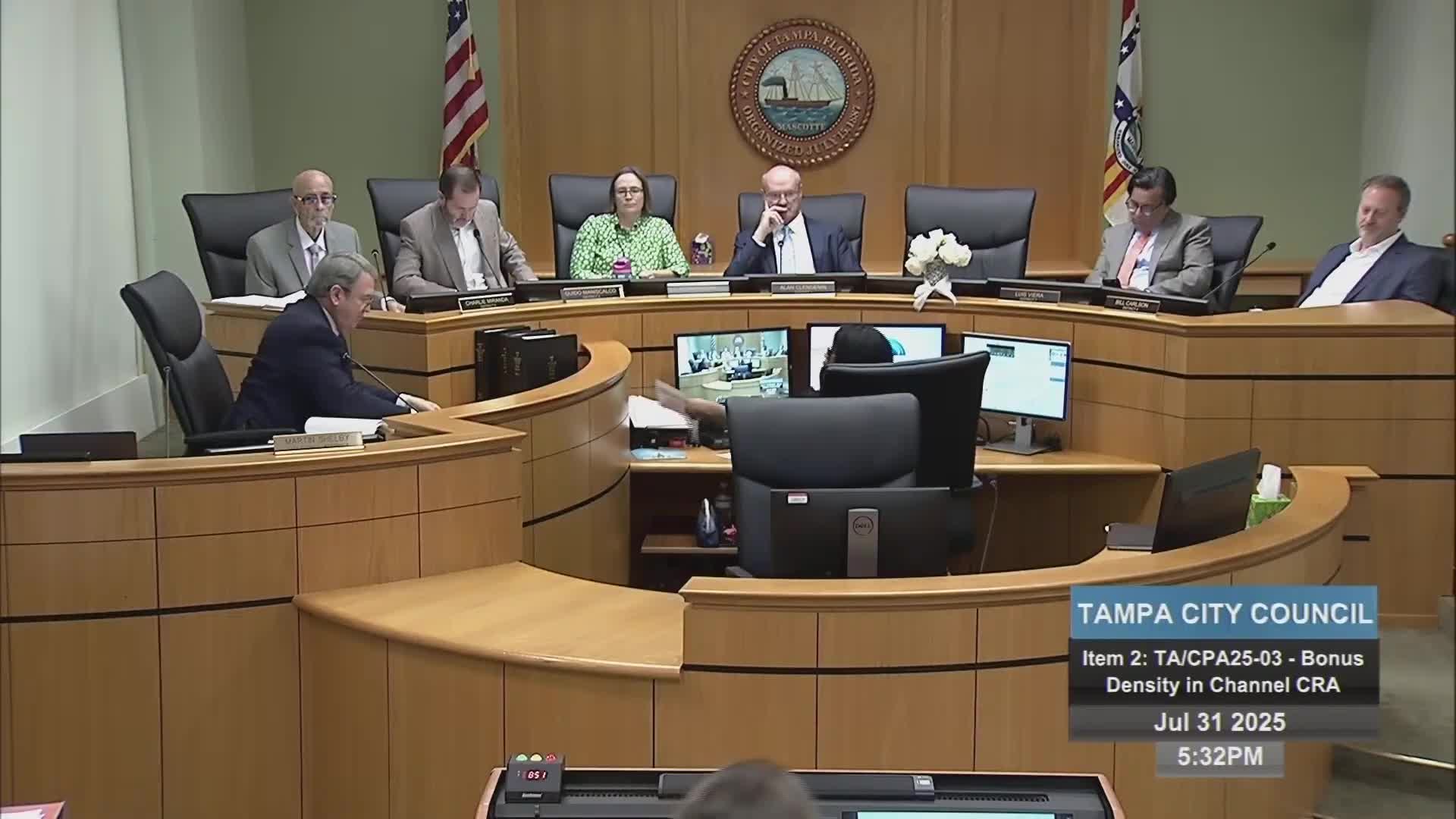
Summary
Council voted unanimously to transmit a privately initiated text amendment that would expand the Central Business District periphery bonus to specified parts of the Channel District CRA boundary after the applicant removed projects south and east of Channelside Drive; staff had objected and the Planning Commission recommended consistency.
Tampa City Council unanimously voted to transmit a privately initiated amendment that would alter the Central Business District (CBD) periphery bonus as applied within the Channel District Community Redevelopment Area (CRA). The amendment, as presented to council, removes projects south and east of Channelside Drive from the amendment’s geographic scope.
Jennifer Malone, planning commission staff, described the item as a privately initiated text amendment to the comprehensive plan that would change the CBD periphery bonus “specific to the Channel District CRA boundary” and would increase the maximum density/intensity available to qualifying projects in the Channel District portion of that boundary. Malone told council the bonus was established in the city’s original comprehensive plan in 1989 to encourage residential and mixed‑use infill around the downtown core.
Applicant representatives told council the change was intended to allow greater density and intensity in underutilized Channel District parcels that they said have become functionally part of downtown, citing nearby Water Street, Aura and other projects. Addie Clark, representing the applicant, described the proposal as a near‑term “interim solution” while broader comp‑plan and code updates proceed, and noted the amendment excludes parcels south and east of Channelside Drive in the version transmitted tonight.
City staff testified the city objected to the request; the Hillsborough County School District reported some nearby schools are overcapacity. The Planning Commission voted that the request was consistent with the comprehensive plan, citing policies encouraging mixed‑use infill and higher density in pedestrian‑oriented urban areas.
Ken Staltenberg, a Channel District developer who spoke for the applicant team, said the proposed increase from a bonus FAR of 7 up to a 10.5 (with bonus) would help make awkward, underutilized parcels viable for new development and allow similar development intensity to the CBD across Meridian Avenue. Staltenberg also discussed building standards and resilience in coastal high hazard areas, saying “it’s not where you build, it’s how you build.”
After questions and discussion, Councilman Escapko moved — and Councilman Miranda seconded — to transmit the amended language to the state (file TACPA25‑03). The motion carried unanimously.
Planning commission staff and applicant representatives said future development that uses the bonus will still require code‑level bonus provision agreements and binding site plans that will be subject to later review and conditions such as buffering, access and storm‑resilience measures.