
Tampa council approves first reading to change land‑use at 3606 West Beta Bay Blvd.
Get AI-powered insights, summaries, and transcripts
Subscribe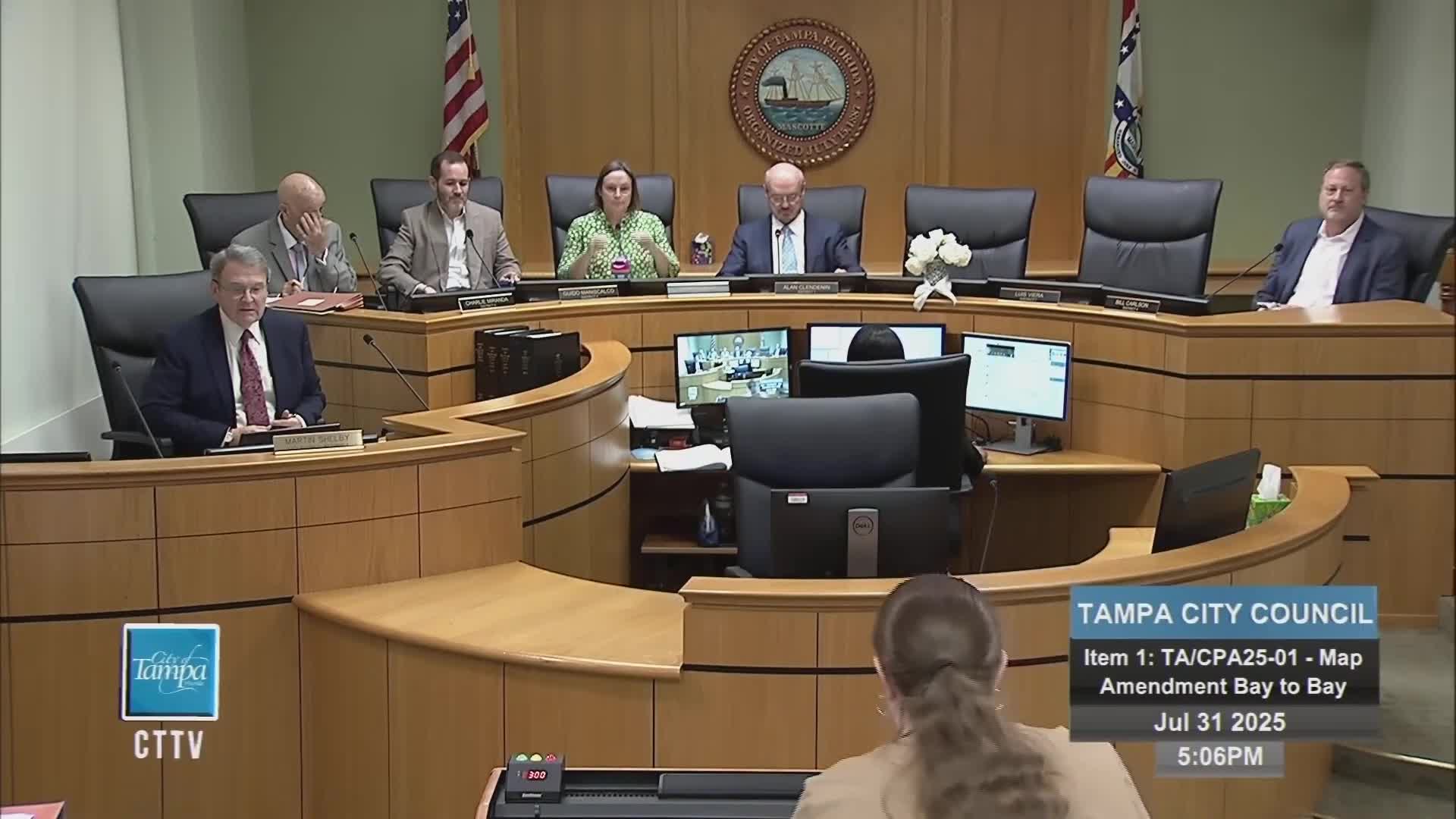
Summary
City Council voted 6–1 on first reading to amend the Tampa Comprehensive Plan future land use map for a 0.14‑acre property at 3606 West Beta Bay Boulevard from Residential 10 to Residential 20; Planning Commission found the amendment consistent while city staff reported the staff review had been inconsistent.
Tampa City Council on first reading approved a privately initiated amendment to the city’s future land use map to change the designation for 3606 West Beta Bay Boulevard from Residential 10 (R‑10) to Residential 20 (R‑20). The ordinance was approved for first reading and will return for second reading and adoption on Aug. 28, 2025.
The applicant, property owner Sam (Nemat) Karimian, told the council he seeks the R‑20 designation to allow a low‑intensity office use and to reflect what he described as existing conditions on the block. “So I'm proposing, future land use change from r 10 to r 20,” Karimian said during his presentation and later identified himself as the owner.
The Planning Commission recommended the map amendment as consistent with the goals, objectives and policies of the Tampa Comprehensive Plan. Planning commission staff Emily Phelan presented the filing to council and explained the change would expand locational criteria and allow up to two dwelling units or a greater amount of nonresidential floor area under the R‑20 designation. Council staff later noted the planning commission vote of consistency but told the council that the staff report — which is separate from the planning recommendation — found the request inconsistent.
Council discussion focused on neighborhood context and potential “domino” effects from changing a single lot’s future land use where most of the block remains R‑10. Council members voiced both support and reservations: some said the parcel sits on a high‑traffic block and could suit a low‑intensity commercial transition; others said approving an isolated change risks prompting additional map amendment requests on adjacent properties.
Councilman Pierre Carlson moved the ordinance approving file number TACPA25‑01 on first reading; the motion passed on a roll‑call vote with Councilmember Miranda recorded as the sole no vote. The ordinance text sets a date for second reading and adoption on Aug. 28, 2025 at 10 a.m. at Old City Hall.
Under the city’s process, the map amendment expands the property’s locational eligibility for commercial or higher density residential uses but does not itself rezone the parcel. If the owner later seeks a rezoning or site plan approval for a specific use, those requests will be evaluated separately under city code and could require additional public hearings and conditions.
Councilmembers and staff said the change will remain subject to locational criteria at the time of any subsequent development proposal, and that typical controls such as setbacks, floor‑area restrictions and site plan review would still apply.