
Commissioners raise parking, jurisdiction and shared‑use questions for proposed Brightline station at county courthouse lot
Get AI-powered insights, summaries, and transcripts
Subscribe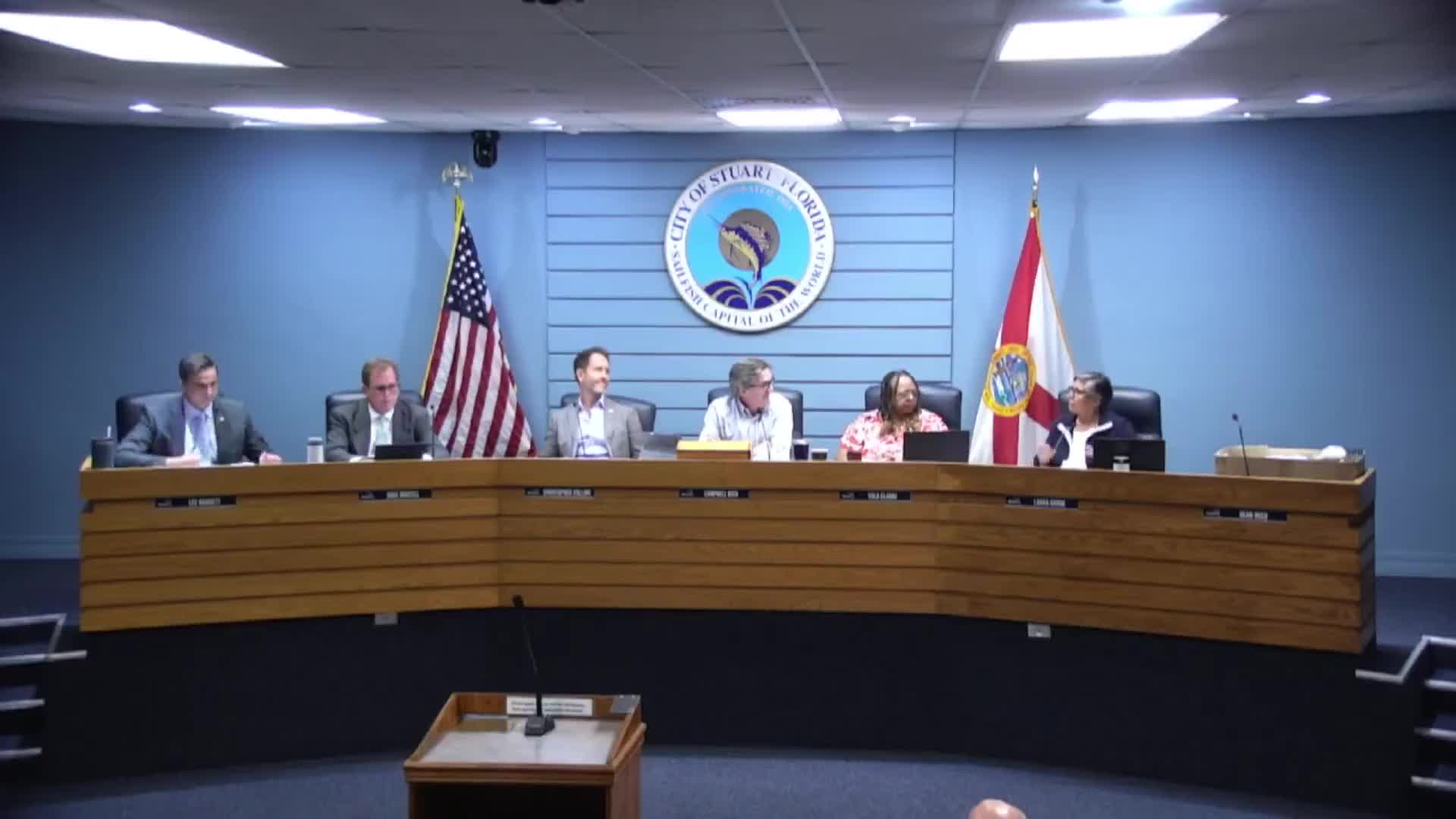
Summary
City staff and commissioners debated whether a proposed Brightline station and its requested 200 parking spaces would displace county courthouse parking that was historically reduced by resolution; discussions highlighted gaps in documents and federal railroad jurisdiction concerns.
The Stewart City Commission debated July 28 how a proposed Brightline station at a two‑acre parcel adjacent to the Martin County Courthouse could affect downtown parking and who has regulatory control over the parcel once leased to a rail operator.
City staff and several commissioners spent most of a lengthy discussion identifying legal, planning and jurisdictional questions: a 1988 city resolution reduced the courthouse’s required parking by 65 spaces to preserve Gazebo Park; the two‑acre parcel currently contains roughly 160 public parking spaces; Brightline’s request in earlier procurement materials sought 200 parking spaces; and staff warned that if the parcel becomes part of the rail corridor a federal agency could assert jurisdiction.
Why it matters: Commissioners and the public said they fear courthouse parking could be displaced onto neighborhood and on‑street spaces if the county’s courthouse is forced to rely on a Brightline‑managed parking area that may operate as paid parking. City code does not currently distinguish paid from unpaid parking when calculating required parking for uses, staff said.
Staff presentation and outstanding documents City Manager and staff summarized the parcel history: in the late 1980s the city and county negotiated to preserve the historic courthouse and to shift 65 parking spaces to a two‑acre parcel the county developed. City staff cited Resolution 33‑88 (1988) as the formal record establishing the 65‑space waiver. Staff also said code requirements would treat a train station differently (Chapter 6: four spaces per platform) than an office building (one space per 300 square feet), and that the city’s existing code does not distinguish paid vs. free parking for counting spaces.
"If they built 200 spaces, they're actually building 40 over," staff said, referring to a hypothetical in which Brightline built 200 spaces on the county parcel and the county retained the 160 needed for courthouse functions. Staff also cautioned that if the county leases the parcel to a railroad and it becomes part of the rail corridor, the Federal Railroad Administration (FRA) could claim preemption over permitting and site control.
Commissioner concerns and missing evidence Commissioners repeatedly pressed staff for documentary evidence showing the courthouse’s historical parking requirement and how the 65‑space waiver was calculated; staff acknowledged some materials were not in the meeting packet and committed to bringing resolution 33‑88 and supporting documents to the next meeting. Commissioner Clark and others warned that allowing a rail operator to treat the entire parcel as Brightline’s paid parking could push courthouse and downtown parking out into neighborhoods.
Public‑policy levers discussed Staff proposed operational measures such as painting diagonal stalls on a paved site behind the water treatment plant and designating three‑hour city parking in nearby lots to prevent long‑term commuter parking from usurping public spaces. Commissioners suggested communicating with the county and obtaining clear plans from any rail operator before final agreements are executed.
No action taken; staff follow up requested No formal vote was taken on Brightline or any parking change. Staff said the Brightline‑related leases and more complete documentation would be brought back to the commission on Aug. 11; commissioners asked staff to meet with the county and to provide a clear accounting of current required parking for the courthouse, the number of existing spaces, and the legal status of Resolution 33‑88.
Ending note The discussion highlighted competing goals: preserving downtown green space established decades ago, maintaining sufficient parking for courthouse functions, and assessing the impacts of a potential passenger rail station that could be governed in part by federal rail rules.