
Commission approves Lifeline ambulance as backup, limits service to standby transport
Get AI-powered insights, summaries, and transcripts
Subscribe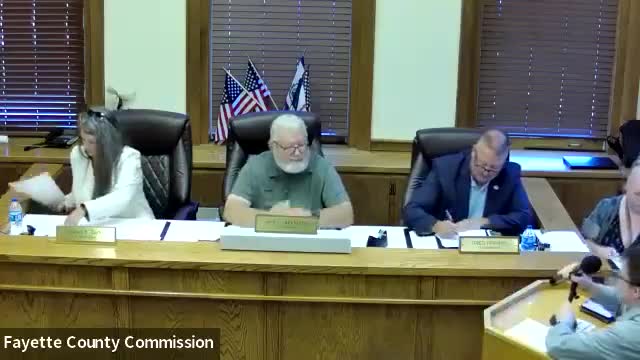
Summary
The Fayette County Commission voted to authorize Lifeline (Lustrevenue Lifetime Ambulance Services LLC) to operate as a backup/basic-life-support transport resource in the county’s dispatch zones when primary resources are unavailable, following testimony from the company and the county’s primary provider.
The Fayette County Commission approved a motion to authorize Lifeline (identified in the meeting as Lustrevenue Lifetime Ambulance Services LLC) to operate as a backup basic-life-support ambulance service in the county’s dispatch system when other resources are unavailable. The authorization does not make Lifeline a primary 911 responder or add it to the county’s ALS (advanced life support) roster.
The vote followed a presentation by Matthew Tyler Kirk, who introduced himself as “the owner and chief executive officer of Lustrevenue Lifetime Ambulance Services LLC.” Kirk told the commission Lifeline was licensed by the West Virginia Office of Emergency Medical Services on May 3, 2025, to respond to scheduled and nonemergent patient transports and asked for permission to transport “non eligible patients” and serve as “a nondecision resource” to help when other ambulances are delayed.
The request, Kirk said, was not aimed at taking 911 responses as a primary provider: “Our request to transport these patients is not for an affirmative … 911 pay through on the 911 system. Instead, we want to act as … the nondecision resource for Fayette County,” he said. He described having two BLS ambulances and four nationally registered EMTs, and said the company would stage units in the county to improve basic-level response when primary providers are stretched.
Representatives of the county’s primary EMS provider urged a cautious approach but signaled conditional support for Lifeline filling gaps. Todd Cornett, identified in the meeting as a representative of JanCare/GenCare ambulance services, told commissioners the county benefits from the existing provider network and mutual‑aid relationships but that allowing a local backup when no other resource is available could be advantageous. “I do think it would be advantageous for this county and this commission to approve for them to be a secondary provider in the event there are no resources in one of specific zones,” Cornett said.
Commission discussion addressed staffing, medical oversight and how DOA (dead on arrival) or extended‑scene situations are handled. Kirk said Lifeline’s clinical oversight is provided by a medical director who supervises multiple EMS agencies. Commissioners requested operational details and dispatch coordination from the county 911 director before full implementation.
The motion to approve Lifeline as a backup/standby transport service passed after a commissioner moved and another seconded; the minutes record the motion as approved and the chair calling for the ayes. The commission did not adopt a detailed written protocol on the floor; staff were directed to coordinate implementation details with county dispatch and existing providers.
Commissioners and witnesses noted conditions and limits on the authorization: Lifeline will remain a BLS resource, will not be designated an ALS primary provider, and will operate when dispatch or the county’s primary provider cannot cover a zone. The approval was framed as a county backup arrangement rather than a shift in primary 911 responsibilities.
Commissioners said they would follow up with the 911 director and relevant stakeholders to finalize operational protocols and clarify billing and transport procedures if Lifeline is deployed on scene.