
Pinellas County staff review CRA expirations, propose stricter county limits on TIF contributions
Get AI-powered insights, summaries, and transcripts
Subscribe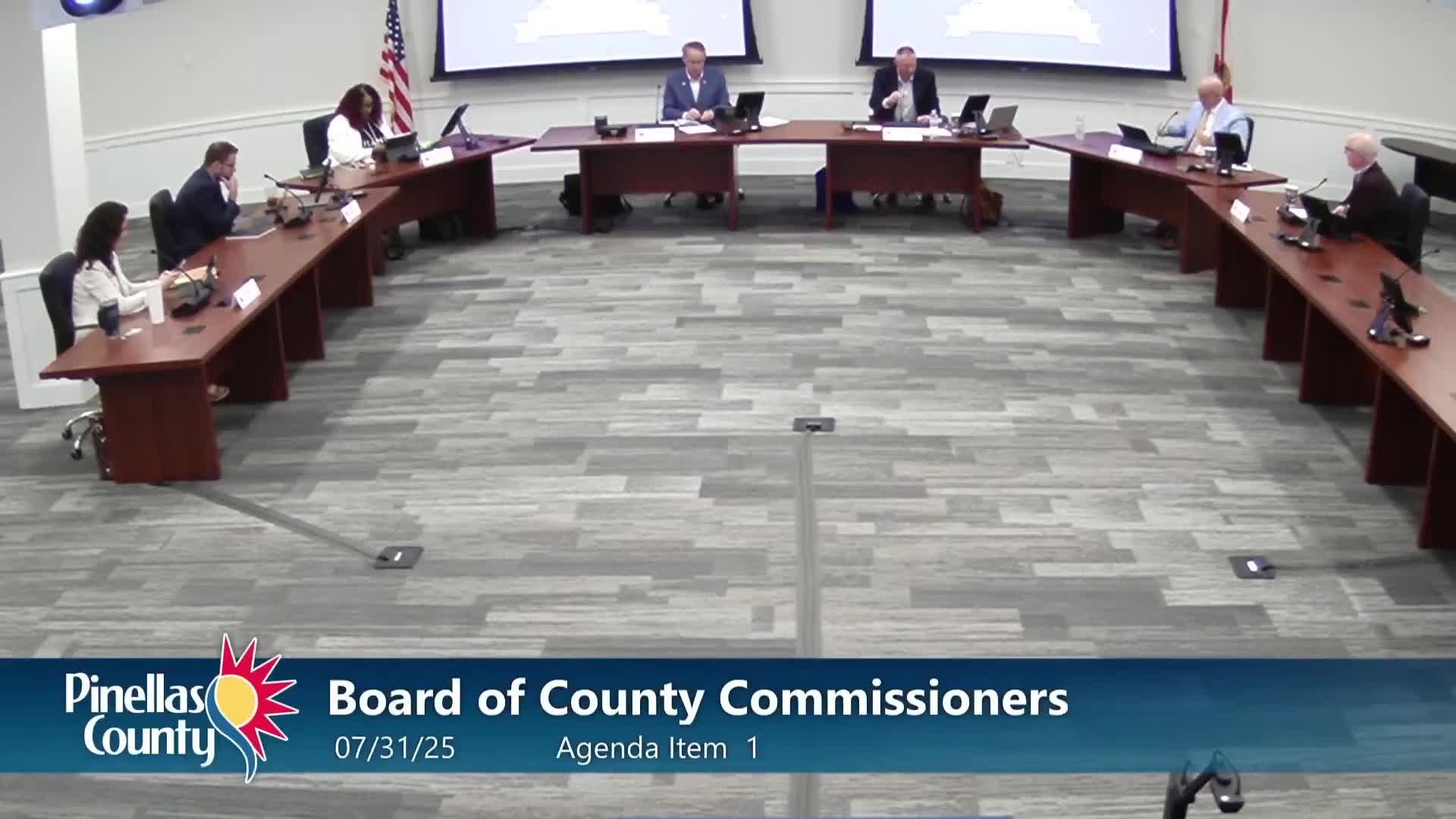
Summary
County staff updated commissioners on the county's Community Redevelopment Area (CRA) policy, showing many CRAs will sunset in the 2030s, explaining changes to maximum CRA terms and county contribution formulas, and noting annual payouts and midterm review opportunities.
Pinellas County housing staff on Thursday walked commissioners through the county's Community Redevelopment Area (CRA) policy, the remaining lifespans of existing CRAs and how the county determines its tax-increment financing (TIF) contributions. Rebecca Stonefield, housing and community development, summarized the policy changes and an inventory of current CRAs.
The presentation matters because dozens of CRAs direct incremental tax dollars away from the county general fund for local redevelopment; the schedule and size of those TIF flows affect the county's future budgets and planning. Stonefield told the commission the county now caps the initial lifespan of any newly established CRA at 20 years and reserves the right to require a midterm review for long-lived CRAs.
County staff said the county's current CRA policy stems from a 2017 directive to standardize how CRAs are evaluated, and that the county narrowed eligible TIF expenditures and lowered maximum CRA lifespans compared with older practice. Stonefield explained historical context: before 2002 state law allowed CRAs to exist up to 60 years, the state later limited that to 40 years, and the county's policy now limits initial CRA terms to 20 years, with the potential for additional time on return requests but not to exceed 40 years overall. She said county policy also now ties higher county matches to plans where a majority of the CRA budget is devoted to county priorities such as housing affordability, mobility improvements and job creation.
Stonefield provided a fiscal snapshot: based on FY 2023-24 payments, the county paid about $24.5 million to CRAs and noted that FY25 payments are a few million higher. She said roughly half of current CRAs will sunset in the mid-2030s and that five of seven CRAs that are at the county's higher 95% contribution level will be eligible to sunset by the mid-2030s; two others (Clearwater North Greenwood and Lowman) have later expirations but are scheduled for midterm review in the early 2030s.
Commissioners pressed staff on practical effects. Commissioner Flowers asked whether updates to the county strategic plan would affect CRAs already approved; Stonefield responded that existing CRAs must follow their adopted ordinances and redevelopment plans and that changes normally surface during amendments or midterm reviews. Flowers also said he wanted the county attorney to review whether approved CRA funds are payable if the project that justified the CRA does not proceed; he told the meeting, "I've asked the county attorney's office to take a look at that." Commissioner Eggers supported the midterm review approach and sought clarification about debt-related limitations; staff said some CRA ordinances prohibit lowering a TIF while indebtedness exists and that those provisions will be examined during midterm reviews.
Staff noted there are two tools to increase the county share of TIF: a base contribution set by CRA type (the county's highest base in policy is 70%) and a county priority match that can increase the county share up to an additional 25 percentage points when a redevelopment plan commits a set portion of its budget to county priorities. Stonefield reiterated that any county TIF that is used must be in alignment with an approved redevelopment plan brought to the Board of County Commissioners for approval.
The presentation included a line-by-line inventory of CRAs, their contribution levels and sunset dates; staff recommended scheduled midterm reviews for older CRAs and highlighted that some CRAs include ordinance language that restricts the county's ability to adjust TIF if indebtedness is outstanding. No regulatory or funding changes were adopted at the work session; staff will return with additional analyses if commissioners direct follow-up work.
Ending: Commissioners expressed differing views about the county's role in CRA oversight and about the fiscal opportunity when CRAs expire. Staff said the inventory will support future budget planning and that midterm reviews will provide opportunities to reassess contributions and outcomes.