
Colorado PUC moves to adopt Tri-State’s preferred Phase 2 resource plan, while preserving review of modeling and procedural safeguards
Get AI-powered insights, summaries, and transcripts
Subscribe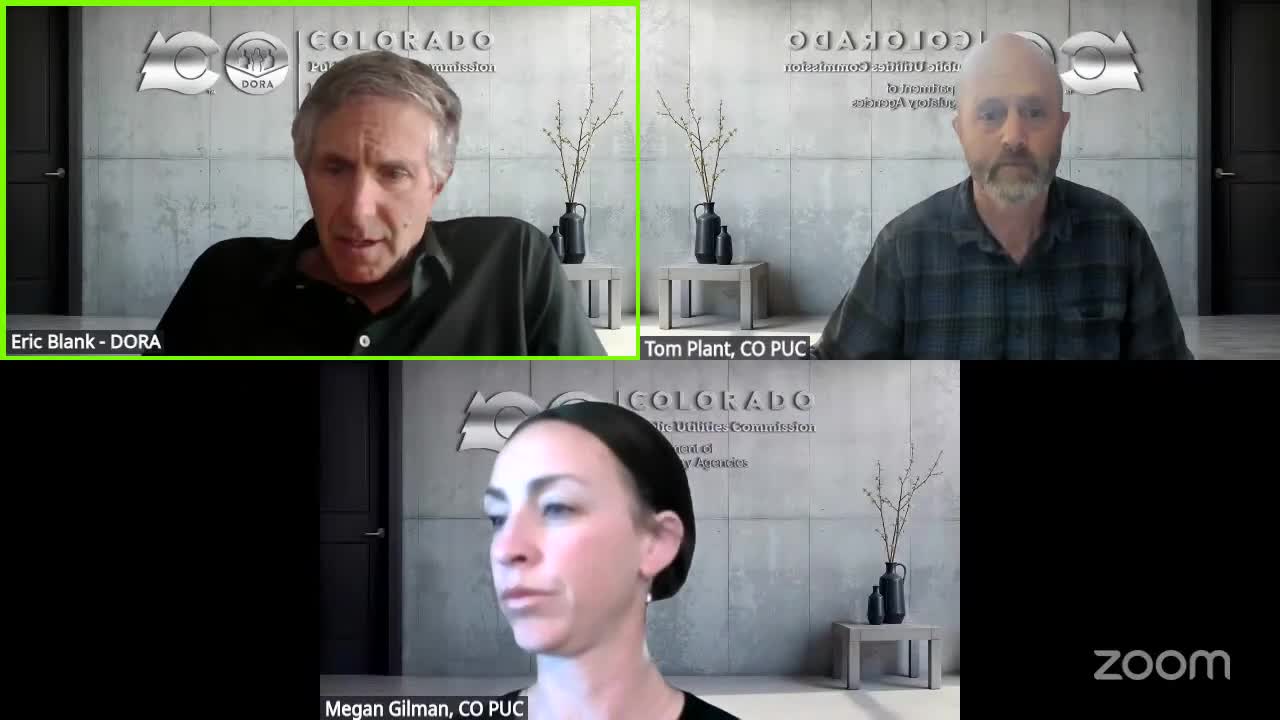
Summary
The Colorado Public Utilities Commission indicated support on Friday for Tri‑State Generation and Transmission Association’s preferred Phase 2 resource portfolio (Portfolio 4) as the cost‑effective plan to close the utility’s Phase 2 electric resource plan (ERP) proceeding, while resolving several procedural and reporting disputes raised by interveners.
The Colorado Public Utilities Commission indicated support on Friday for Tri‑State Generation and Transmission Association’s preferred Phase 2 resource portfolio (Portfolio 4) as the cost‑effective plan to close the utility’s Phase 2 electric resource plan (ERP) proceeding, while resolving several procedural and reporting disputes raised by interveners.
Ron Davis of the commission’s advisory staff opened the deliberations by framing the meeting’s purpose: “the purpose of today's meeting is for the commission to render a phase 2 decision to bring this electric resource plan for Tri State Generation and Transmission Association to a close.” The commission’s discussion covered the company’s implementation report, party comments, an independent evaluator’s findings, and several motions filed during the comment period.
Why it matters: The decision will guide which new resources Tri‑State pursues between 2026 and 2031, affect emissions outcomes tied to state targets, and shape local economic impacts in areas such as Moffat County and the City of Craig. The portfolio choice also touches on longer‑term questions about whether to add dispatchable gas capacity, battery storage, or a blend of resources to preserve reliability as Tri‑State retires coal units.
Tri‑State’s implementation report and parties’ positions Tri‑State presented a ‘‘preferred portfolio’’ (Portfolio 4) it said would add renewable and firming capacity and retain previously announced coal retirements for Craig and Springerville. The implementation report, filed in April, summarizes results of a competitive RFP and bid scoring process. Davis summarized Tri‑State’s characterization of the preferred portfolio as the least‑cost option in present‑value-of‑revenue‑requirements terms, noting the company’s estimate that the preferred portfolio is roughly $88,000,000 lower in net present value than the next closest alternative in the scenarios that exclude the social cost of emissions.
The Colorado Air Pollution Control Division (APCD) filed a verification report using Tri‑State’s modeling and reported that the preferred portfolio meets the statutory greenhouse gas target the ERP must demonstrate: APCD ‘‘concludes that the emission reductions for the preferred portfolio are 80% below baseline levels’’ measured against a 2005 baseline by 2030, as required by the statute referenced in the record.
Supporters and objectors Several parties and local governments backed the preferred portfolio, including the Colorado Energy Office, local elected officials in Moffat County and the City of Craig, and a number of Tri‑State distribution cooperatives that intervened. The Colorado Energy Office noted that the proposed turbines would be hydrogen‑capable, which it said could enable lower emissions over time. Tri‑State and some local governments emphasized potential tax revenues and economic development tied to siting dispatchable resources in Moffat County.
Conservation and advocacy groups — including the Sierra Club and the Natural Resources Defense Council (grouped in the record as the Conservation Coalition), and Western Resource Advocates — opposed approval of Portfolio 4 and urged adoption of Portfolio 6 (a ‘‘no‑new‑gas’’ variant). They argued portfolio 6 would lower capital and curtailment costs when accounting for the social cost of emissions, would allow Tri‑State to gain operational experience with batteries, and questioned certain modeling inputs Tri‑State used for the selected new combustion turbine(s).
Modeling and contested inputs A core dispute centered on Tri‑State’s modeling inputs for a proposed new gas combustion turbine in Moffat County. Interveners argued some bidder‑supplied heat‑rate assumptions used in Tri‑State’s modeling were unusually low and that the company did not independently verify those values before running the portfolio model. Tri‑State acknowledged using bidder‑provided heat rates in its modeling and argued that, even if the heat rate were higher, the model would likely still select a dispatchable resource to meet reliability needs in the western portion of its system.
Commissioners described that dispute as a substantive record issue to be weighed, with several saying the broader record still supports allowing Tri‑State to move forward now rather than delay procurement and risk losing time‑limited federal incentives. As one commissioner summarized: “Tri State’s choice of portfolio 4 is reasonable and supported by evidence on this record.” (Chair Eric Blank)
Procedural rulings and other commission determinations - Motion to strike: The Conservation Coalition sought to strike portions of Tri‑State’s Phase 2 comments, arguing the company applied inconsistent reliability rubrics in violation of the Phase 1 settlement. Commission counsel advised that striking testimony is an extraordinary remedy and recommended denial because the record shows Tri‑State applied the agreed‑upon level‑1 and level‑2 reliability screens to all modeled portfolios and the settlement preserved parties’ rights to make operational arguments. Commissioners voted to deny the request to strike Tri‑State’s comments; counsel noted the settlement permits parties to present advocacy about operational judgment beyond the uniform modeling screens.
- Reporting requirement on contract negotiations: A party asked the commission to require Tri‑State to file reports on contract negotiations with winning bidders. Commission staff recommended against imposing that reporting requirement, citing Tri‑State’s cooperative ownership structure and the commission’s limited jurisdiction over Tri‑State. Commissioners agreed not to require such post‑procurement reports in this Phase 2 decision.
- CPCN waivers: Tri‑State had requested that separate certificates of public convenience and necessity (CPCNs) not be required for construction of the potential new gas generation and for the retirement of the Craig unit. An administrative law judge issued an interim decision granting those waivers; commissioners agreed to incorporate the ALJ’s interim findings into the final Phase 2 decision.
- Best‑value employment metrics: The commission noted Rule §42‑1‑129 and related PUC rules require a Phase 2 decision to address best‑value employment metrics. Staff recommended, and commissioners agreed, to adopt language consistent with Tri‑State’s prior Phase 2 decision that Tri‑State complied with the information required for this record and to place responsibility on developers/EPC contractors to determine whether project labor agreements apply.
- Finding on Craig Unit 1 and next steps: The Conservation Coalition asked the commission to find Craig Unit 1 was not needed for reliability. Commissioners agreed to enter a finding consistent with Tri‑State’s submissions that the record does not demonstrate a need to retain that unit for reliability. Commissioners also directed that a separate future proceeding should be used to examine Tri‑State’s next ERP and how approvals should be reviewed if Tri‑State joins SPP RTO West.
- Timing waiver: Commissioners agreed to waive Rule 3605(h)(2)(A) to expedite issuance of the Phase 2 decision given concerns about timing and the risk of losing federal tax incentives if procurement is delayed.
Where the record leaves open questions Several commissioners emphasized the record contains modeling ambiguities and asked that the final Phase 2 order reflect those concerns and invite a future process to resolve persistent modeling and transparency issues as Tri‑State prepares its next ERP. Interveners who pressed for re‑modeling or remedies asked the commission to require Tri‑State to rerun model runs with corrected inputs for the Moffat County gas plant; Tri‑State and other parties opposed re‑modeling on grounds that it would delay procurement and raise costs. The commission’s action at the meeting favored moving forward now while capturing commissioner concerns in the final order and reserving broader process changes for a future proceeding.
Quotes from the record “the purpose of today's meeting is for the commission to render a phase 2 decision to bring this electric resource plan for Tri State Generation and Transmission Association to a close.” — Ron Davis, Commission advisory staff
“Tri State’s choice of portfolio 4 is reasonable and supported by evidence on this record.” — Chair Eric Blank
“Tri State’s description of this as a clear record is probably overly generous.” — Commissioner Gilman
“Striking testimony is a significant remedy typically reserved for cases where a party has clearly violated procedural rules or made improper submissions.” — Alex Acerra, Commission counsel
Ending The commission’s deliberations signaled support for Tri‑State’s preferred portfolio while formally rejecting requests to excise company filings, declining to impose additional post‑award reporting in Phase 2, and incorporating interim findings that remove separate CPCN requirements for the projects at issue. The commission instructed staff to draft a Phase 2 order that records commissioners’ concerns about modeling inputs and reliability arguments and that establishes a separate future proceeding to address review of Tri‑State’s next ERP and the implications of potential SPP RTO West membership.