
Emergency management outlines severe-weather plan, debris contracts and points-of-distribution for large storms
Get AI-powered insights, summaries, and transcripts
Subscribe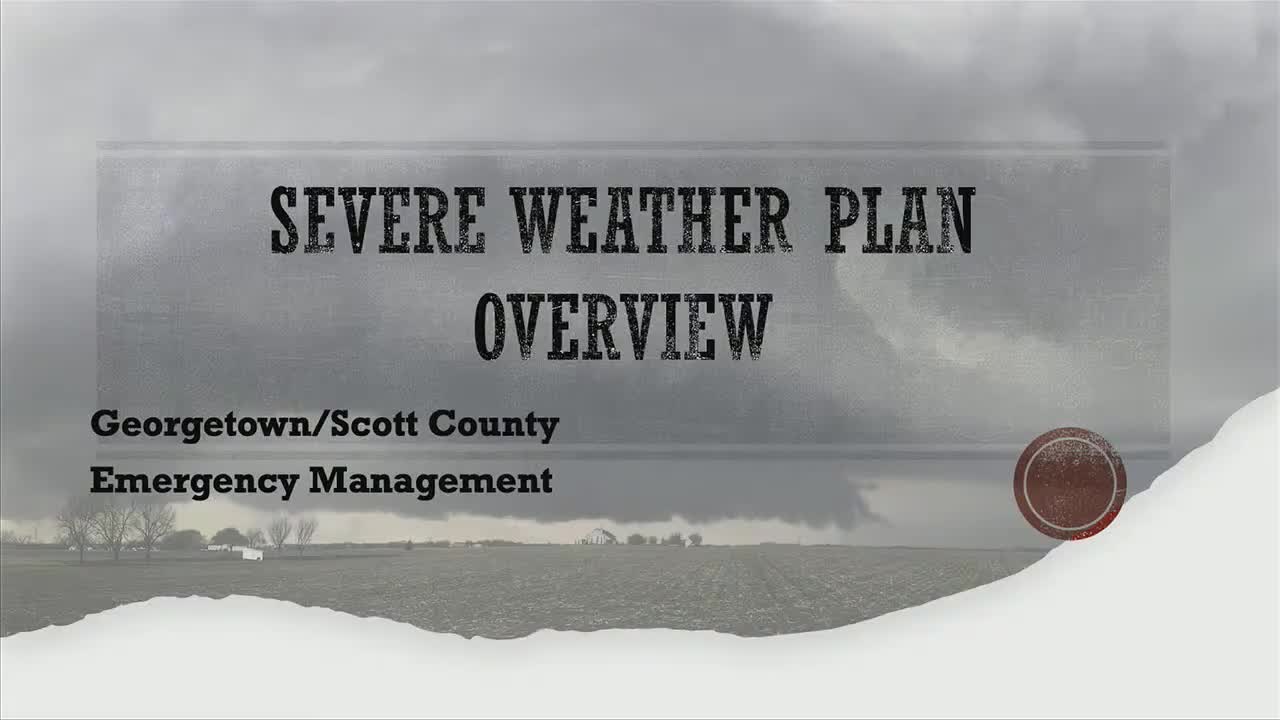
Summary
Emergency management staff reviewed the county's severe-weather and emergency operations planning, highlighted debris-management contracting and points-of-distribution planning, and said the county will launch an upgraded public alert platform with geofencing to reach nonresident workers.
Mike Kennegan, a county staff member, presented Scott County's severe-weather plan and related emergency operations preparations at the Aug. 1 work session, stressing planning for debris removal, sheltering and points of distribution (PODs) in large storms.
Kenneken (speaker used name in transcript) said the county maintains 35 incident-specific plans and is prioritizing a debris-management plan that includes contracts with companies able to handle large-scale vegetative and structural debris. He said the county needs pre-negotiated RFPs so contractors with tri-axle trailers and heavy equipment can be mobilized quickly after a storm.
Why it matters: Recent regional disasters required months or years to clear debris; Kenneken cited London/Laurel County work that is still ongoing. The county's plan includes predetermined shelters, staging areas and multiple POD sites (Great Crossing Park, Scott County Park and a potential industrial-park site) to distribute food, water and supplies rapidly.
Kenneken said the county will deploy a new public-notification system through CivicPlus to enable internal and public messages, and he emphasized a desire to geofence alerts to reach phones physically present in the county—important because thousands of people commute into Scott County daily to work. "I want to be able to geofence and hit phones that are not registered to Scott County residents," he said.
The emergency manager also urged building a volunteer pool to staff shelters and PODs and said he is working with local churches and nonprofits to identify roles, training and a cooperative model so smaller organizations need not provide every service themselves.
Operational steps Kenneken listed as immediate priorities include: (1) finalizing debris-removal contracts, (2) formalizing POD traffic plans and staging areas, (3) confirming shelter spaces and supplies (cots, blankets), and (4) launching the CivicPlus notification platform with integrated 911 coordination.
Ending: Kenneken invited churches and community organizations to contact his office to volunteer or to be evaluated as potential shelter or POD sites; no formal vote was taken.