
Parowan council and Prime West negotiate access, pedestrian paths and phasing for large annexation
Get AI-powered insights, summaries, and transcripts
Subscribe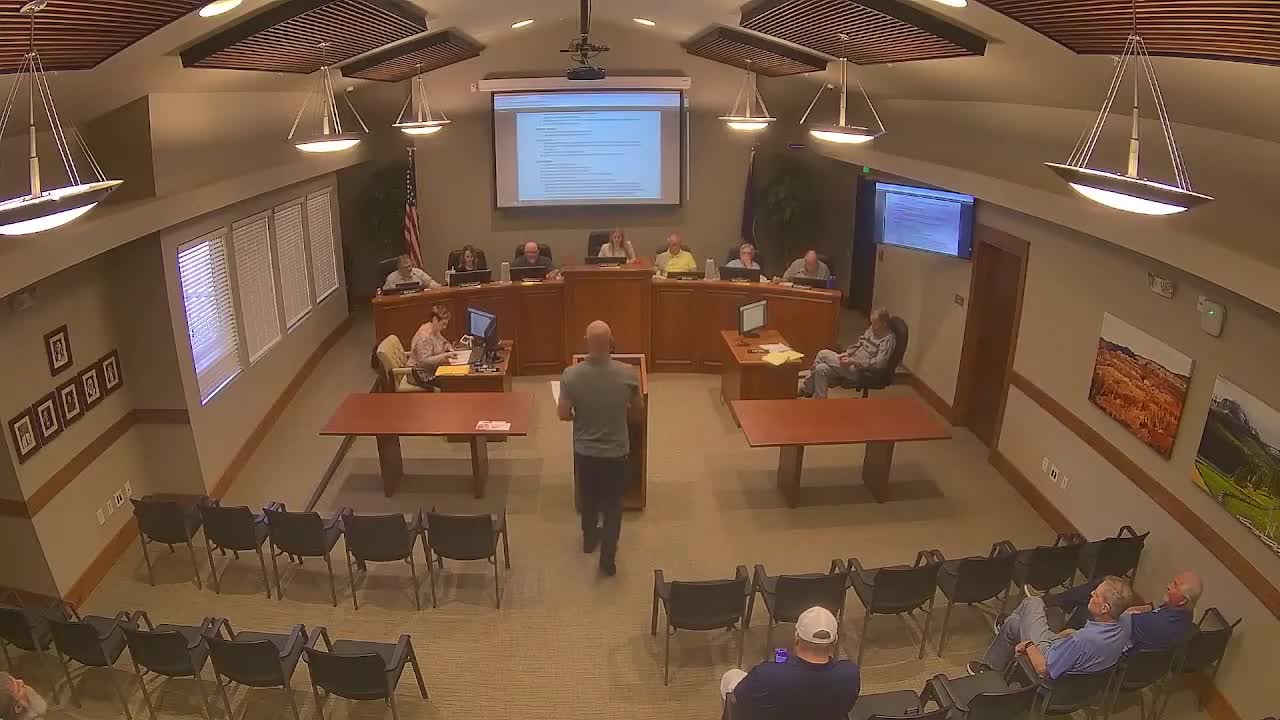
Summary
Parowan City Council members spent more than an hour on July 31 negotiating final annexation language with Prime West Development LLC, pressing the developer to guarantee a pedestrian connection to 200 North and to clarify when a second vehicular access will be required.
Parowan City Council members spent more than an hour on July 31 debating a proposed annexation and development agreement with Prime West Development LLC that would add new residential lots north of town and connect into existing neighborhoods.
The discussion centered on which road would serve as the project’s initial access, whether the developer must upgrade nearby off-site roads such as 200 North or 1200 West before building, and how to provide safe pedestrian access for schoolchildren. After extended discussion the council asked staff to draft clarified language that would require a temporary pedestrian connection with the first phase and set triggers for a required second vehicular access, then return the language for council review.
The stakes are practical and immediate: the developer seeks to build in phases that could reach dozens of lots, council members said, and several councilors worried that a single, unimproved access could create a public-safety risk for residents and children walking to school. City staff and the developer debated whether the city could lawfully require curb, gutter and sidewalk across private frontage that is outside the annexation boundary, and how to make a phasing schedule that meets the International Fire Code’s minimum access standards.
City Manager Dan Jessen explained the council’s prior requirements and the developer’s counterproposal, saying the original annexation language required the developer to “improve 200 North from the new annex property to 600 West, including curb, gutter and sidewalk on one side” and to provide a second legal access at the time of first subdivision. Jessen said the applicant’s counterproposal would allow one improved access at first subdivision (most likely, the developer suggested, by dedicating and extending 1200 West) and would allow up to 80 lots before a second access is required — a higher threshold than the International Fire Code’s baseline of 30 lots.
Dallas, the developer’s civil engineer, told the council the 80-lot trigger has precedent in nearby rural jurisdictions and argued it reflected the local practice of allowing greater lot counts on a single access in less-urban areas. Dallas also explained the developer’s approach to off-site improvements: if the second access chosen is 200 North, the applicant proposed constructing a 4-foot meandering asphalt trail and widening the road to a 26-foot asphalt section (city detail A‑9) on the south side; if the second access is a different existing roadway (for example, 1200 West), the developer would not upgrade 200 North unless and until it is used as an access.
Developer partner Larry Pendleton told the council the development team “is all for safety” and said the company would participate in some pedestrian and road improvements. He said the developer would agree to a meandering trail and to ensuring at least a 26-foot-wide travel surface for emergency access where required, but cautioned the city that forcing full curb-and-gutter frontage improvements on privately owned, already subdivided parcels off-site could be hard to accomplish without other property owners’ cooperation.
Council members pushed back on several points. Council member Rochelle Topham said she would accept a phased approach only if 200 North is explicitly included as one of the required access points and if a pedestrian connection to 200 North is guaranteed by the first subdivision phase. “If we can come to some sort of agreement where we can include 200 North as one of the access — I will be happy,” Topham said. Council member Dave Harris recommended that a temporary asphalt or gravel trail be required from phase 1 to the existing dirt frontage road and be maintained until permanent improvements are built.
Council discussion also turned to technical standards. City public-works and planning staff said the city’s “A‑9” typical section requires a minimum 26-foot-wide asphalt street (no curb/gutter/sidewalk required by A‑9), whereas the city’s typical new-subdivision section includes curb, gutter and a 5-foot sidewalk. Staff noted that requiring curb/gutter/sidewalk across existing private frontages would be an off-site improvement that the city cannot automatically impose unless it negotiates or conditions the annexation approval.
Other technical clarifications logged during the discussion: the city code requires 1.5 acre-feet of culinary water per connection (entitling three connections) as a minimum water-supply demonstration at annexation or subdivision; the applicant’s engineers said the design team had proposed an 8-inch water main on 1200 West as the logical initial water tie-in.
Rather than vote on a final annexation agreement, the council reached consensus on a set of directions for staff to draft a revised annexation paragraph: require a temporary pedestrian connection with phase 1 linking to the existing frontage/dirt road and 200 North; specify that any use of 200 North as a primary access will trigger improvement obligations to an A‑9 (26-foot asphalt) standard and the meandering asphalt trail; and require that a second access be provided by a specified lot threshold or earlier if required by fire/engineering review. The draft language will be reviewed by council and legal counsel before returning to the council for a formal vote and any second public hearing required by ordinance.
The council did not adopt final annexation language at the July 31 meeting; the item was placed back on the work agenda so staff can prepare a revised exhibit and ordinance language for the next council meeting.
Ending: Staff will prepare the written language reflecting the council’s directions, consult with city legal counsel and the applicant, and bring an updated annexation agreement and ordinance back to the council for a formal vote at a future meeting.