
Advisory committee reviews code, permitting and design options for permanent supportive housing
Get AI-powered insights, summaries, and transcripts
Subscribe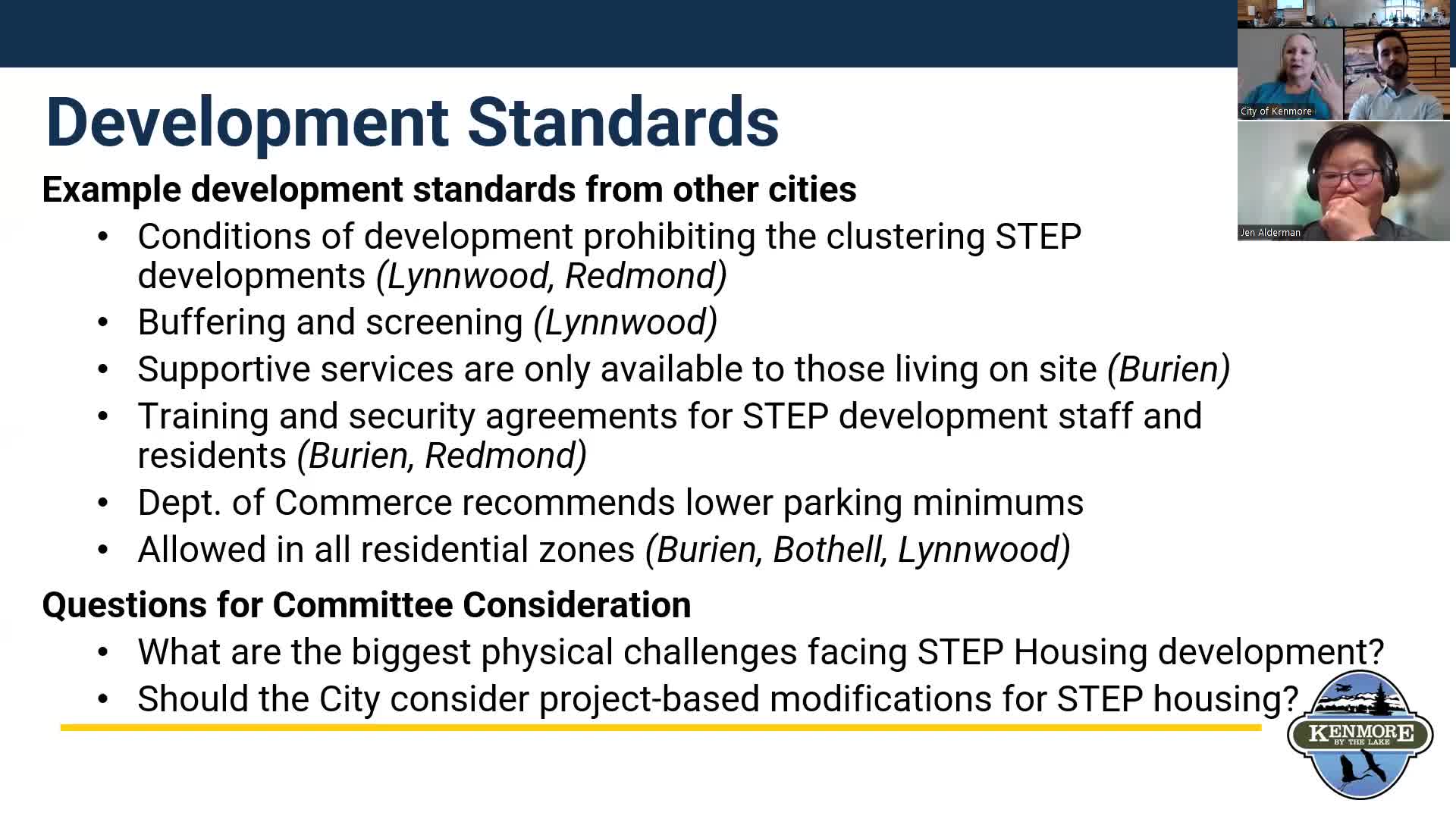
Summary
Kenmore staff and an advisory committee discussed whether to tailor development standards, permitting steps and design expectations for permanent supportive ("step") housing, including parking, security and density counting, and agreed to draft recommendations and examples for council review.
Staff member (Speaker 1) opened the meeting saying the committee’s main task is to prepare a recommendation for city council on development standards: “the bulk of the meeting will be looking at what our the actual deliverable is for council, which is a recommendation number ending the development standards.”
The committee focused on how permanent supportive housing — referred to in the meeting as “step housing” — is treated under current rules and what targeted changes (if any) to code or process are appropriate. “Currently, step housing is evaluated very similarly to how most multifamily projects are evaluated in the city,” Staff member (Speaker 1) said. The discussion covered permitting level, density counting, parking, security and buffering.
Why it matters: committee members said choices about whether to add distinct standards or rely on the existing multifamily rules will affect how quickly projects can be permitted, how neighbors are notified and what design features (parking, access control, on-site services) become standard in projects serving vulnerable populations.
Most of the meeting was a practical review of options rather than votes or final policy. Staff explained that most step housing proposals can be processed as a Type 1 permit: “it is a type 1 process. It is, through the city manager level,” Staff member (Speaker 1) said, adding that discretionary steps (a variance, conditional use permit or a development agreement) would move review to higher permit types and public hearings. Committee members noted that because many projects can be approved administratively, the city’s code is effectively where many operational details must be set if they are to be widely enforced.
On density and unit counting, committee members flagged that different unit types can change permitted capacity under existing rules. One committee member asked whether SROs (single-room-occupancy) are treated like other dwelling units for density; Staff member (Speaker 1) explained the city follows the standard dwelling-unit definition (kitchen, sanitation, sleeping) and that shared-kitchen SROs can affect how many units fit under zone density limits.
Parking was widely discussed. Staff referenced external guidance: “Commerce recommends lowering parking,” and participants debated the tradeoffs. Several committee members argued for flexibility: reduced minimums can lower project costs, but a local parking plan (required from the developer) could explain circulation, short-term drop-off, van service and accessible stalls so neighborhoods are not surprised by street crowding.
Security and building access also drew sustained attention. Committee participants described operational controls used by providers — locked entries, front-desk check-ins and elevator or floor pass systems — and discussed which features are operational choices vs. code requirements. One committee member cautioned that detailed operational items (for example, which key-card systems to use) may be more appropriate for contract conditions or development agreements than zoning text.
Committee directions and next steps: staff said they will draft recommended development-code edits (if any), an example good-neighbor agreement template and outreach materials, and return them to the group for review before presenting final recommendations to council. Staff also agreed to confirm a set-housing public-notice practice for Type 1 permits and to collect example language and design standards from other cities for reference.
Ending: The committee did not vote on policy at this meeting. Members emphasized balancing flexibility for developers with clear minimums to protect neighbors and residents, and asked staff to return with draft language and examples to inform a final recommendation for council.