
Seattle City Light proposes lower 2026–27 conservation target; committee amends report attachment and postpones final vote to Sept. 5
Get AI-powered insights, summaries, and transcripts
Subscribe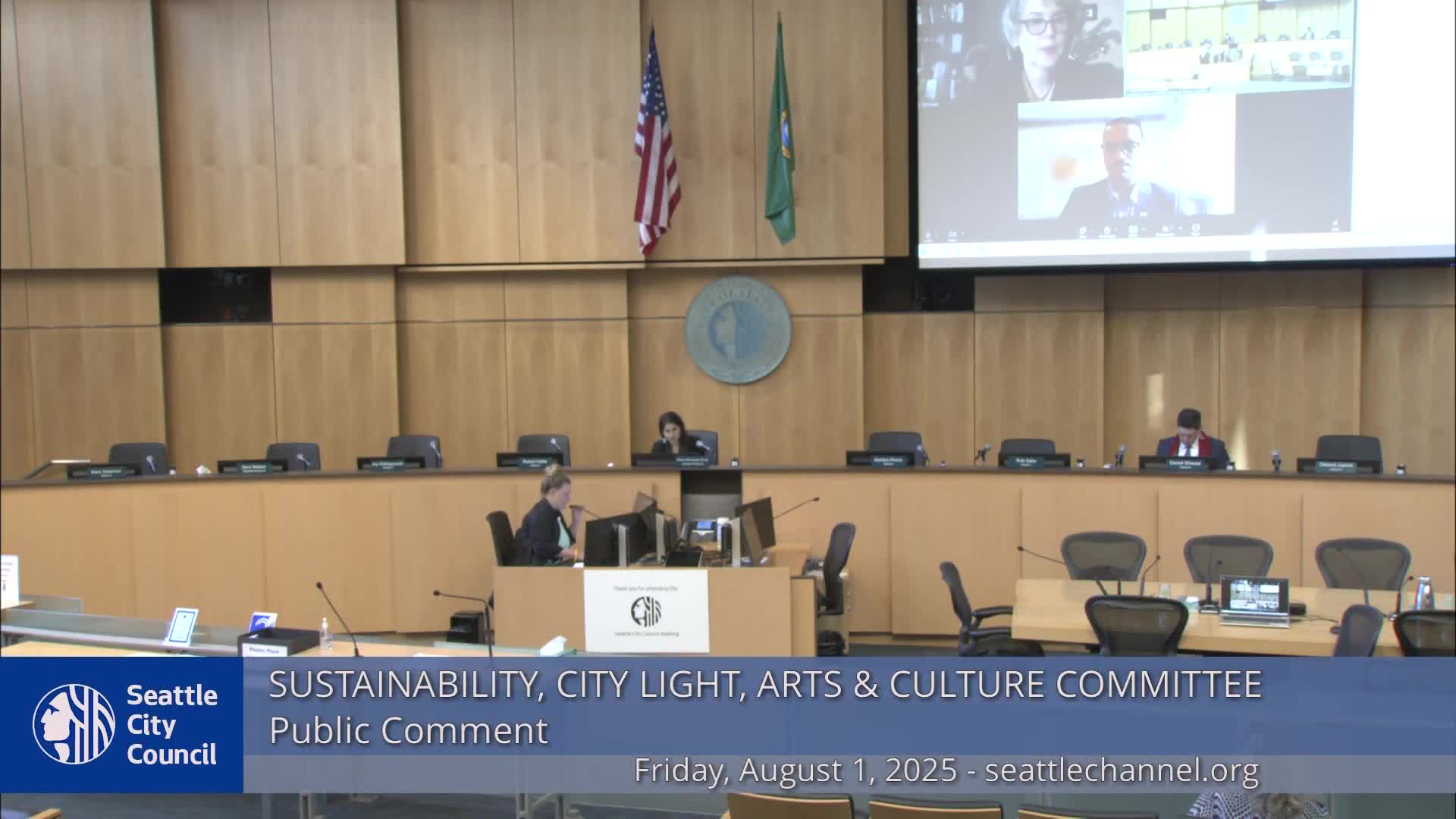
Summary
Seattle City Light presented proposed biennial and 10-year conservation targets, saying the 2026–27 two-year target is 16 average megawatts (a decline from 18). The committee voted 4-0 to substitute a corrected attachment and postponed final action and a public hearing to Sept. 5 to allow public review.
Seattle City Light presented its proposed biennial energy conservation target of 16 average megawatts for 2026–27 and a 10-year conservation potential of 78 average megawatts during the Aug. 1 Seattle City Council Sustainability, City Light, Arts & Culture Committee meeting. Council members amended a report attachment to replace the original file with a corrected version and postponed a final vote and a public hearing to Sept. 5 to allow the public time to review the revised materials.
City Light officials said the targets were developed through a demand-side management potential assessment that follows methodology prescribed by the Northwest Power and Conservation Council and state law. “We are sharing our biannual energy conservation target for the next 2 years, along with a 10 year conservation potential,” said Dawn Lindell, general manager and chief executive officer, Seattle City Light. The department said the targets reflect the amount of conservation that is cost‑effective, reliable and feasible under the Washington Energy Independence Act (Initiative 937) and the Clean Energy Transformation Act (CETA).
The department described the proposed two‑year target of 16 average megawatts as a floor that it intends to meet or exceed. Jennifer Finnegan, customer energy solutions, framed the presentation as meeting a statutory requirement: “This is to fulfill a state legislative requirement. We are here because Washington initiative 9 37, the Washington Energy Independence Act, requires utilities to pursue all available conservation that is cost effective, reliable, and feasible.” City Light staff said the lower two‑year target (about 11% lower than the previous biennium) is driven by market conditions including high office vacancy and federal policy uncertainty.
Why it matters: the committee and City Light framed conservation as a low‑cost, low‑risk resource that reduces system demand and delays larger supply investments. The department explained that one average megawatt equals roughly the annual usage of 1,200 average Seattle residential homes, and staff said failure to meet a statutory two‑year target can trigger a penalty on the order of about $85 per megawatt‑hour.
Key discussion points and staff explanations included market transformation (previous conservation and stronger building codes reduce what the utility may still count as claimable savings), the loss of low‑cost lighting savings as markets and codes evolved, and near‑term impacts from commercial vacancy rates. Craig Smith, chief customer officer, described current conditions as “a little bit of a weird lull” driven by high office vacancy and other headwinds but said new programs and market changes could increase future conservation opportunities. City Light staff also explained the practice of banking excess savings: Joe Fernandez, director of customer energy solutions, said, “you can think about it as if we're depositing those kilowatt hours into a piggy bank,” and that utilities may draw on excess savings from prior biennia when shortfalls occur.
The committee took a limited but specific action. Chair moved that the committee recommend adoption of Resolution 32176 and, separately, moved to amend Attachment A by substituting version 2 for version 1. The amendment to Attachment A was adopted on a roll call vote of 4‑0 (Vice Chair Juarez, Council Member Saka, Council Member Strauss and the chair recorded as in favor). The committee did not take final action on the underlying resolution. The chair announced the item would be taken up for final action and a public hearing at the Sept. 5 committee meeting to allow review of the amended attachment.
City Light noted two consequential follow‑ups: a corrected report attachment will be provided before the next meeting, and the department will return in September to present its Clean Energy Implementation Plan and related CETA materials (a separate state requirement). Staff also discussed work on demand‑response potential and a forthcoming large‑load policy for new high‑demand customers; Craig Smith said a draft large‑load policy is in development and the utility expects to bring a proposal to council in December.
Public comment at the meeting included two remote speakers; the clerk reminded speakers that comments should pertain to items on the agenda. City Light said it will post the corrected attachment and requested the committee schedule a public hearing on Sept. 5 to capture additional public feedback.
Ending: The committee approved the administrative amendment to Attachment A and set the corrected resolution for final action and a public hearing on Sept. 5. City Light told the committee it will continue to pursue conservation across residential, commercial and industrial programs while preparing the September materials and the separate CETA presentation.