
Guam panel marks 75th anniversary of Organic Act, urges public education on political-status options
Get AI-powered insights, summaries, and transcripts
Subscribe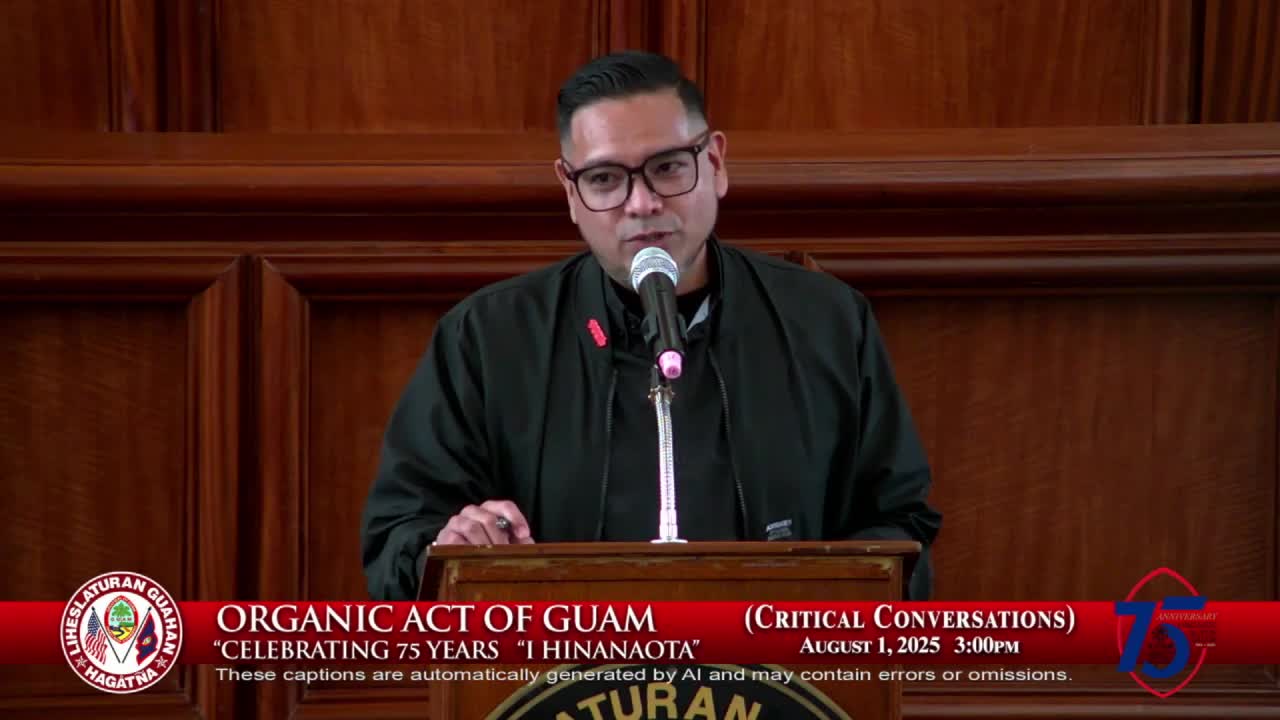
Summary
A panel convened by the Commission on Decolonization used a 75th-anniversary event in the Guam Legislature session hall to call for broader public education and discussion about Guam's political-status options, civic participation and the limits of U.S. authority over the island.
GUAM — A panel convened by the Commission on Decolonization and held in the Guam Legislature session hall marked the 75th anniversary of the Organic Act of Guam and pressed for increased public education about political-status choices and decolonization.
Melvin Juan Pat Borja, director of the Commission on Decolonization, opened the program and told attendees the event aimed to “help put this conversation in historical context” and to spur broader public discussion. The afternoon program included presentations and a panel discussion with Pauli (Polly) Eric Forbes, Capuchin Superior for Guam and Hawaii; Dr. Lisa Baza, a behavioral-health clinician and former Commission on Decolonization board member; and former U.S. Rep. Robert Underwood, who served as Guam’s nonvoting delegate to Congress.
The panelists described the Organic Act’s gains and limits and urged more public outreach. Pauli Eric Forbes warned that many residents appear disengaged from political-status debate, saying, “The silence of the majority of people I come across every day suggests to me that the historical island way of just accepting what is decided for us and making the best of it is still very much the current island way.” Forbes said any future movement on status will require wider awareness and intergenerational engagement.
Dr. Lisa Baza framed the work as part of a social and cultural recovery, telling the audience that “healing begins with clarity.” She credited grassroots organizations and the Commission’s outreach for preparing residents to “make an informed, confident decision” and urged education that explains differences among statehood, free association and independence.
Robert Underwood, who represented Guam in Washington, D.C., described the practical limits of Guam’s federal representation and the daily reality of serving as a nonvoting delegate: “Being a nonvoting delegate in the U.S. House of Representatives is like being asked to pass legislation with one hand tied behind your back,” he said, adding that delegates can win committee influence but ultimately lack a floor vote. Underwood and other panelists also reviewed key historical moments cited during the discussion — petitions from the early 1900s, the Guam Congress walkout in 1949, and a status vote in the 1970s that panelists said produced a plurality for “status quo with improvements.”
Speakers stressed specific constraints created by the Organic Act of 1950. Panelists said Congress consistently retains final authority over Guam’s political status and certain policy areas cited in historic proposals — for example, immigration and mutual-consent provisions — were repeatedly raised as issues that have blocked past congressional acceptance of local proposals. Dr. Baza and Underwood noted that the United Nations’ Special Committee on Decolonization can play a role only if the administering power, in this case the United States, agrees to a visiting mission; panelists said U.S. authorization for a UN visiting mission has happened only once and only for a constitution-related event.
The discussion also addressed civic engagement and intergenerational awareness. Panelists said younger residents may be less focused on status unless changes in housing, incomes or military-related land use make the political stakes more tangible. Underwood warned that large-scale shifts in geopolitics or U.S. strategic priorities could alter Guam’s circumstances without local initiation, a point Forbes used to urge urgency in public education.
Borja closed by noting the Commission has educational materials available and invited attendees to pick up information at a table outside the session hall before a festival across the street.
The panel did not propose or adopt any formal motions or votes. It focused on public education, historical context and the Commission’s role in preparing Guam residents for any future political-status process.