
North Carolina’s automatic-enrollment policy for advanced math cited as model as Tennessee staff weigh options
Get AI-powered insights, summaries, and transcripts
Subscribe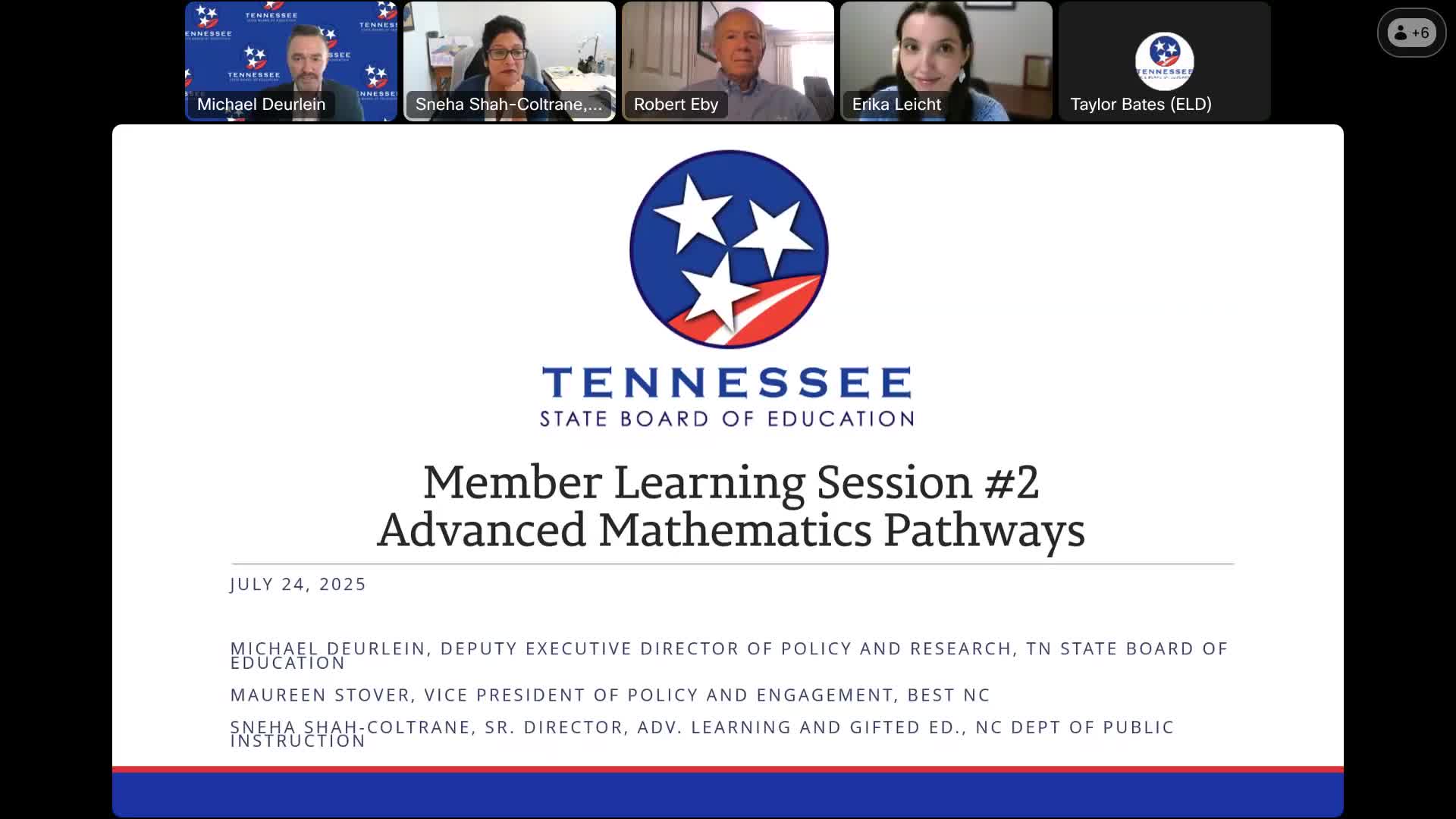
Summary
State Board members and outside experts discussed North Carolina’s policy of automatically enrolling high-scoring students into advanced math courses and explored options for Tennessee, including using standards review, virtual courses and pilots to expand access without new legislation.
State Board of Education staff from Tennessee heard from North Carolina officials on how an automatic-enrollment policy for advanced coursework expanded access to higher-level math for elementary and middle school students, and discussed possible steps Tennessee could take during an upcoming math standards review.
Michael Duraline, Deputy Executive Director of Policy and Research with the State Board of Education in Tennessee, told members the state currently leaves placement for middle-grade advanced math largely to districts. “There’s not an expectation in Tennessee, that districts automatically enroll students performing at a high level on state assessments into an advanced math course,” Duraline said as the session opened.
That local-control approach contrasts with North Carolina’s model. Maureen Stover, vice president of policy and engagement at Best NC, described North Carolina’s statutory approach: “Any student who scores a level 5, the highest score, on their end of grade or end of course math exam is automatically enrolled into the advanced math coursework.” Sneha Shaw Coltrane of the North Carolina Department of Public Instruction added that the state’s policy starts early: “In North Carolina, students who score a 5 on their EOG in third grade are automatically enrolled into advanced coursework moving into the fourth grade.”
Why it matters: speakers argued that early access to advanced math shapes students’ long-term options. Stover said research links completing algebra in eighth grade to higher rates of college enrollment and STEM careers, and that automatic enrollment removes dependence on parental advocacy or teacher recommendation, which local stakeholders said had created uneven access.
Tennessee staff presented state data showing limited middle-grade access. Erica Light, director of research for the State Board, said nearly 90% of eighth graders are not enrolled in high-school level math courses and noted substantial variation by district and school size. Light said about 7,500 eighth graders were enrolled in an initial high-school level math course while roughly 6,000 seventh graders exceeded expectations on the state test the prior year, but the department could not match individual students across years in the dataset presented.
Implementation and challenges discussed: North Carolina speakers described multiple complementary policies and practices that supported the law, including a statewide virtual public school, guidance from the state education agency, data reporting requirements, and flexibility for districts to deliver courses via in-person, virtual or cross-school models. Participants also flagged recurring obstacles: teacher shortages, standards alignment (so accelerated students do not “miss” foundational standards), scheduling and the logistical difficulty small districts face offering single sections.
North Carolina officials said legislation was followed by stronger implementation steps. Stover and Shaw Coltrane cited two legislative milestones and state guidance that required districts to report placements and to provide access for eligible students; they said placement of eligible students rose substantially after the policy and implementation supports were added. Stover noted the law allows families to opt out of placement and stressed the policy is intended to set a guaranteed minimum of access while leaving districts room to enroll additional students.
Next steps discussed for Tennessee: board members and staff considered nonlegislative actions that could advance access. Ideas included using the upcoming math standards review to develop statewide guidance, piloting district policies, recommending a model advancement policy for districts, leveraging virtual-course arrangements to reach students in small schools, and adjusting educator-preparation or endorsement language so middle-grade teachers are prepared to teach algebra-level coursework. No formal board action or vote was taken at the session.
Closing: presenters left links and a Johns Hopkins brief on North Carolina’s policy for further review. Maureen Stover and Sneha Shaw Coltrane provided contact information for follow-up from Tennessee board members and staff.