
Teachers, students and language advocates urge State Board to retain world language graduation requirement
Get AI-powered insights, summaries, and transcripts
Subscribe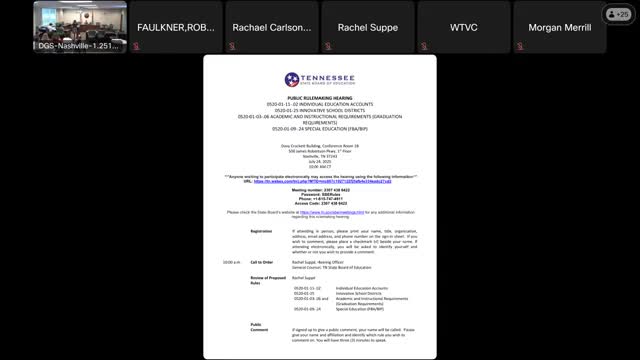
Summary
At a July 24 Tennessee State Board of Education rulemaking hearing, multiple educators, students and language experts urged the board to keep the two-credit world language graduation requirement and to slow any timeline for changing the policy; board counsel said the proposed rules under review do not remove that requirement.
At a July 24 rulemaking hearing of the Tennessee State Board of Education, educators, students and language advocates spoke in opposition to removing the two-credit world language requirement from high school graduation requirements and urged the board to preserve the requirement.
Rachel Soupey, General Counsel for the State Board of Education and the board's designated representative, opened the hearing and reviewed proposed rule revisions, noting that "this item does not propose any changes to the world language graduation requirements." She also explained the public-comment process and deadlines for written submissions.
Why it matters: World language educators and students told the board they consider a two-credit requirement essential for college readiness, workforce competitiveness and long-term cognitive benefits. Speakers said the policy opens opportunities they otherwise would not have had and warned that removing the requirement could deepen disparities between districts.
Gibson Keith, Advocacy Committee Chair of the Tennessee World Language Teachers Association, told the board that "retaining the 2 credit world language graduation requirement is not just about curriculum. It's about ensuring our students that are equipped for the world that they are entering." He said the requirement is "not a burden, it is an opportunity" and urged the board to preserve it.
Roxanna McCommon, a world language content specialist who has served as World Language Supervisor for Memphis-Shelby County Schools and worked with business and chamber partners, said removing the requirement could "place our students at a disadvantage" and expressed concern that rural districts may lose access to language courses. She cited data presented to her showing demand for language proficiency in Tennessee jobs and asked for greater transparency and broader stakeholder involvement in any future rulemaking.
Matthew Harrison, a Spanish teacher at Sullivan East High School and adjunct faculty member, said the policy discussion itself has already "could dismantle years of progress" and described concrete student benefits in his classes, including college credit earned through advanced language courses and career outcomes tied to language skills.
Several current and recent college students described personal experiences they tied directly to the state's language requirement. Emma Hatcher, a student at East Tennessee State University who studied in Mexico, said, "It's an absolute mistake" to eliminate the requirement and called the policy a "ladder for opportunity." Mikayla Webb, a junior at East Tennessee State University, described how language study changed her academic and career path and said, "Foreign language isn't just a subject, it's a bridge to opportunity." Helder Monet Weil, a classroom teacher with more than 15 years' experience, said students frequently tell him, "I wish I'd taken Spanish in high school," and urged the board to maintain access.
Charles Cooper, a professor of medieval Latin and Greek in Knoxville speaking as a private citizen, asked the board to slow the timeline for any change because "12 months from initial presentation to statewide implementation is very fast for such a consequential decision," and warned that moving too quickly "could significantly disadvantage future generations of students."
What the board said: Soupey reiterated that the current rule package under consideration does not propose removing the world language graduation requirement and explained the administrative timeline: written comments are due by 9 a.m. Central on Tuesday, July 29; the board plans a final-reading vote on the rules at its quarterly meeting on Aug. 15, 2025; if adopted on final reading, rules will be sent to the Attorney General's Office, published with the Secretary of State for 90 days, and go before the Joint Government Operations Committee of the Tennessee House and Senate.
Public process details: Speakers were allotted three minutes each for oral comment; written comments may be emailed to sbe.rulemaking.public.comments@tn.gov by the July 29 deadline. The hearing record will be provided to State Board members ahead of their August meeting.
The hearing closed with Soupey thanking attendees and noting that "student need is at the center of every decision that the board makes."