
University of Washington GEAR UP site coordinator outlines tutoring, college trips and STEM camps for Yakima middle-school cohorts
Get AI-powered insights, summaries, and transcripts
Subscribe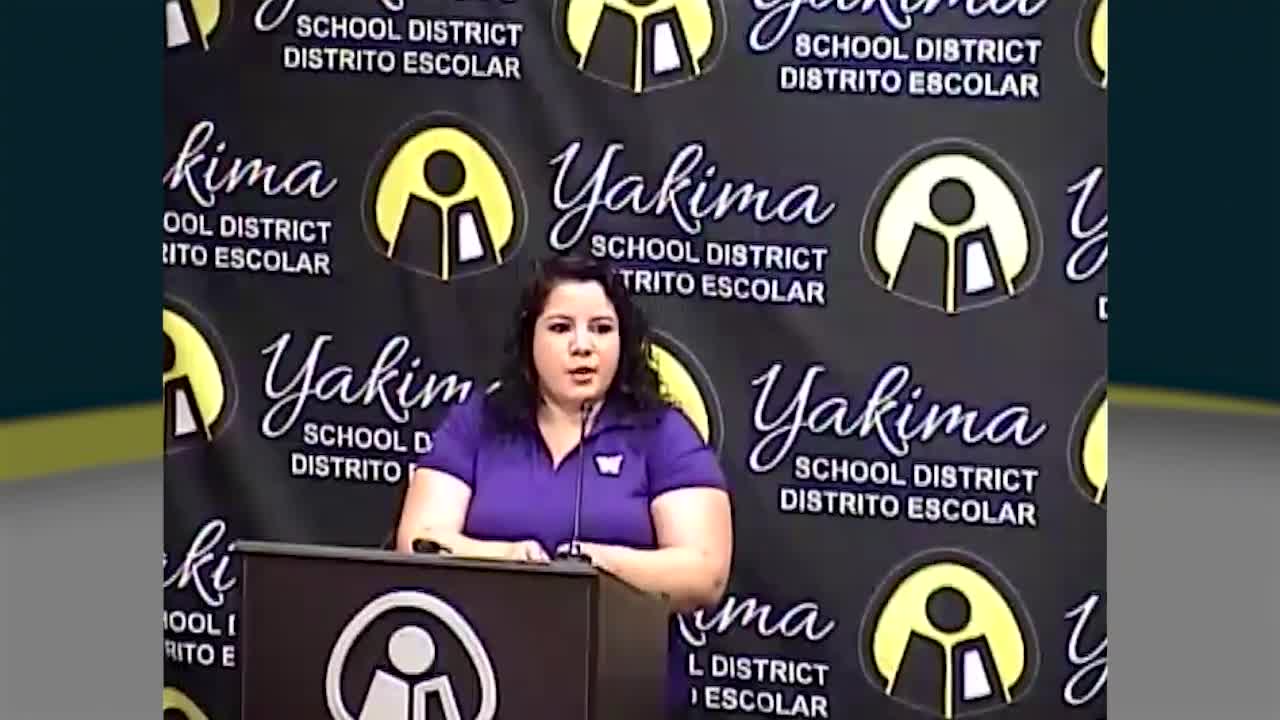
Summary
Noemi Barbosa, site coordinator for the University of Washington GEAR UP grant in Yakima, summarized tutoring, college visits, summer STEM camps and family engagement work serving cohort students entering middle and junior high.
Noemi Barbosa, the University of Washington’s GEAR UP site coordinator for Yakima, presented the new multi-year program to the Yakima School Board on July 29, detailing services planned for two cohorts of middle-school students under two seven-year grants.
Barbosa described two grants: a RISE UP grant covering students in the class of 2030 (beginning in sixth grade at Lewis & Clark and Franklin) with a grant performance period through Sept. 30, 2030, and a PATH grant serving the class of 2031 with a performance period to Aug. 31, 2031. Both are cohort-based, STEM- and college-access-focused grants administered by the University of Washington.
Services provided in the first year included seven tutors across four middle schools serving 278 cohort students (tutoring was also available to non-cohort students), 12 college and conference field trips (including a boys’ empowerment conference where participating students won a keynote activity), and STEM-focused camps such as a Central Washington University campus visit and a NASA/Central STEM camp that included drone-coding, rocket activities and geology work. Barbosa said the program funded 30 teacher mini-grants and 57 staff spots at a professional-development conference and helped host family-facing events — for example, a Franklin Middle School college-and-career night that drew about 280 attendees.
Barbosa told the board that the grants are forward-funded and that, while federal freezes earlier this year applied to categorical programs across districts, the UW GEAR UP funding available to Yakima has been secured for the coming year; she noted the district remains subject to the same federal constraints and that the UW central office and the district will continue advocacy for future years. She said the site team recently added two academic counselors to the Yakima program to expand services.
Why it matters: the program targets students early in middle school with tutoring, college exposure and family engagement to increase college and career readiness for historically underrepresented students and families.
Ending: Barbosa asked the board to continue partnership and advocacy to sustain the long-running cohort model; the district’s assistant superintendent of teaching and learning introduced Barbosa and thanked the University of Washington for the partnership.