
Murfreesboro council rejects proposed settlement with Republic Services, reaffirms opposition to Middle Point Landfill expansion
Get AI-powered insights, summaries, and transcripts
Subscribe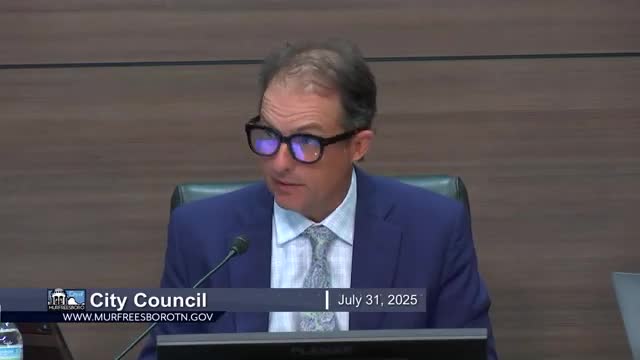
Summary
The Murfreesboro City Council on July 31 rejected a proposed settlement with BFI Waste Systems of Tennessee LLC and Republic Services over alleged air and water pollution at Middle Point Landfill and separately adopted a resolution opposing any expansion of the landfill.
The Murfreesboro City Council on July 31 rejected a proposed settlement with BFI Waste Systems of Tennessee LLC and Republic Services that would have resolved a federal lawsuit accusing the companies of water and air pollution at Middle Point Landfill, and separately adopted a resolution reaffirming the city’s opposition to any expansion of the landfill.
City Attorney Adam Tucker summarized the settlement proposal to council members before public comment, saying it was the product of multi‑year litigation and mediation and included monitoring, treatment studies and a gas and odor management plan. Tucker said the agreement would require monthly sampling of leachate for PFAS, semiannual groundwater and spring testing, construction of a granular activated carbon system at a primary stormwater outfall, and potential pretreatment construction if state or federal regulation requires it. He said the agreement also provided the city reimbursement for certain costs and penalties for failures to comply with key terms.
The settlement would have required BFI and Republic to reimburse the city $500,000 for past sampling and odor‑plan development, provide $40,000 for two years of city sampling of surface and drinking water, and reimburse up to $50,000 per year for two years for expert oversight. It also included a gas‑collection and control system management plan, a shared odor complaint portal and daily penalties for certain failures, ranging from several hundred to several thousand dollars, and gave the U.S. District Court continuing jurisdiction over enforcement. Under the agreement, the city retained the right to sue for the cost of a new drinking‑water treatment system if EPA’s 2024 PFAS drinking‑water standards are violated.
Residents who spoke at the public hearing urged the council to reject the deal or demand stronger commitments. James Farley, who said he worked with a chemist reviewing PFAS data, told the council the landfill’s leachate PFAS readings were far higher than typical values cited in national studies and said, “We need more from the Republic than their agreement to study options.” Several other speakers pressed for longer‑term sampling, binding cleanup triggers, third‑party oversight and broader funding for monitoring and remediation.
Pat Bacon said the effects of contamination “won’t be seen for years and years and years” and called the settlement inadequate. Laura McGowan asked why BFI would “study pretreatment options for up to a year” rather than install known technologies now, and flagged limits in the settlement on how long the city’s sampling would be funded. Multiple commenters noted that some remediation commitments in the draft would be triggered only “if” EPA or the Tennessee Department of Environment and Conservation (TDEC) adopted specific regulation.
Council discussion before the vote returned repeatedly to trust and enforceability. Mayor Mary McFarland and several council members said the city’s legal team had obtained detailed technical commitments but that a number of council members remained unconvinced Republic would carry them out or that the measures were sufficiently durable or public‑facing. A motion to deny the settlement passed on a roll call vote; the clerk recorded unanimous support for the motion to reject the settlement.
Separately, earlier in the meeting the council unanimously adopted Resolution 25 R 25 opposing expansion of Middle Point Landfill and expressing support for the so‑called Jackson Law, a Tennessee statute that allows local governments that have opted into it to approve or reject landfill siting or expansions within one mile of city limits. The resolution states the council’s position that expansion would be detrimental to the environment, public health and the local economy.
The council recorded that the settlement’s provisions do not limit the city’s ability to oppose future expansion proposals, including proposed resumption of filling over certain areas or a major expansion onto adjacent closed landfill property in Rutherford County. But speakers and several council members said they want clearer, longer funding and direct public oversight mechanisms before supporting any negotiated agreement.
The council did not adopt specific additional terms requested by some speakers — such as an explicit company apology, a binding promise to abandon all expansion plans, or an open‑ended long‑term sampling fund — and several council members said those items were not agreed to during mediation.
The immediate outcome leaves the federal lawsuit unresolved; the city may continue litigation or pursue further negotiations. Council members said they will continue to monitor regulatory and enforcement actions by EPA and TDEC and seek ways to strengthen local oversight and funding for testing and remediation.