
Yakima School Board opens public hearing on preliminary 2025–26 budget amid federal funding uncertainty
Get AI-powered insights, summaries, and transcripts
Subscribe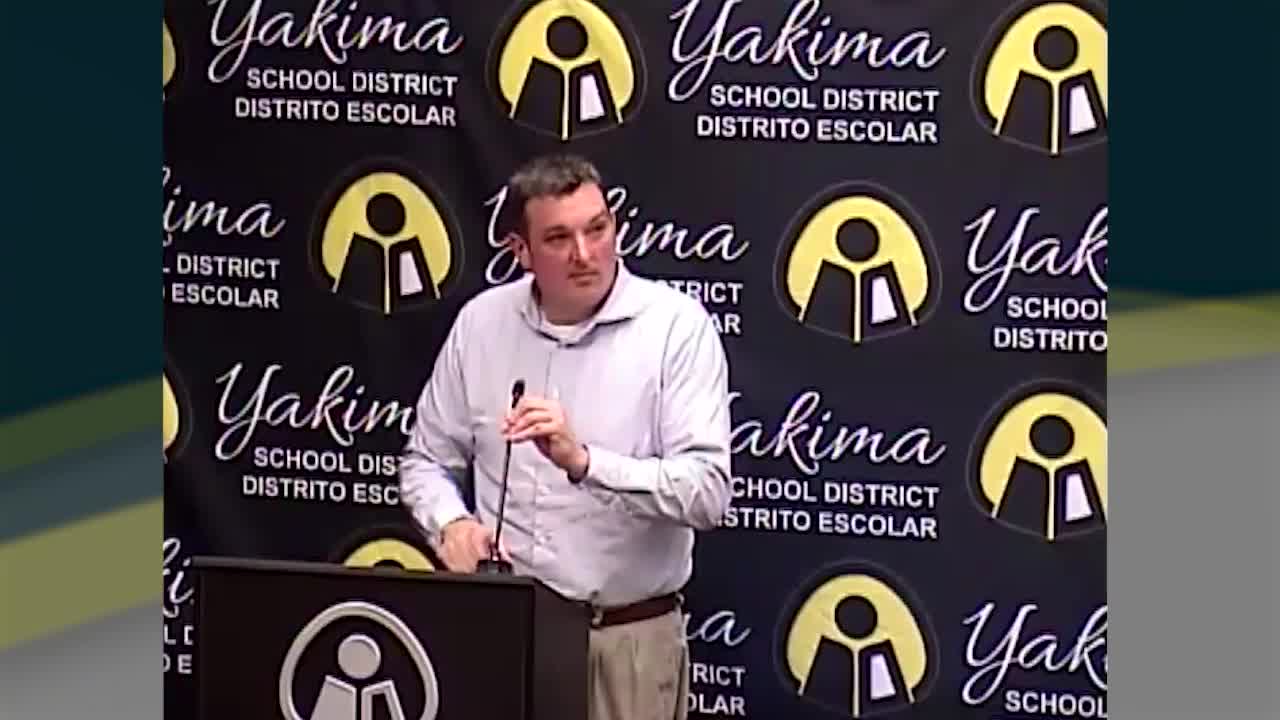
Summary
At a July 29 public hearing, district finance staff outlined a preliminary $296 million budget with a $1.7 million deficit on paper, explained drivers such as rising health insurance and special education costs, and warned of possible federal and state funding reductions in coming years.
The Yakima School Board on July 29 held the statutorily required public hearing on the Yakima School District’s preliminary 2025–26 budget, where finance staff presented a revenue plan of about $294.7 million and projected expenditures of roughly $296.05 million, leaving a budgeted deficit position of about $1.7 million on paper.
The district’s budget presenter, Mister Cooper, led the presentation and told the board the district estimates a beginning fund balance of about $22.6 million and an estimated ending fund balance of $15.6 million under the current preliminary budget. He said the district expects to avoid drawing down that beginning balance and anticipates ending the fiscal year nearer $18 million if projections hold.
Board members and staff discussed key budget drivers: growth in classified positions driven largely by 1-on-1 paraeducator staffing in special education, a substantial increase in health insurance costs linked to changes in the School Employees’ Benefits (SEB) program, and higher utilities and technology costs. Cooper said special education costs remain significant, with the district covering about 20% of special-education costs from local levy funding — nearly $10 million — and that state safety-net awards and compliant individualized education programs had reduced a larger projected shortfall by roughly $3 million.
Why it matters: the district is in a multi-year period of declining enrollment (about 8.5% since its peak enrollment year) while staffing levels have not declined proportionally, a dynamic that pressures per-student costs and long-term fiscal stability.
The presentation laid out several other budget details and risks. Cooper said the district’s administrative overhead is budgeted at about 9.83% — below the statewide average of 12.3% — and said that if the district spent at the state average it would be spending about $7.4 million more annually on administration. He also described a planned December repayment of a tax anticipation note and previously approved nonvoted debt that together account for some transfers to other funds.
Federal and state funding uncertainty featured prominently. Cooper said Yakima was the most-affected district in the state in a recent federal funding freeze scenario: roughly $3.8 million in categorical federal funds had been held temporarily by the executive branch this summer, a freeze that has been lifted; however, OSPI modeling for fiscal 2026–27 shows a potential $2.8 million reduction if certain programs (notably Title I migrant and Title III) are cut. Cooper and Superintendent Doctor Green warned that earlier freezes had forced some neighboring smaller districts to make immediate personnel reductions.
Board members asked about the composition of fund balance and liquidity. Cooper said the district serves as fiduciary for the regional skill center and holds both operating carryover for the skill center and capital project funds the board does not control for general district use. He said restricted carryover still provides monthly liquidity but emphasized the difference between cash on hand and unrestricted reserves. At the moment, Cooper estimated unrestricted (unassigned) fund balance at roughly 2.75% of the budget, below the board’s 5% goal, and said that reaching an 18 million total fund balance would put the district in the neighborhood of 6% total reserves once short-term borrowing is repaid.
Public comment at the hearing included a retired teacher and taxpayer who questioned administrative staffing numbers and district communications spending; board and district leaders offered to meet with that commenter to review the publicly available OSPI data and the district’s financial documents.
The hearing was informational only: the public hearing was opened and closed and the district will move forward with budget adoption processes required by state law. The district’s full 22-page budget presentation and supporting documents are posted in BoardDocs.
Ending: Cooper told the board he will continue to monitor enrollment trends — especially kindergarten numbers — and communicate changes in federal or state allocations when they are finalized. Superintendent Doctor Green urged continued advocacy with legislators and noted the district will be watching both federal categorical allocations and the state budget for actions that would require mid-course adjustments.