
How to protect mature trees when replacing lawn with water‑wise landscaping
Get AI-powered insights, summaries, and transcripts
Subscribe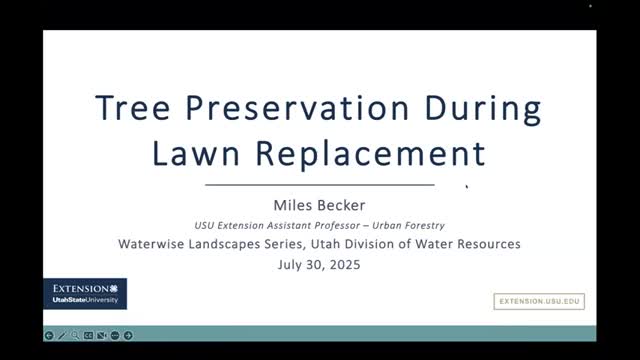
Summary
Miles, an extension educator with Utah State University Extension, told a Utah Division of Water Resources webinar that homeowners can preserve mature trees while replacing lawn with water‑wise landscaping but must plan to protect roots, avoid soil compaction and provide appropriate supplemental water.
Miles, an extension educator with Utah State University Extension, told a Utah Division of Water Resources webinar that homeowners can preserve mature trees while replacing lawn with water‑wise landscaping but must plan to protect roots, avoid soil compaction and provide appropriate supplemental water. “Trees also benefit us, and ... saving them while we’re taking out the lawn is a goal,” Miles said.
Why it matters: trees provide shade that lowers local temperatures, add measurable property value and deliver other neighborhood benefits that take decades to replace. Lawn‑removal projects commonly cause tree injury by direct mechanical damage, compacting soil and changing watering patterns; any of those can shorten a tree’s lifespan.
Most important guidance from the webinar: - Evaluate the tree first. Some problems (for example, iron chlorosis that causes yellowing leaves) are treatable; others (girdling roots or severe decline) may make replacement the pragmatic choice. Miles advised homeowners to check trees before and after landscape changes and to take photos for comparison. - Protect roots. Much of a tree’s absorptive root mass is in the top 18–20 inches of soil and overlaps the lawn area. Miles said to avoid cutting or compacting roots over about 2 inches in diameter when removing turf, because larger structural roots are harder for the tree to replace and more likely to invite pathogens if damaged. - Consider removal methods and supervision. Mechanical excavation can work but requires a careful operator and someone watching to prevent root damage or compaction; hand tools, solarization (plastic sheeting) and other methods are alternatives depending on scale and owner comfort. - Replace turf irrigation by targeting the tree’s drip line. Roots typically concentrate near the crown’s edge (the drip line); place emitters or drip tubing in a ring around that area so available water follows roots outward as the tree grows. - Water to the tree’s needs, not the lawn’s. Miles gave a practical minimum: when you water, provide roughly 5 gallons of water per inch of trunk diameter per supplemental irrigation event as a baseline for survival (for example, a 7‑inch trunk ≈ 35 gallons per watering). Young trees require more frequent, smaller applications (daily for the first two weeks after planting, then tapering to twice weekly, then weekly after a few months). Mature trees use more water overall but have larger root systems and generally need less frequent supplemental irrigation; during hot, dry periods the presenter suggested a baseline of about once every two weeks in summer and once a month in cooler fall conditions if a smaller baseline supply is being supplied by other sources. - Design irrigation for soil type and site. Soil texture changes how water spreads (sand drains fast and requires more frequent applications or closer emitters; clay absorbs slowly and holds water longer). Emitters or drip rings should be spaced so their wetting “cones” overlap across the root zone. For street trees or narrow planting strips the same ring design may not fit and a different irrigation approach and higher flow rates might be needed. - Mulch and soil care. Organic mulches and compost help retain moisture and improve soil biology; rock or artificial turf do not provide the same benefits and can increase soil temperature. If soils become compacted, root‑invigoration (mechanical aeration of compacted soil) can help trees recover, but prevention of compaction during turf removal is preferable.
What the webinar did not do: the session was advisory; no formal votes or policy changes were made. Presenters repeatedly encouraged homeowners in cities to check local municipal rules because many cities have ordinances governing removal of trees or work in planting strips and rights‑of‑way.
Resources and next steps: presenters said they would send follow‑up links to the Division of Water Resources watering guide and USU Extension fact sheets on drip‑irrigation design and tree care. Homeowners with questions were invited to contact their county extension office and to send follow‑up photos or irrigation site details by email for individualized calculations.