
DeKalb County holds public hearing on wheel and excise tax as officials outline funding shortfall for road maintenance
Get AI-powered insights, summaries, and transcripts
Subscribe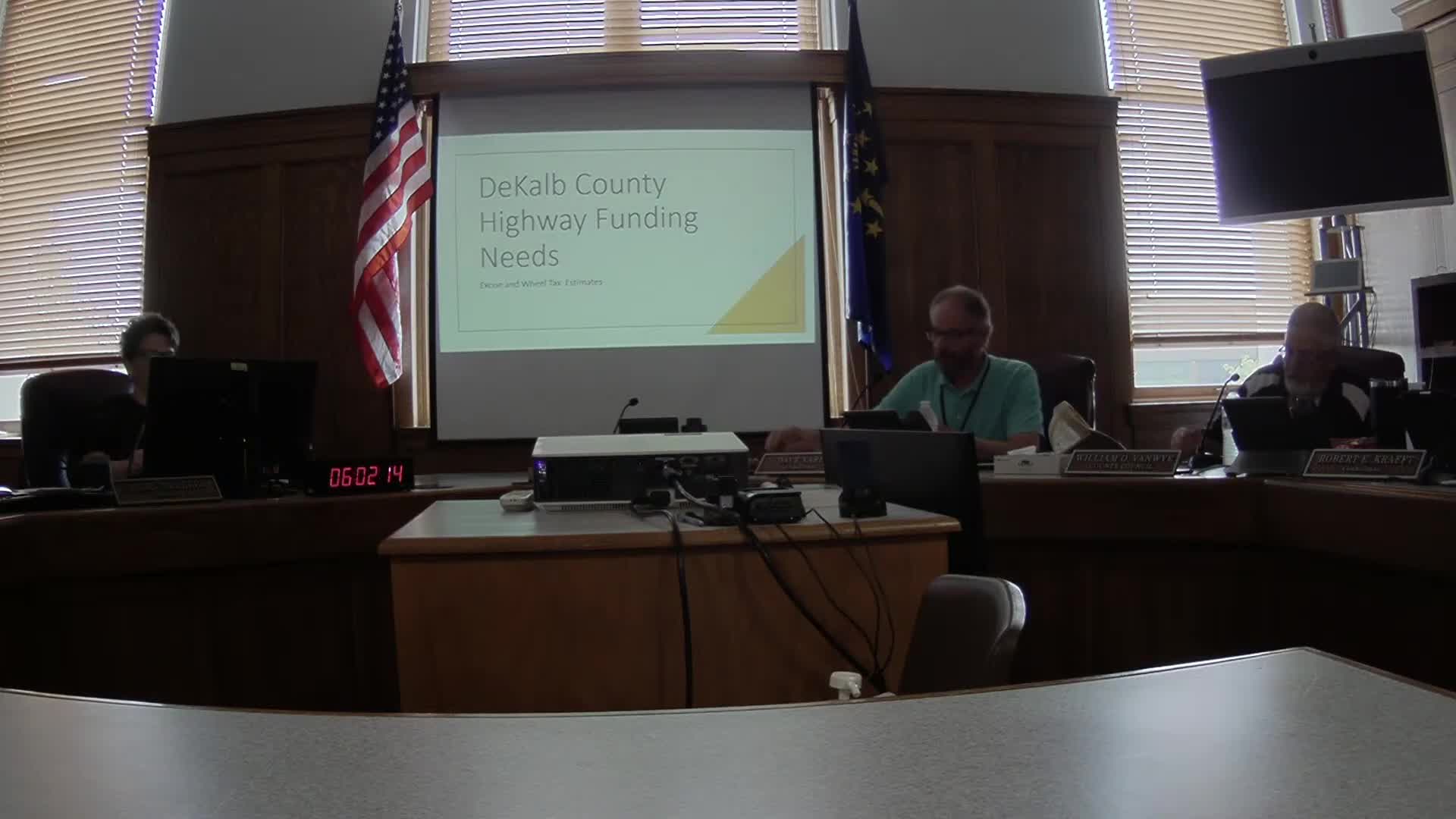
Summary
DeKalb County Council held a public information session July 31 to explain proposed local-option wheel and excise taxes and to gather public comment; council members did not take a vote.
DeKalb County Council held a public information session July 31 to explain proposed local-option wheel and excise taxes and to gather public comment; council members did not take a vote. Councilman Bill Van Wye said the county is considering the taxes after reductions in state funding and said the levies are intended to help pay a maintenance backlog on county roads.
The session matters because the taxes are tied to eligibility for additional community-crossings formula funds administered by the state. County staff and council members said the county must adopt both the excise tax (for passenger vehicles) and the wheel tax (for heavier vehicles) together to qualify for the higher tier of formula funding. County staff presented condition and cost estimates for paved roads and bridges and urged the public to review a slide packet posted on the county website.
County officials described the scale of need. Councilman Bill Van Wye said the county has 704 miles of paved roads and identified 123.14 miles rated 2–5 on the PACER (0–10) pavement-rating scale; county staff estimated about $10,247,768 in maintenance work on that 123.14 miles. Presenters outlined annual recommended pavement maintenance of roughly $5.1 million and said current, recurring maintenance funding is about $2.9 million, leaving an annual shortfall of roughly $2.2 million. Staff also noted a bridge inventory of 103 structures and said a large share would require replacement over the next 10–15 years.
Council and staff described statutory and program basics. The county’s asset-management plan (PACER) lets DeKalb seek higher tax-rate caps: the excise tax caps at $7.50–$50 per vehicle with an approved asset-management plan and the wheel tax caps at $5–$80 depending on the plan. Presenters said a council decision before Sept. 1, 2025, would allow an effective date of Jan. 1, 2026; later passage would push any effective date to Jan. 1, 2027. Staff also explained that the first year of collections affects how much “crossroads” match the county would receive in later rounds and that formula distributions will depend on how many other jurisdictions adopt the taxes.
Public commenters expressed a range of positions. Supporters said the levy is needed to maintain and improve roads and to qualify for state funding. Karen Griggs, a resident of County Road 35 in Ashley, said, “My purpose here is to support the wheel excise tax” and argued that delaying revenue would increase costs for equipment and projects. Several residents urged that any tax design include protections for low-income and fixed-income households, and small-business owners said per-vehicle charges could harm firms that register multiple work vehicles.
Others opposed the tax or urged caution. Commenters argued the county should find efficiencies first, questioned past capital spending, and urged the council to set the lowest possible rates. Keith Hefner, a Garrett resident who identified himself as an owner of collector vehicles, said, “Excise tax is supposed to be for support of the highway. If I’m very rarely using that, how much should I pay?” and urged a formula that charges heavier road users more. Multiple speakers asked whether school buses and small commercial fleets would be exempt or subject to new fees; presenters said the council would need to address those details later and that state law already lists limited exemptions (funeral vehicles were cited as exempt under state law).
County staff and a representative from the Indiana LTAP/PACER program explained formula and grant differences. Staff said the Community Crossings program’s competitive grant pool was capped and that formula funds would be distributed to participating counties at different levels depending on participation statewide. Presenters gave an estimated range of formula funding for DeKalb County in future fiscal years (for example, staff estimated $1.6 million–$2.1 million in formula funds in 2027 under current assumptions) but emphasized that those are estimates and depend on statewide participation.
Council members emphasized process and timing. The council’s stated purpose for the July 31 session was to gather information; no motions or votes on tax rates were taken. Council members said staff would post presentation materials and the LTAP video on the county website and that rate-setting and any formal ordinance would be considered at a future council meeting.
What’s next: council members said they will consider the public input and staff recommendations at upcoming meetings; if the council chooses to proceed, it must set rates and adopt an ordinance in accordance with state law and the statutory deadlines discussed at the session.