Get Full Government Meeting Transcripts, Videos, & Alerts Forever!
Get email alerts on the Drainage And Infrastructure topic
No spam. Unsubscribe anytime.
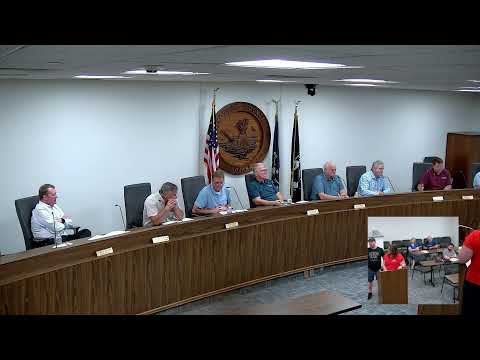
Howard County drainage board approves temporary assessment hike after Cotswold Hills residents describe recurring flooding
Summary
The Howard County Drainage Board voted during a public meeting to raise the assessment for the Cotswold Hills regulated-drain watershed and directed county staff to pursue additional short-term measures after residents described repeated flooding that has damaged basements, driveways and yard infrastructure.
The Howard County Drainage Board voted during a public meeting to raise the assessment for the Cotswold Hills regulated-drain watershed and directed county staff to pursue additional short-term measures after residents described repeated flooding that has damaged basements, driveways and yard infrastructure.
Residents said the problem intensified after a large pipe was installed in a nearby field in 2024. "Before the pipe was put in in 2024, we didn't have this issue," said Shelly Layman, a neighbor of the heavily affected property, adding that the neighborhood has seen repeated inundation even in storms of about 2–3 inches. Several residents said a June 14 storm produced the largest recent surge and that the new pipe appears to have increased the volume and speed of water flowing into the regulated drain and downstream neighborhoods.
The board heard detailed accounts from multiple homeowners. One resident described constant ground saturation and water breaching doors: "When we get a hard thunderstorm ... I just don't know what to do next," he said, describing pumps that run continuously and a yard that becomes "a mosh pit" in heavy rain. Another resident said riprap from the pond and broken pipe sections washed into yards during recent events, and a third speaker said a sinkhole near Dixon Road posed a traffic safety hazard.
County staff and board members summarized prior and planned work and outlined options discussed in the meeting. A county staff member said three work orders are active to clear inlet pipes and fix holes and that contractors were scheduled to begin repairs on pipes and pond inlets. Staff estimated that a full reconstruction of the watershed—replacing undersized tiles and upsizing culverts—would be expensive: "a little under a half a million dollars" for an initial reconstruction, and cautioned that reconstruction could cost more if deferred.
Staff presented a financing option modeled on a previous project (Brookshire): a temporary assessment increase such as a $300-per-parcel minimum to raise roughly $50,000 a year for three years to fund design work and begin repairs, then reduce the assessment to a lower ongoing maintenance amount. Staff said regrading the overland swale or installing a cutoff trench behind individual homes could provide partial relief but would not address watershed-scale capacity limits. One staff estimate for a lower-cost interim regrading project was roughly $20,000–$30,000.
The board took two formal actions. First, a motion to raise the assessment for the Cotswold Hills watershed passed by voice vote (motion by Mr. Dodd; second by Mr. Byrum). The board clerk said the paperwork would be provided to residents. Second, the board unanimously directed county staff (Greg) to investigate other alternatives, large and small, to alleviate the flooding as soon as practicable (motion by Mr. Olery; second by Mr. Bray).
Several speakers asked the county to coordinate with the state on drainage tied to State Road 26, where new roadway drainage was cited as a potential source of increased runoff. Megan Massey, whose properties sit where a rebuilt roadside drain and culverts intersect local ditches, requested copies of INDOT plans and assistance contacting the state; staff agreed to provide the area engineer contact information and said they would follow up with county highway on a collapsed roadside culvert adjacent to a right of way.
Homeowners also raised maintenance and debris issues: field crop residue and piles of material on private parcels can plug small drainage structures and inlets, county staff said. Residents asked what private landowners can do to limit field debris, and staff advised that measures must not obstruct natural flow; planting debris-capturing vegetation or directed, temporary measures were discussed but no county mandate was issued.
The board concluded that the watershed's drainage infrastructure is undersized for current residential use, that immediate, site-level fixes can help some properties but not solve the whole problem, and that assembling funds for engineering and reconstruction is likely necessary to address the root cause. Board members said they will follow up with work orders and outreach to residents while staff develops design options and cost estimates.
Votes at a glance: - Motion to raise the assessment for the Cotswold Hills regulated drain: passed (motion by Mr. Dodd; second by Mr. Byrum; voice vote). Board staff to prepare paperwork and public hearing notices. - Motion directing county staff to research short- and long-term alternatives to alleviate flooding in the Cotswold Hills/Cotswold area: passed (motion by Mr. Olery; second by Mr. Bray; voice vote). Staff tasked to report back to the board.
The board said it will return to the matter after staff compiles design estimates and potential assessment schedules; residents were told staff would attempt interim repairs and follow up with state and highway contacts where applicable.