
Residents urge denial of rezoning near Deer Creek, commissioners accept planning commission recommendation
Get AI-powered insights, summaries, and transcripts
Subscribe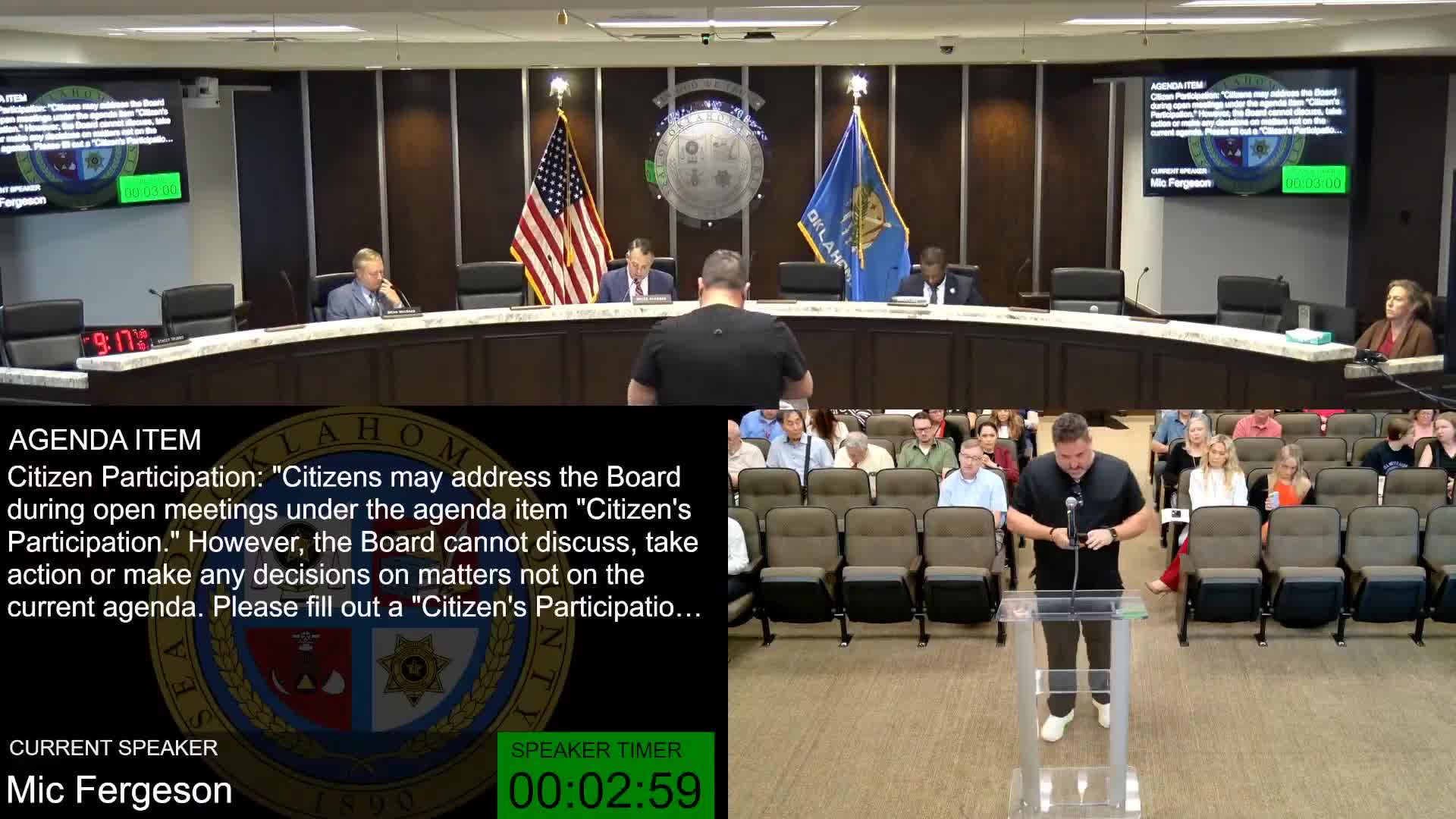
Summary
Residents and experts told the Oklahoma County commissioners that a proposed rezoning near 170th East and Deer Creek sits in a FEMA-designated floodway and would change the rural character of the neighborhood; the Board accepted the planning commission's recommendation to deny the rezoning.
Residents, a hydrologist and the property owner debated a rezoning request for a parcel near 170th East in the Deer Creek area, and the Oklahoma County commissioners accepted the Planning Commission's recommendation to deny the rezoning. Residents said the site sits in a FEMA-designated regulatory floodway and warned commercial development would threaten safety and the neighborhood's rural character.
Why it matters: The change would allow commercial uses adjacent to long-established single-family homes. Opponents said a commercial development in a floodway could increase flood risk for neighbors and bring traffic and safety concerns; proponents said engineering measures can mitigate flood impacts but such mitigation would come later in the permitting process.
Residents spoke in opposition at the public-comment portion. Mick Ferguson said he and his family moved to the area to protect an old home and its open land, adding, “We are caretakers of history.” His wife, Stephanie Ferguson, told commissioners the family chose the rural area so their four children could “grow up outdoors” and asked the board to “vote no to the zoning change.” Fourteen-year-old Caroline Ferguson said she opposed rezoning on safety grounds and cited local crime statistics, saying, “Humantraffickinghotline.org reported 210 victims of trafficking in Oklahoma in 2024. 82 of those people were a victim of *** trafficking.”
Technical testimony: Thomas Logsdon, identifying himself as a professional engineer, and Bill Smith, a professional hydrologist, addressed floodplain concerns. Smith said he performed a pre-zoning evaluation and concluded “there is a physical solution to have no rise in the current base flood elevation or the floodway elevation for either Deer Creek or Soldier Creek,” but he explained that floodplain changes normally require a later set of approvals, including a FEMA conditional Letter of Map Revision and construction before a final Letter of Map Revision is issued.
Developer presentation and permitting sequence: The property owner, identified in testimony as Mr. Kim, and his consultant described a three-building, low-impact office or retail complex positioned on the southeast corner of the lot with parking and a north-side vegetated buffer. They said a multiuse ponding area was intended to detain stormwater and release it at a controlled rate. Engineer testimony and the developer’s plan were presented to respond to questions raised at the Planning Commission hearing.
Board action: After public comment and presentations, a commissioner moved to accept the Planning Commission’s recommendation. The motion carried, and the board accepted the recommendation to deny the rezoning request.
What’s next: Because floodplain mitigation, FEMA reviews and design approvals occur after zoning in the county’s described permitting sequence, any future developer seeking similar changes would need separate floodplain and design approvals and, if warranted, FEMA review and map revisions.