
Council reviews stream-bank stabilization study; staff asked to return with easement, funding and participation options
Get AI-powered insights, summaries, and transcripts
Subscribe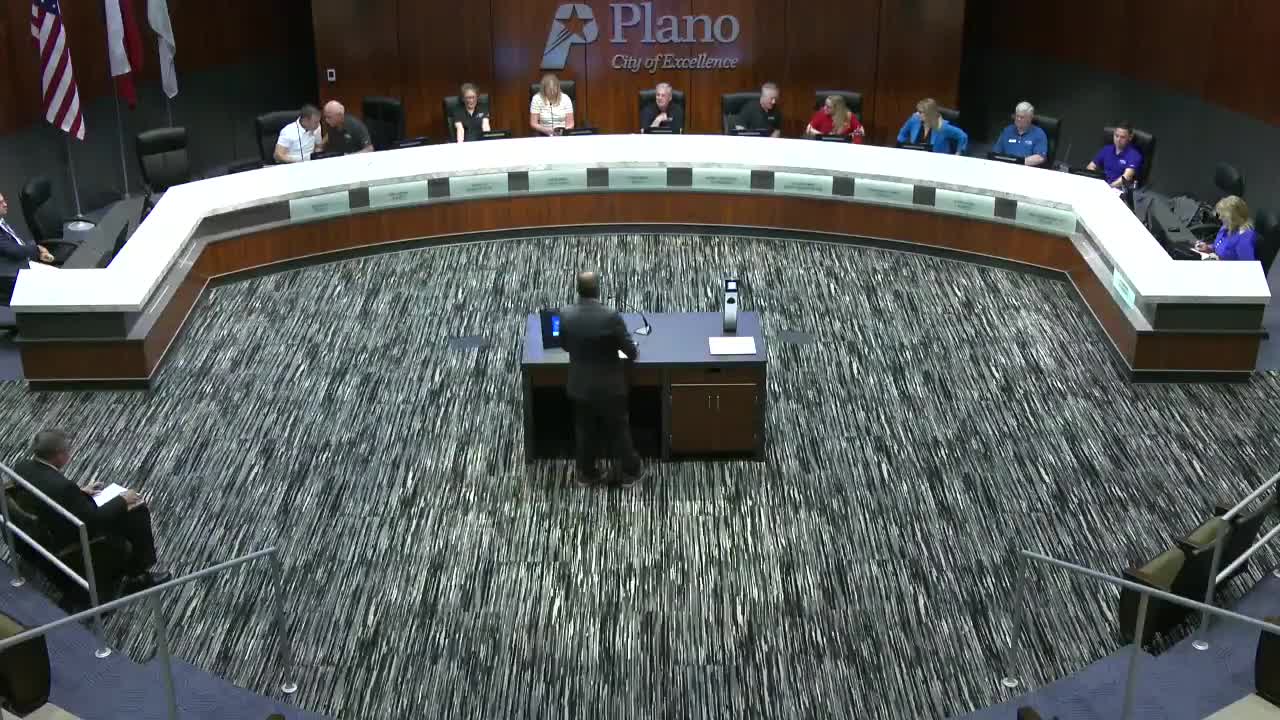
Summary
Engineering staff presented a study of stream-bank erosion across Plano, identifying more than 3,000 locations with about 42 rated as critical. The estimated cost to address critical sites is about $10 million; council asked staff to return with easement templates, cost-sharing options and maintenance proposals.
Caleb Thornhill, director of engineering, told the Plano City Council the city studied 127 miles of stream channels and identified more than 3,000 locations that show erosion or bank-stability issues, and that about 70 percent of those locations are on city-owned land. He said the consultant’s scoring system ranges from 0 (worst) to 100 (no action needed), and that roughly 42 locations fell into the critical category (scores 0–20).
Thornhill said his office estimated the cost to address the critical locations at about $10,000,000; of that amount, the estimate for city-owned sites is roughly $6,750,000, with private and HOA-owned portions of the critical total estimated at about $3,450,000 and $150,000, respectively. He gave an example of a large gabion wall project that cost about $1,600,000 at a single site, and said that many projects would be bundled—several problematic spots could be designed and constructed as a single project to reduce per-site costs.
Council discussion focused on ownership, acquisition rights, participation by homeowners and HOAs, scheduling and interim maintenance. Thornhill said the city is working with legal on acquisition language and proposed that, if the city works on private property, property owners would be asked to dedicate easement rights to the city (rather than sell fee title). He said property owners would be responsible for resolving any encroachments—fences, landscaping or pools—that intersect the needed stabilization work.
Council members pressed for options on cost-sharing. Thornhill showed models used by neighboring cities—flat-fee programs, percentage split (for example, 50/50 residential), and tiered shares for commercial properties—and said the city could evaluate a flat participation fee such as $5,000–$7,500 per property or a percentage of the improvement cost. Councilman Rick said he favored a higher flat contribution from homeowners and suggested considering $10,000 as a participation level.
On timing, Thornhill said the city’s plan would be to address the current critical locations within three years by grouping multiple spots into design and construction projects and running several projects concurrently. He also proposed a five-year re-evaluation cycle to update priorities and inventories.
What council asked staff to return with: the council requested easement templates and legal options if property owners decline to grant rights, a range of homeowner/HOA participation models including flat-fee and percentage approaches with cost examples, reassessment thresholds (for example, where to draw the line between maintenance and capital intervention), and a proposed annual maintenance budget to address lower‑scored (noncritical) sites.
Thornhill and staff said they will bring those options back for council consideration at upcoming budget work sessions and will provide breakdowns for the 10 specifically identified private properties in the critical category. Council did not approve a specific funding commitment or new program at the meeting; members said they wanted both acquisition/legal options and concrete cost-sharing figures before deciding on private-property participation.