
School board advances second reading of staff concealed‑carry policy after lengthy debate on training and mental‑health checks
Get AI-powered insights, summaries, and transcripts
Subscribe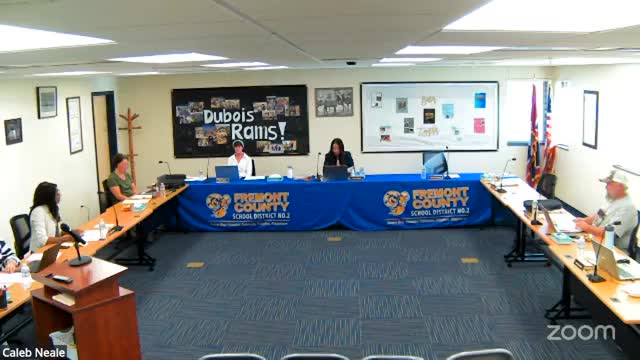
Summary
Du Bois, Wyoming — The Fremont County School District #2 board held a second reading May 29 of proposed Policy CKA, which would regulate employees and volunteers who apply for district approval to carry concealed firearms on school property, and spent more than an hour debating training requirements, mental‑health evaluations and who should pay for any required training.
Du Bois, Wyoming — The Fremont County School District #2 board held a second reading May 29 of proposed Policy CKA, which would regulate employees and volunteers who apply for district approval to carry concealed firearms on school property, and spent more than an hour debating training requirements, mental‑health evaluations and who should pay for any required training.
Superintendent Dr. Walters opened the discussion by emphasizing the district’s stated priority: "As we are considering this policy, our priority is and always will be the safety of our students, staff, and school community." The policy is being developed to align with Wyoming law, including House Bill 172, and would apply only to employees and volunteers who are approved under district procedures, not the general public.
The board heard detailed recommendations from Paul Swenson, a retired FBI agent and firearms instructor the district engaged as a consultant. Swenson described his experience instructing firearms and tactics and said the legislative minimum for proficiency is likely insufficient for school settings. "I believe there’s no such thing as too much training," he said, arguing for extensive live‑fire and scenario‑based instruction and for more frequent recertification than the annual standard many districts currently use. Swenson said Fremont County School District 1’s program had used about 40 hours of live training and that he favored semiannual retraining in early years to preserve muscle memory.
Swenson also recommended incorporating mental‑health screening into the approval process. He said firearms instructors are not mental‑health professionals but can observe behavior during training; he recommended a professional psychological evaluation as part of initial approval and recurring reviews. The draft policy was updated to include a psychological assessment "including without limitation" and to leave administration and definition of those evaluations to board discretion.
Board members debated who should bear training costs. Some community forum participants told the district the expense should be personal; others urged the district to support staff who take on the responsibility. Board Member Janine argued the district should help pay because the training and time commitment are substantial and the role carries community responsibility. Others favored a conservative approach: adopt the policy now without committing district funds and gather more information on likely interest, trainer availability and cost before deciding whether to contribute. The board directed staff to collect cost estimates; Swenson offered to get a 40‑hour cost estimate from a trainer he knows.
The board also discussed lockboxes and confidentiality. Swenson said lockboxes can protect firearms in secured areas but can unintentionally reveal who is armed if observed. He suggested limiting public disclosure of no‑carry zones and considering lockboxes in administrative spaces if needed.
On several procedural points the board reached preliminary agreement: keep the draft’s initial training totals (24 hours of live fire plus 16 hours of scenario‑based training, for 40 hours total) as a reasonable baseline; consider adjusting recurring training to a semiannual cadence (the board discussed splitting annual hours into semiannual sessions or using 12/12 hours per year as a compromise); and change routine psychological re‑evaluation from annual to every three years unless there is cause for earlier review.
The board acknowledged that final details — number of hours, exact recertification schedule, reimbursement policy and approved trainers — remain to be finalized. Staff will gather additional information and present revised language at a work session and a subsequent meeting before final adoption.
The board recorded the CKA second reading as a formal second reading (not final adoption). A motion to acknowledge the second reading passed on a voice vote, recorded as 5–0 with 2 members absent.