
La Plata officials brief public on wastewater-plant compliance; seek USDA loans to replenish upgrade funds
Get AI-powered insights, summaries, and transcripts
Subscribe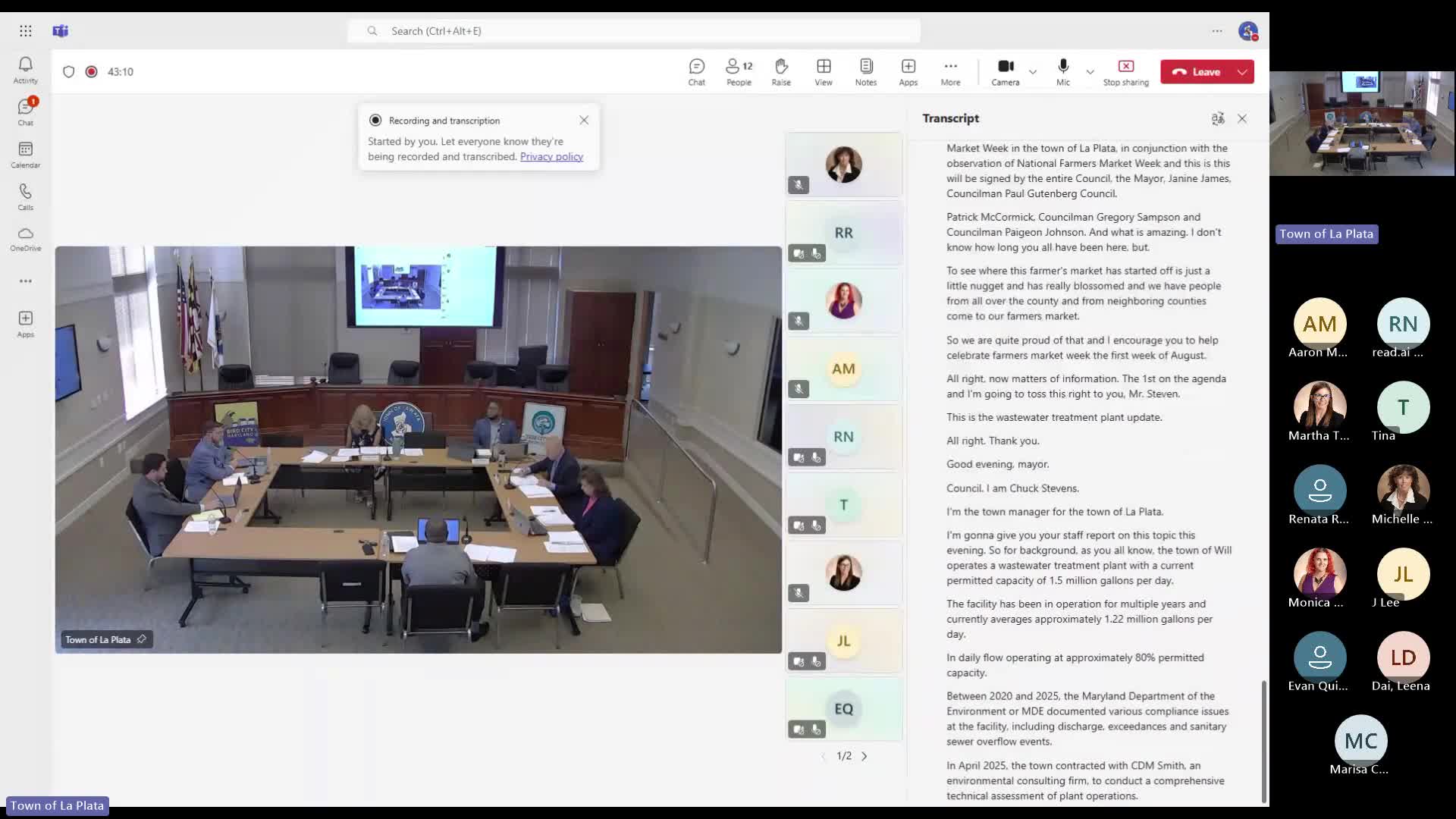
Summary
La Plata officials briefed the Town Council on wastewater-treatment plant compliance and infrastructure upgrades and agreed to advance an ordinance to seek up to $7.56 million in USDA-backed loans to reimburse major-facility funds used for recent improvements.
La Plata, Maryland — At its July 29 meeting, the Town Council received a technical update from Town Manager Chuck Stevens on the La Plata wastewater treatment plant and voted to move forward with legislation to pursue two USDA-backed loans to replenish funds used for recent plant upgrades.
Stevens told the council the plant’s current permitted capacity is 1,500,000 gallons per day and that the facility averaged roughly 1,220,000 gallons per day — about 80% of permitted capacity. He also said the town is “meeting our permit requirements for all parameters as of this report date.” The report noted that Maryland Department of the Environment (MDE) documented violations between 2020 and 2025, including discharge exceedances (copper, ammonia nitrogen, total suspended solids), sanitary sewer overflows in the collection system, and coliform exceedances tied to disinfection performance.
Why it matters: The plant’s past compliance problems, the town manager said, stemmed from three technical factors identified in a CDM Smith assessment: excessive inflow during heavy rainfall (peak flows reached about 2,980,000 gallons during significant rain events), capacity reduced when a module was taken offline for conversion and pilot testing (Module 1 offline Jan. 2023–Mar. 2024), and aging infrastructure (manual equalization-tank operation, tertiary clarifier limits, and frequent UV bulb failures). Stevens reported repairs to the equalization tank had just been completed: “repairs to that tank were effected yesterday, and that tank is now fully back in automatic operation,” he said.
The town is coordinating with MDE and working under a forthcoming consent order that will define compliance milestones, Stevens said. He also said the town maintains an operational partnership with Maryland Environmental Service (MES) for on-site operational support.
Funding and planned upgrades: Stevens reported CDM Smith was contracted in April 2025 for an amount not to exceed $20,000 and that current expenditures on that contract total about $15,862.50. Cost estimates for capital improvements to achieve sustained compliance are being developed. The town plans to finance required improvements from the major-facility fee fund; Stevens said the strategy is intended to avoid an immediate increase in utility rates or taxes, though he cautioned the town is not promising rates or taxes will never rise.
Council members discussed longer-term expansion plans: staff described a phased approach to raise treatment capacity to 2,000,000 gallons per day, with a later target of 2,500,000 gpd; Stevens said MDE has approved the town’s plans to expand capacity to 2,000,000 gpd once the programmed infrastructure improvements are complete. He added that the plant is designed to accommodate heavy rainfall surges and that, on a short-term basis, the facility can manage up to about 3,000,000 gallons over a four-hour surge when surge-handling systems — including the automatic equalization tank — are functioning.
USDA loan proposal: The council also discussed a legislative package to secure USDA-backed loans and introduced an ordinance to issue up to $7,562,000 in general-obligation bonds to obtain the financing. Staff described the bond structure as two series: $4,842,000 at up to 1.75% and $2,720,000 at up to 2.75%, each amortized over 40 years. The town would pledge its full faith and credit as a secondary guarantee and would maintain an annual short-lived-asset reserve deposit of at least $49,787. Stevens said the immediate objective is to reimburse the major-facility fee fund for prior work already paid from that fund and to restore the account so subsequent modules and capacity projects can proceed.
Public comment and next steps: Resident Michael Medatic, who lives downstream from the plant outflow, asked the council to consider a temporary moratorium on new sewer hookups until the compliance and capacity issues are resolved. Stevens and council members noted the need to balance development commitments already approved with infrastructure readiness and said a comprehensive water and wastewater study is underway and will be presented to council in September. Stevens also reported the town received a Clean Water Act notice from Potomac Riverkeepers and is evaluating it.
Stevens’ recommendation to council was to receive the presentation, continue coordination with MDE and consultants, and proceed with financing authorization so the town can reimburse the major-facility fee account and proceed with additional upgrades. Council signaled consensus to advance the USDA loan ordinance to the legislation calendar for further consideration.
Ending: Council members scheduled further deliberation on the loan ordinance for formal legislative consideration; staff said the town will post technical memos and MDE correspondence to the town website for public review and will report back after a planned MDE site visit.