
California takes delivery of final Firehawk helicopters, completing 16-aircraft upgrade
Get AI-powered insights, summaries, and transcripts
Subscribe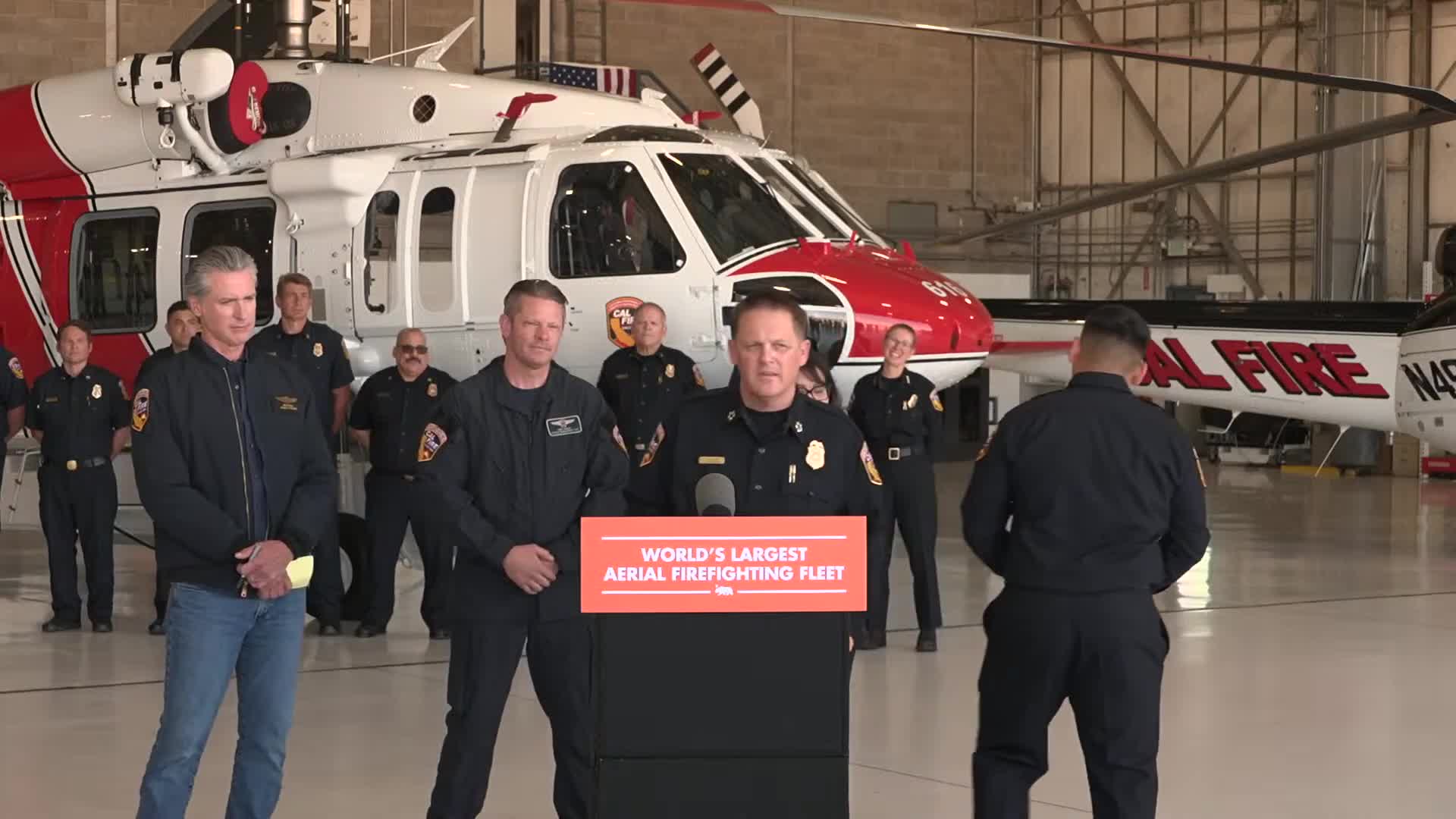
Summary
Gov. Gavin Newsom and CAL FIRE officials on Wednesday announced the arrival of the final two Firehawk helicopters, completing a 16-aircraft purchase intended to expand the state's aerial firefighting capacity, enable night operations and increase water-carrying capacity.
California on Wednesday announced the delivery of the final two Firehawk helicopters to the state's aerial firefighting fleet, completing a 16-aircraft procurement intended to boost fire suppression capacity and enable night operations. CAL FIRE Director Joe Tyler and Gov. Gavin Newsom introduced the helicopters at the Aviation Management Unit in Sacramento, saying the aircraft replace older single‑engine “Huey” helicopters and increase water capacity from roughly 325 gallons to as much as 1,000 gallons. “These helicopters are here to serve and support the people of California, both our residents and our visitors,” Tyler said. The acquisition began after devastating San Diego County fires in February 2003, Tyler said. State procurement work started in February 2015 and the first contract was signed in February 2018; United Rotorcraft of Centennial, Colorado, built the fire packages on Sikorsky airframes, according to remarks at the event. A ceremony was held July 15 at the United Rotorcraft facility, and Gov. Newsom said helicopter 616 landed at McClellan on July 24. The state placed Firehawks at helitack bases across California, with Newsom and Tyler listing Humboldt, Lassen, Mendocino, Lake, Santa Clara, Tehama, San Benito, Tuolumne, San Bernardino and Riverside counties; CAL FIRE also staffs an aircraft in San Diego under a cooperative agreement with the San Diego County Fire Protection District. Newsom said the state additionally contracts 24 helicopters that can be dispatched across California. CAL FIRE pilot and training team member Chris Renner described the maintenance and training investments required to field the fleet: “We have an outstanding maintenance team full of great aviation professionals,” he said, adding that many behind‑the‑scenes personnel make operations possible. Officials said the Firehawks provide faster, longer range, twin‑engine performance and a night‑fighting capability that the Hueys lacked. Newsom noted the scale of California’s aerial fleet: “There’s simply no jurisdiction in the world that has more assets at bear, more aerial assets than the state of California.” Newsom also said the state will retain a portion of the older Hueys for other work: “We’re keeping the old Hueys, at least 6 of them. We had 12. We’re sending another 6 back to the U.S. Forest Service. We’ll keep those 6 Hueys to do something that we’re also doing more of,” he said, referring to helitorch and prescribed burn efforts. Officials tied the helicopter procurement to the state’s broader wildfire strategy, which includes accelerated vegetation‑management projects under an emergency proclamation and expanded prescribed burn programs. At the event Cal OES Chief Deputy Director Tina Curry emphasized readiness and interagency coordination for all hazards and encouraged Californians to sign up for local emergency alerts. There were no formal votes or policy adoptions at the event. The announcements were presented as the culmination of a multiyear procurement and as part of ongoing state investments in wildfire prevention, suppression and readiness. Looking ahead, officials said the helicopters will be deployed as needed across the state for wildfire suppression and other missions, and that additional contracted aircraft remain available for surge operations.