
Selma council moves into closed session to review city manager applicants after resident challenges notice
Get AI-powered insights, summaries, and transcripts
Subscribe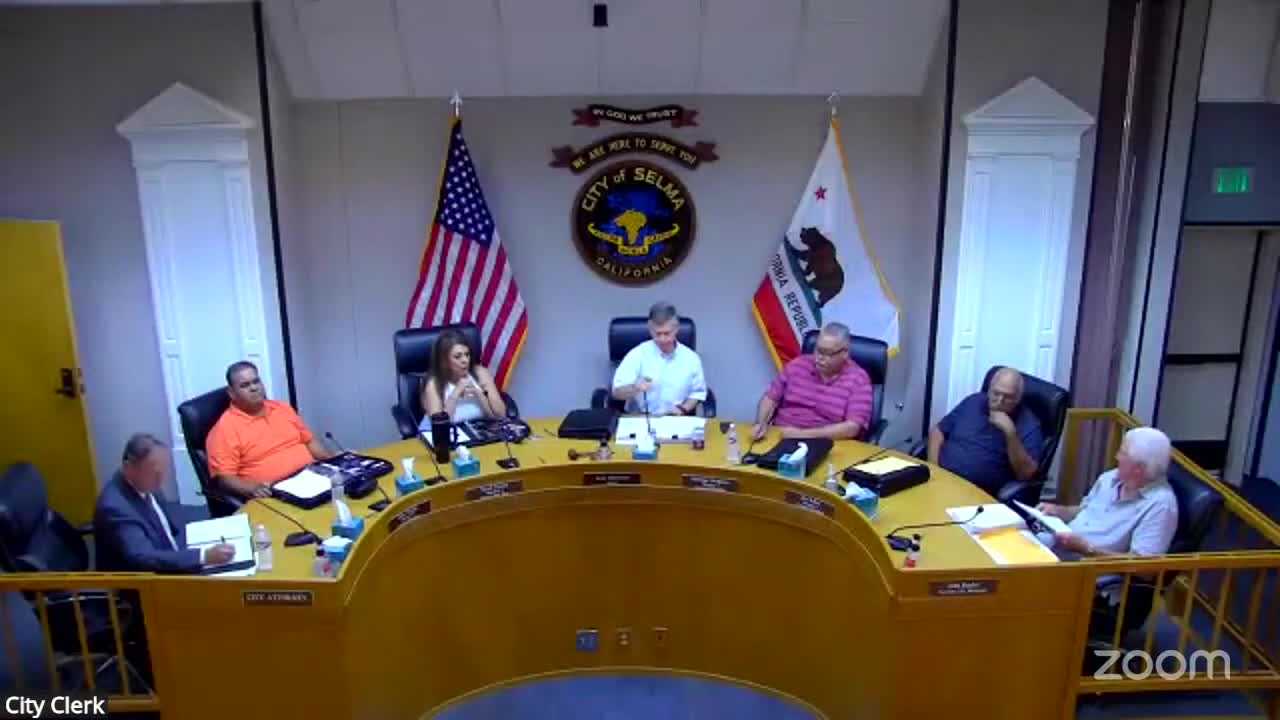
Summary
The Selma City Council convened a special meeting July 30, 2025, to go into closed session to review city manager applicants. A resident objected that the meeting was improperly noticed and said they would file a complaint; the city attorney defended the council's authority under state law.
Selma City Council convened a special meeting July 30, 2025, at 11 a.m. and moved into closed session to review qualified applicants for the city manager position under California Government Code section 54957, officials said.
The matter matters because it concerns the selection of the city manager and the council’s use of a special meeting and closed-session authority amid a public challenge to the meeting notice.
Staff announced the meeting at the Selma City Council Chamber and said two closed-session items had been set aside, citing a government code provision for attorney-client or litigation matters and Government Code section 54957 for public employment. A resident who addressed the council during oral communications said the special meeting was improperly noticed and asked the council to postpone. The resident said, “Special meeting is designed for an emergency situation which cannot wait until its next regularly scheduled meeting, which I believe is on the fifth for you. Government code 54957 simply gives the council the ability to hold a closed session because the agenda states that all employees, all classification, there's no indication of what's gonna be discussed. The only employment matters that can be discussed in closed session are the appointment of a public employee that's under the council jurisdiction, and you must employ, identify the employee classification, the dismissal of a public employee under council jurisdiction, which also must be identified, anticipation of litigation by an employee, initiate anticipated initiation of a litigation towards an employee or negotiations, none of that is listed in the council agenda, and you must identify the group if you're going to do so.” The resident added, “Short of that, it it will end up with an unfair labor practice. I'll I'll I'll file it this afternoon. I'll file a complaint with the secretary of state for an improper notification. And if it rises to it, then I'll contact the grand jury as well.”
The City Attorney responded to the objection, saying the council’s authority to discuss employment matters in closed session is broader than the resident asserted: “Your ability to discuss employment matters in closed session is not nearly that limited. We're discussing an employment matter that affects the entirety of the city's employees. That's what we're discussing. And 54957 plainly authorizes that.”
A staff member monitoring the phone line reported no participants requesting public comment online and the council then convened to closed session. The public portion of the transcript contains no reportable action or vote on the record.
Because the discussion moved to closed session, the transcript does not show any decision, appointment or vote on the city manager matter in open session; the only public actions recorded in the available transcript are the announcement of the closed-session items, a resident’s procedural objection and the city attorney’s response.