Get Full Government Meeting Transcripts, Videos, & Alerts Forever!
Get email alerts on the Overdose Prevention Sofr Coordinator topic
No spam. Unsubscribe anytime.
Local prevention group seeks funding for SOFR coordinator to speed overdose‑death reviews
Summary
Upstream Prevention told the Johnson County Opioid Advisory Board it wants funds to hire a part‑time coordinator to run its Suicide and Overdose Fatality Review (SOFR) team, improve follow‑up on recommendations and pursue a possible state match for transportation support.
Upstream Prevention asked the Johnson County Opioid Advisory Board on July 23 for money to hire a part‑time coordinator to run the county’s Suicide and Overdose Fatality Review team and help implement its recommendations.
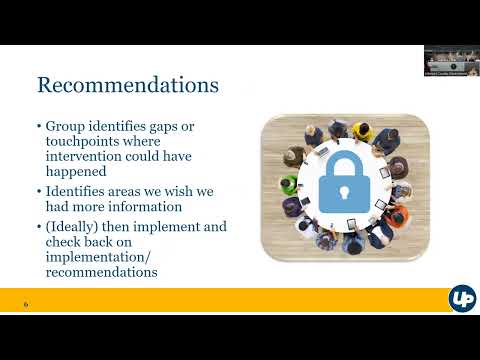
The SOFR team reviews recent overdose and suicide deaths to identify missed opportunities for prevention and produce policy and program recommendations. "Our mission is to fix that bridge," said Kathleen Ratcliffe, executive director of Upstream Prevention, using an upstream/downstream analogy to describe systems work. She said the team meets about 10 times a year, reviews two to three recent deaths per meeting and shares recommendations that local partners can act on.
The nut of Ratcliffe’s request was operational: she asked for funds to post a part‑time position to compile case information, coordinate partners, run meetings and follow up on recommendations. She said those follow‑up tasks have fallen on her and have limited the team’s effectiveness over the last six months.
SOFR has produced tangible changes, Ratcliffe told the board. She said EMS departments now leave a resource packet after nonfatal overdoses, Johnson Memorial Hospital (JMH) can refer patients to a peer recovery coach or community health worker, naloxone and test strips are more widely available countywide, and a local recovery café received first‑round funding. Ratcliffe said those actions grew out of SOFR recommendations because the team includes decision‑makers from law enforcement, hospitals, EMS, treatment providers and public health.
Ratcliffe described several priorities she hopes the coordinator would advance: formalizing next‑of‑kin interviews (currently discussed but not implemented due to capacity), expanding communication tools across agencies (she referred to a shared records platform called the Gulata platform), strengthening bereavement and traumatic‑grief supports, and pursuing a state RFP for transportation funding that requires a local match.
Board members asked clarifying questions. Jennifer Price (Franklin City Council) confirmed that Upstream already has an Indiana Department of Health overdose‑prevention grant (the Indiana Cares ECHO grant, roughly $95,000 annually) and that the state recently released a competitive RFP for opioid settlement funds requiring local match. Ratcliffe said the ECHO award is expected to continue through next August pending federal and state contracting delays. Pamela Burton (Johnson County Council) and other members pressed on volunteer status and sustainability; Ratcliffe said most partner attendees participate while on their employers’ time and that the coordinator could be supported with continuing grant funds, pooled sponsorship from major partners, or matched state funds if the county applies.
No formal decision was taken. The advisory board indicated it will review Upstream’s request and include recommendations when it presents funding proposals to the Board of Commissioners on July 28.
Ratcliffe closed by saying the coordinator would increase the SOFR team’s meeting efficiency and, more importantly, ensure the team follows up on recommendations that have led to immediate operational fixes in the past.