
City engineer reports water use, rights and new projects; council presses for timeline on safe-yield gaps
Get AI-powered insights, summaries, and transcripts
Subscribe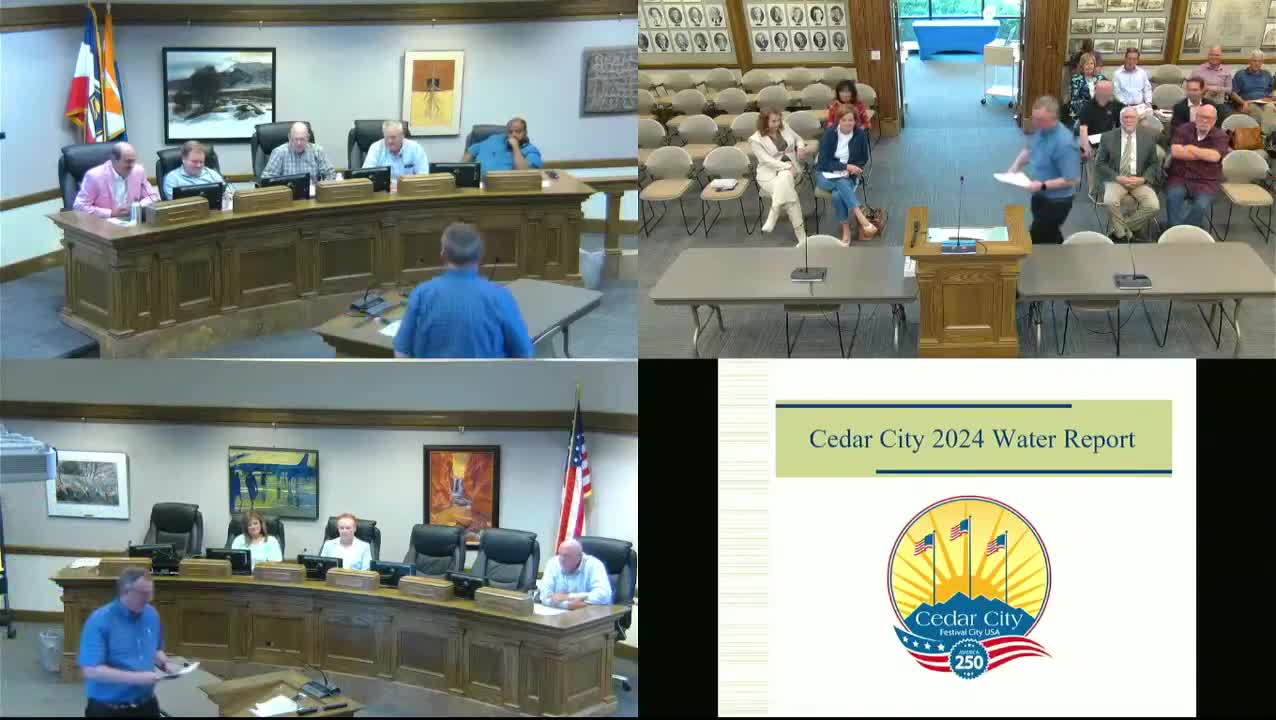
Summary
Cedar City’s engineering department presented its 2024 water report on July 30, saying per-capita use rose to about 200 gallons per person per day while outlining new well tests, chlorination steps and water-rights totals.
Cedar City’s engineering department presented its 2024 water report on July 30, telling the council the city’s per-capita water use rose to about 200 gallons per person per day last year but remains on a long-term downward trend when normalized for two decades of growth. City Engineer Jonathan Stouth told the council the city’s portfolio of water rights currently totals about 25,261 acre-feet across multiple source types and basins. Stouth reviewed “safe yield” categories, explained which rights are subject to future groundwater-management reductions and noted the city’s recent purchases of pre-1934 rights to improve long-term reliability. Stouth described near-term projects: the BLM production well recently finished construction and test-pumped to about 1,400 gallons per minute; samples had been taken and results were pending. A Martin’s Flat test well drilling contract was about to begin and a pilot filtration study for Cedar Canyon continues. He also outlined work on a chlorination plan: the state is requiring systemwide chlorination timing and the city plans a temporary chlorination system at the Cross Hollow tank to allow more consistent disinfection coverage while staff coordinate phased implementation. Council members pressed staff for a timeline and asked for an updated analysis showing when projected groundwater cuts under the state groundwater-management plan could cause the city’s safe yield to fall short of demand as growth continues. Stouth said an updated assessment could be produced; councilmembers asked for scenarios tied to the 2035/2040/2060/2070 staged cuts referenced in the discussion. The report also described aquifer trends: certain monitoring wells continue to decline (two to 2.5 feet per year in the Quichapa area) despite recharge projects, and recharge tends to be concentrated nearer the airport and not evenly distributed across the basin. Peak-day usage in 2024 reached 16.5 million gallons per day; the 10-year average had been roughly 14.8 million gallons per day. Staff noted construction and dust-control meters also raise summer demand. Stouth and council members described coordination with the Water Conservancy District and Enoch to create an interlocal approach to pressure-zone redesign and shared infrastructure that could reduce duplication and lower costs. Stouth said modeling by consultants will be needed to finalize a plan that would move the district pressure zone to a single elevation band with pumps and valves placed at strategic nodes. Stouth encouraged conservation and said the city is pursuing additional wells to add redundancy. He also noted the city is tracking recharge volumes (about 2,800 acre-feet of recharge reported last year via the Conservancy District) and that reuse/effluent return is part of the long-term supply picture. Council members asked staff to return with updated water-rights analyses showing when cuts could create a gap between supply and demand.