
Utah Division of Water Rights outlines Great Salt Lake distribution plan, ties curtailments to June 15 lake elevation
Get AI-powered insights, summaries, and transcripts
Subscribe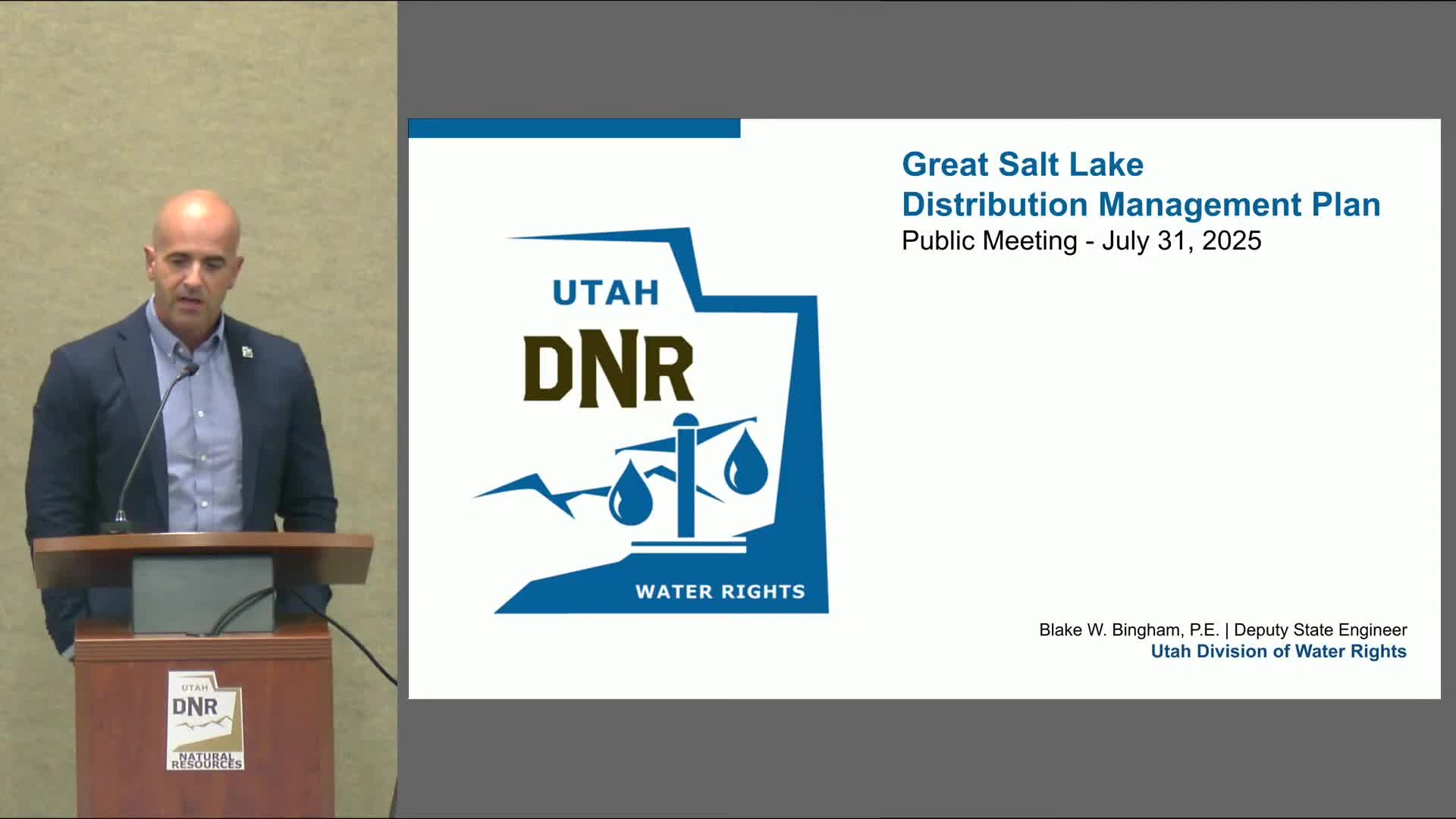
Summary
SALT LAKE CITY — Utah Division of Water Rights staff on July 31 presented a draft Great Salt Lake Distribution Management Plan that would curb or allow mineral-extraction diversions based on a priority schedule triggered by the South Arm mean daily elevation measured on June 15 and applied the following calendar year.
SALT LAKE CITY — Utah Division of Water Rights staff on July 31 presented a draft Great Salt Lake Distribution Management Plan that would curb or allow mineral-extraction diversions based on a priority schedule triggered by the South Arm mean daily elevation measured on June 15 and applied the following calendar year.
The plan, introduced at a public meeting by Teresa, State Engineer, Utah Division of Water Rights, and presented in detail by Blake Bingham, Deputy State Engineer, defines “Great Salt Lake water rights” (mineral-extraction rights within the lake), describes “dedicated water” (water changed for beneficial use on sovereign lands under Utah Code 73-3-30), and publishes a distribution accounting tool that the division says will track dedicated water deliveries, evaporation losses and available diversion volumes.
Why it matters: the plan formalizes how the state will apportion limited lake-connected water to mineral-extraction rights and to water dedicated to the lake, and it establishes reporting and measurement expectations intended to improve transparency about how much water enters and remains in the lake.
Blake Bingham described the two main controls in the plan as the underlying water-right priority date and a tiered set of lake-elevation thresholds. "When we talk about apportioning water rights in the Great Salt Lake, we're really looking at two critical factors: the priority date of the underlying water right and a certain tiered elevation of the lake," Bingham said. Under the proposed schedule the division will measure the South Arm mean daily elevation as recorded by the U.S. Geological Survey gauge at Saltair Boat Harbor on June 15 of each year; that measurement will determine which priority tranche applies beginning Jan. 1 of the next year.
The draft includes a set of elevation tranches (for example, below 4,193 feet; 4,193–4,194.9 feet; 4,195–4,197.9 feet; 4,198–4,199.9 feet; and 4,200 feet and above) and lists which Great Salt Lake water rights are authorized to divert in each tranche. Bingham said the table is arranged from most senior to most junior rights and that rights falling outside the applicable elevation range will be curtailed for the calendar year. "Water rights that fall outside the elevation range listed in the priority schedule will be curtailed that calendar year," he said.
The plan separately treats "dedicated water" — rights converted via change application under Utah Code 73-3-30 for beneficial use on sovereign lands — and records them in the accounting model. Bingham said dedicated water is not available for diversion by Great Salt Lake mineral-extraction rights once it has been moved into the lake. The division's accounting reports show about 161,000 acre-feet of dedicated water currently tracked in the model and note a 26,000‑acre-foot conversion associated with a Compass Minerals change application and voluntary arrangement.
Voluntary arrangements between mineral operators and the Utah Division of Forestry, Fire and State Lands (DFSL) are incorporated into the plan where there is an approved change application tied to the arrangement. Bingham said the Compass Minerals arrangement is the only voluntary agreement currently approved with a change application, and that other voluntary arrangements exist and in some cases have pending change applications. "The incentive for entering into these voluntary arrangements ... is that it excludes them from the priority schedule," he said, describing that dedicated portions may be protected from the curtailment schedule in exchange for protections or commitments to the lake under the change application.
The division also demonstrated a public distribution accounting tool that uses USGS gauges and bathymetry to estimate lake volume, evaporation and salinity, and to show which rights are "on" or "off" for a given year. Bingham said the tool uses the south-arm elevation for the priority schedule but uses both north- and south-arm data to estimate lake volume and evaporation, noting some limitations in available continuous salinity monitoring on the north arm.
On measurement and compliance, the draft reiterates statutory measurement and reporting requirements and adds that the division expects physical measurement (metering) rather than operator runtime estimates in cases where operators had been estimating diversions. "This will require physical measurement of the water," Bingham said. The plan also notes existing reporting obligations to other agencies such as the Utah Department of Environmental Quality and DFSL.
Timeline and administrative directions: the division mailed notice of final adoption on July 31 to meet a 60‑day notice requirement; staff said adoption is scheduled for Oct. 1, and that management under the priority schedule will be applied beginning Jan. 1, 2026, using the June 15, 2025 south-arm elevation. After adoption there will be a 60‑day statutory complaint period in which interested parties may file in district court.
During Q&A, attendees asked how the elevation thresholds were chosen and whether voluntary agreements override the priority schedule. Bingham said the elevation thresholds were informed by previously developed plans and voluntary arrangements, including benchmarks used by DFSL and the Great Salt Lake strategic planning efforts, and reiterated that a voluntary arrangement affects a right's priority only if there is an approved change application tied to that arrangement. He also clarified that a priority date is tied to the application filing date, not the approval date.
The draft plan allows the division to incorporate administrative updates — such as newly approved change applications and ownership updates to Great Salt Lake water rights — into the plan's tables and the online accounting tool without undergoing a formal plan-amendment process, so the published lists remain current.
The division urged stakeholders to review the live accounting tool and the draft plan on the Division of Water Rights website and to submit written comments by the channels listed on the plan landing page. Bingham said the tool is intended to improve transparency and provide a common dataset for conversations about dedicated water and extraction availability.
For more information or to submit comments, the division directed attendees to the Great Salt Lake Distribution Management Plan landing page on the Utah Division of Water Rights website, where the draft plan, voluntary-arrangement documents and the distribution accounting tool are published.