
DRCOG staff outlines 2050 regional transportation plan project solicitation, scoring and timelines
Get AI-powered insights, summaries, and transcripts
Subscribe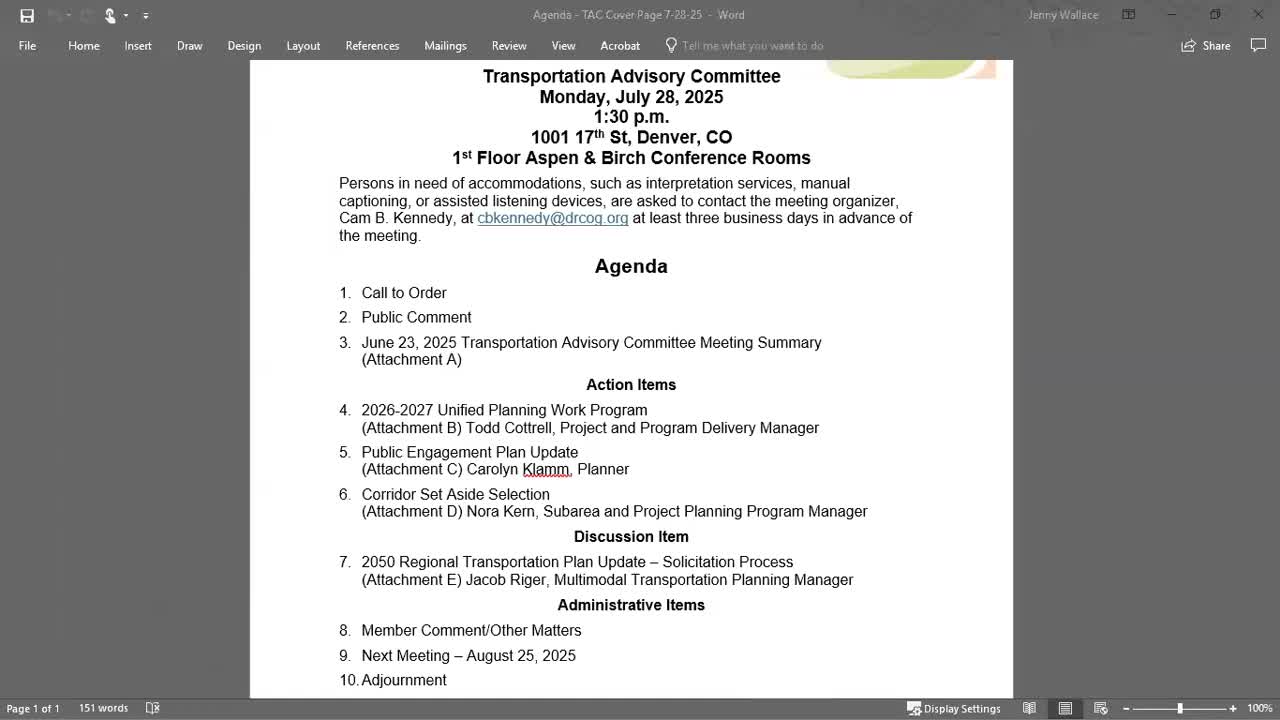
Summary
DRCOG staff presented the solicitation and evaluation process for the 2050 Regional Transportation Plan update, calling for candidate project submittals late August–October, scoring projects against Metro Vision objectives, RTP priorities and federal performance measures, and requiring public‑sector sponsorship.
DRCOG staff presented an informational update on July 28 describing the candidate project solicitation and evaluation process for the 2050 Regional Transportation Plan update. The item was informational; TAC did not take action but provided feedback on process design and schedule.
Jacob Reager presented the process on behalf of Alvin Bedell Sanchez, who led the work but was absent. Reager said the RTP update will combine identified projects, program categories and a financial plan to produce a fiscally constrained 2050 plan. He explained two project types: (1) regionally significant projects that federal air quality conformity requires the MPO to list individually (roadway widenings, interchanges, fixed guideway rapid transit), and (2) program/project funding categories for smaller or locally defined investments.
DRCOG will carry forward projects already under construction, in NEPA, or with funds in the TIP/STIP; those sponsors do not need to resubmit them. Everything else — conceptual projects, corridor planning items, projects in early study phases — should be submitted as candidate projects. Reager said projects that are complete this year do not need to be included; projects with active NEPA or construction funds in the TIP/STIP will be carried forward automatically.
The call for projects will open approximately late August and remain open through about October 10. DRCOG will use an online Formstack application for submissions. Only public agencies (municipalities, counties, CDOT and RTD) may submit candidate projects; RTD will be the sponsor for FastTrack rail projects and toll highway authorities must sponsor toll road projects.
Evaluation will combine three inputs: RTP priorities (six regional priorities), Metro Vision objectives (an eight‑point component in the proposed rubric), and applicable federal Transportation Performance Measures. DRCOG staff will score submissions and convene a regional review panel composed of DRCOG, CDOT, RTD and appointees from each county subregional transportation forum. The panel’s scoring and interagency coordination will inform draft investment priorities that TAC will consider in December and that will move to the Regional Transportation Committee and Board early next year for adoption and fiscal constraint work.
Members asked technical and procedural questions. Jessica Micklegloss (CDOT) asked about whether unused submittal slots from one county could be reallocated; Reager said unused slots would generally not be redistributed but that forums can coordinate and that DRCOG wants to receive submissions from multiple forums for multi‑jurisdiction corridors. Jessica also asked about NEPA reevaluations and whether those projects would be carried forward; staff invited follow‑up coordination. Multiple members asked about how greenhouse gas and federal air quality conformity relate; staff clarified that federal air quality conformity addresses criteria pollutants in the state implementation plan and is distinct from Colorado’s transportation greenhouse gas rule; greenhouse gas work is a state requirement and DRCOG will treat both in the planning work though they have separate technical processes.
Reager said DRCOG will publish a draft carry‑forward project list in the packet and invited jurisdictions to flag any inaccuracies before the call for projects. He also noted that DRCOG will develop the financial plan in parallel with the project solicitation to enable staging and fiscal constraint decisions.
The committee did not take formal action; DRCOG staff requested informal consensus to proceed with the described schedule and evaluation approach.