
State fire managers warn fire season is ongoing, urge public caution as resources are held for local defense
Get AI-powered insights, summaries, and transcripts
Subscribe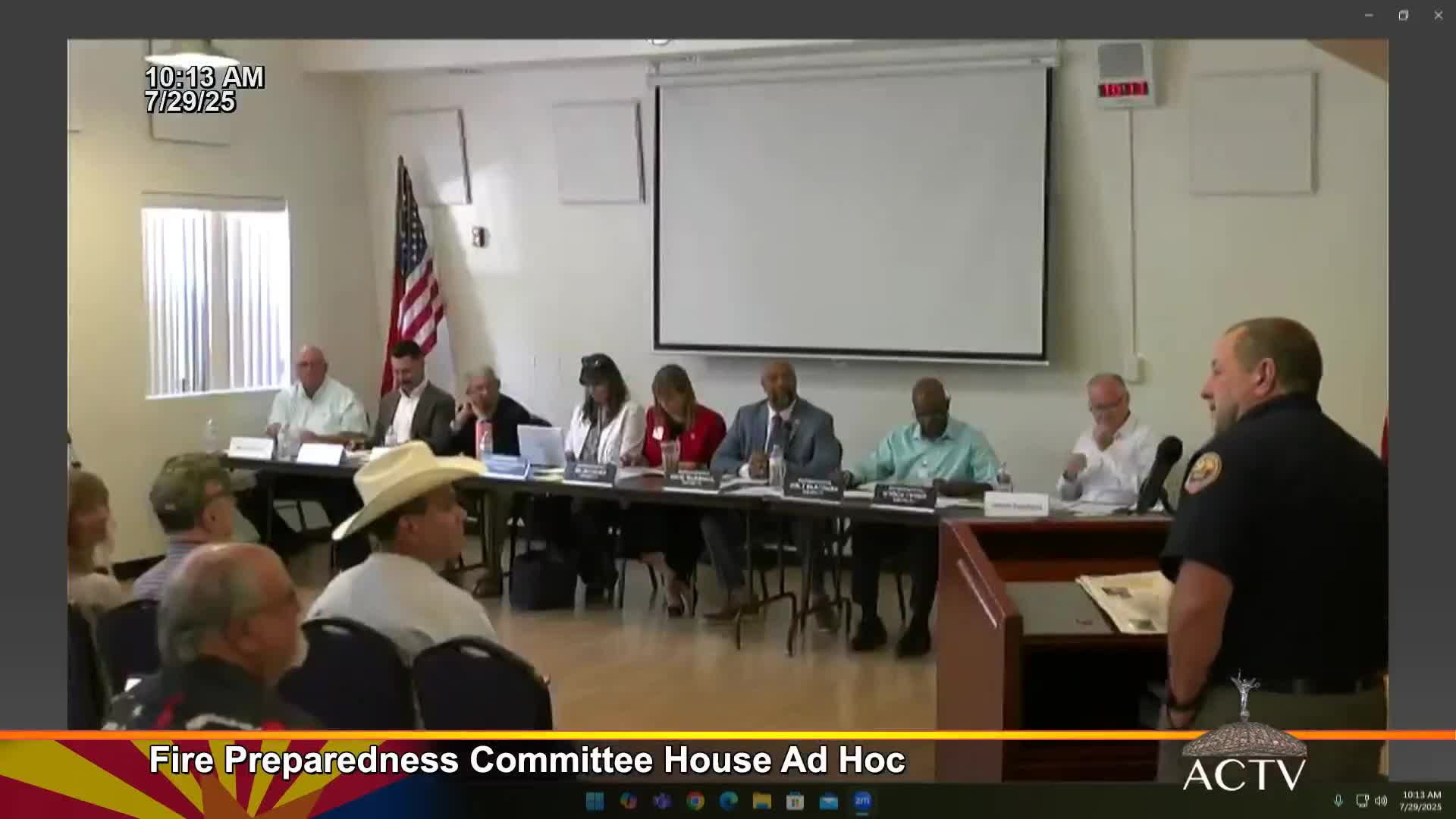
Summary
Arizona Department of Forestry and Fire Management officials told the House Ad Hoc Committee on Fire Preparedness that the state remains in an active fire season, with national demand for resources increasing and a decision to hold some engines in-state for local defense.
John Truitt, state fire management officer for the Arizona Department of Forestry and Fire Management, told the House Ad Hoc Committee on Fire Preparedness that Arizona remains in an active, extended fire season and the department is keeping some resources in the state rather than deploying them elsewhere. "We can anticipate here at home that we have to hold some of our folks in ready reserve," Truitt said. He added that national and regional demand is rising and that preparedness levels (PL) are increasing across the West.
Truitt told legislators the department had recorded 913 fires this year and 122,000 reported state acres burned, a total that does not yet include federal acres. He described the Dragon/Bravo incident as a rapidly growing, dangerous fire with almost 50,000 acres of growth over four days and said mixed-conifer terrain made it unsafe to place firefighters on the front edge. "You cannot put our firefighters in harm's way," he said, noting an eight-mile run of fire in tall timber during a recent wind event.
The chief described how PL levels work and how they determine resource allocation. He said state PL levels combine fuel, resource availability and other science-based inputs; regional PLs cover multi-state areas; and the national PL, set by the National Interagency Coordination Center, guides allocation of national teams, hotshot crews and aircraft. "As you get into PL level 3, 4, and 5, now that starts to trigger our resource availability, our resource drawdown," he said.
On staffing and equipment, Truitt said DFFM has about 75 permanent fire positions statewide and roughly 120 seasonal positions when fully staffed. He told the committee his agency relies heavily on local cooperative fire departments and is “very, very stretched.” Regarding engines, he said roughly 25 state engines were assigned to incidents in the western U.S., on 14-day rotations, and that Arizona is staging resources to ensure local defense capability.
On funding, Truitt said the department has received new state dollars transferring through WIFA: $30 million for fire suppression going forward and an additional $11.2 million to pay past federal invoices dating back to 2021. "The 11.2 has come through from WIFA...it will be used to pay federal invoices from previous fires, and the $30,000,000 has been received, and that is to fund future fires," he said. He also acknowledged that larger capital purchases would require additional legislative approval.
Committee members pressed for public explanation of terminology and process; Truitt answered questions about PL levels, the role of geographic area coordination centers (GACCs) and the drawdown decision to hold some resources in Arizona. He emphasized that many fires this year are human-caused and urged continued public awareness and caution: "Public awareness of being fire safe during these times...is a very important message that our PIO constantly promotes."