
Conway committee reviews proposed sales-tax bond to fund public safety, streets and new visitor projects
Get AI-powered insights, summaries, and transcripts
Subscribe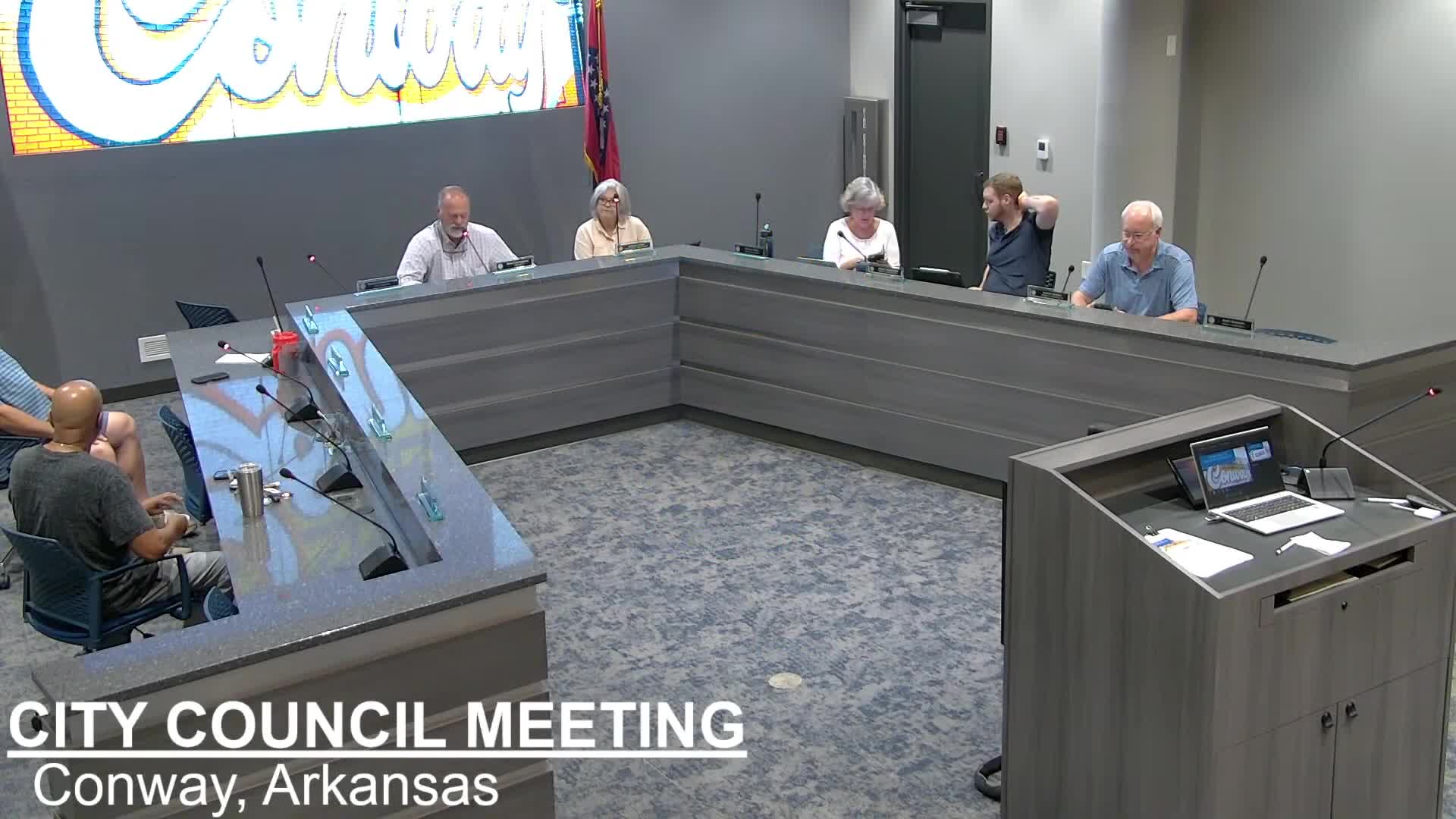
Summary
City officials and residents discussed a proposed local sales-tax bond that would add up to three‑eighths of a cent to finance public-safety capital, street maintenance and destination projects including a 12,000‑capacity music pavilion, a 40,000‑square‑foot convention center, an Oak Street theater renovation and a Lake Conway boardwalk.
Jamie Gates, a presenter at a Conway City Council committee meeting, outlined a proposal to use a local sales‑tax bond to pay for public‑safety capital, street maintenance and several visitor‑oriented projects intended to grow Conway’s sales‑tax base.
Gates said the package is framed as two parts: roughly three‑eighths of a cent to cover essential capital needs (“protect, pave, and prepare”) and another three‑eighths of a cent to build destination‑quality civic infrastructure. “Three eighths of a cent to protect, pave, and prepare,” Gates said while describing the funds’ uses and the rationale for growing Conway’s taxable trade area.
The presentation included construction budgets and consultant estimates for four priority projects: a Central Arkansas Music Pavilion (presented as a $35 million build with a 12,000 capacity, and a conservative year‑one direct‑spending estimate of about $26 million for 24 promoted shows), a Lake Conway North Shore Boardwalk (phase 1 estimated at $10 million and a conservative 50,000 annual visitors), a Grand Theater renovation (about $8 million for a 320‑seat live performance venue), and a 40,000‑square‑foot Conway Convention Center (about $25 million construction budget; the presenter’s year‑one model projected roughly 52,000 visitors and $15 million in indirect spending).
Gates summarized the consultant estimates for the four projects combined as roughly 312,000 visitors and $43 million in direct spending in year one and about 418,000 visitors and $66 million in direct spending by year five if Conway adopted a median peer rate and the projects met the consultant assumptions. He said the package is designed so the destination projects would not increase general‑fund operating costs because each would be operated under a third‑party contract or operator model.
Council members, staff and outside participants raised legal, financial and operational questions. Bond counsel and city staff explained that ballot language can be broad — for example “within the city” — but projects funded with tax‑exempt bonds generally require that the city own or have a long‑term lease on the site before bonds are issued. Staff said the city would have about five years to issue the bonds after a successful vote and that IRS rules generally require bond proceeds to be spent within about three years after issuance.
Council members asked how revenue and bond proceeds would be allocated. City staff presented the administration’s working numbers: each one‑eighth of a cent in local sales tax would generate about $2.5 million in annual revenue under current collections; three eighths could under current market conditions be expected to finance roughly $100 million in bond proceeds over 30 years under the assumptions used in the presentation. Staff estimated one‑eighth would support roughly $33 million in bonded capacity (presenter’s figures rounded to the nearest million in council discussion).
Several council members and residents urged that a larger share be allocated to public safety than the preliminary model showed. Councilmember Ledbetter and several speakers cited the fire department’s equipment and staffing needs — including replacement air packs and a new station — and argued that one‑eighth of a cent would be insufficient. Firefighter Ryan Wolf said the department is losing experienced staff and “we don't have the bullets and the gun to attack issues with fire department salaries and staffing,” warning that capital dollars do not directly fill salary gaps.
Other public speakers supported the plan’s economic development aims. Jerry Adams, vice chair of the Conway Development Corp., said the projects are “common sense options” used by peer cities to grow visitor spending. Grace Raines, who serves on the downtown partnership board, cited studies she said show downtown cultural investment multiplies local spending and argued that the proposed projects would bolster downtown businesses.
Staff and council members also flagged other project‑specific operational implications: a potential new district court building would trigger a recently passed state law on court funding effective Aug. 5 (staff recommended an agreement with Faulkner County before moving forward); a parking deck’s funding and usage (free vs. paid parking) can affect whether tax‑exempt bonds are permissible and may create ongoing maintenance costs; and a convention center’s viability depends on an adjoining full‑service hotel and a qualified operator to market events.
Gates and staff recommended issuing requests for proposals (RFPs) and management contracts after the council decides the ballot language and project list; staff noted that RFPs, MOUs and management contracts are constrained by state and federal municipal‑bond rules and that successful bids and site deals typically must be negotiated after a vote but before bond issuance.
The committee did not take a vote on bond questions. Councilmembers set a schedule for more public committee meetings and added that bond counsel and city legal staff will be brought into upcoming sessions to refine ballot language, ownership and operational terms. Several council members said they wanted more detailed cost breakdowns, RFP language and site options before deciding whether to place questions before voters.
What’s next: staff and council expect further committee meetings in August to refine project scopes, firm up ballot language with bond counsel, and develop RFPs and site agreements; any recommendation to send a bond question to voters would require additional council action and legally prescribed ballot wording.
Ending: The committee meeting closed after roughly two hours of presentation, questions and public comment; no formal action was taken and the council scheduled more meetings and outreach before any potential November ballot placement.