
St. Louis outlines phased rollout of Rams settlement for tornado recovery; residents press for housing, debris removal and transparency
Get AI-powered insights, summaries, and transcripts
Subscribe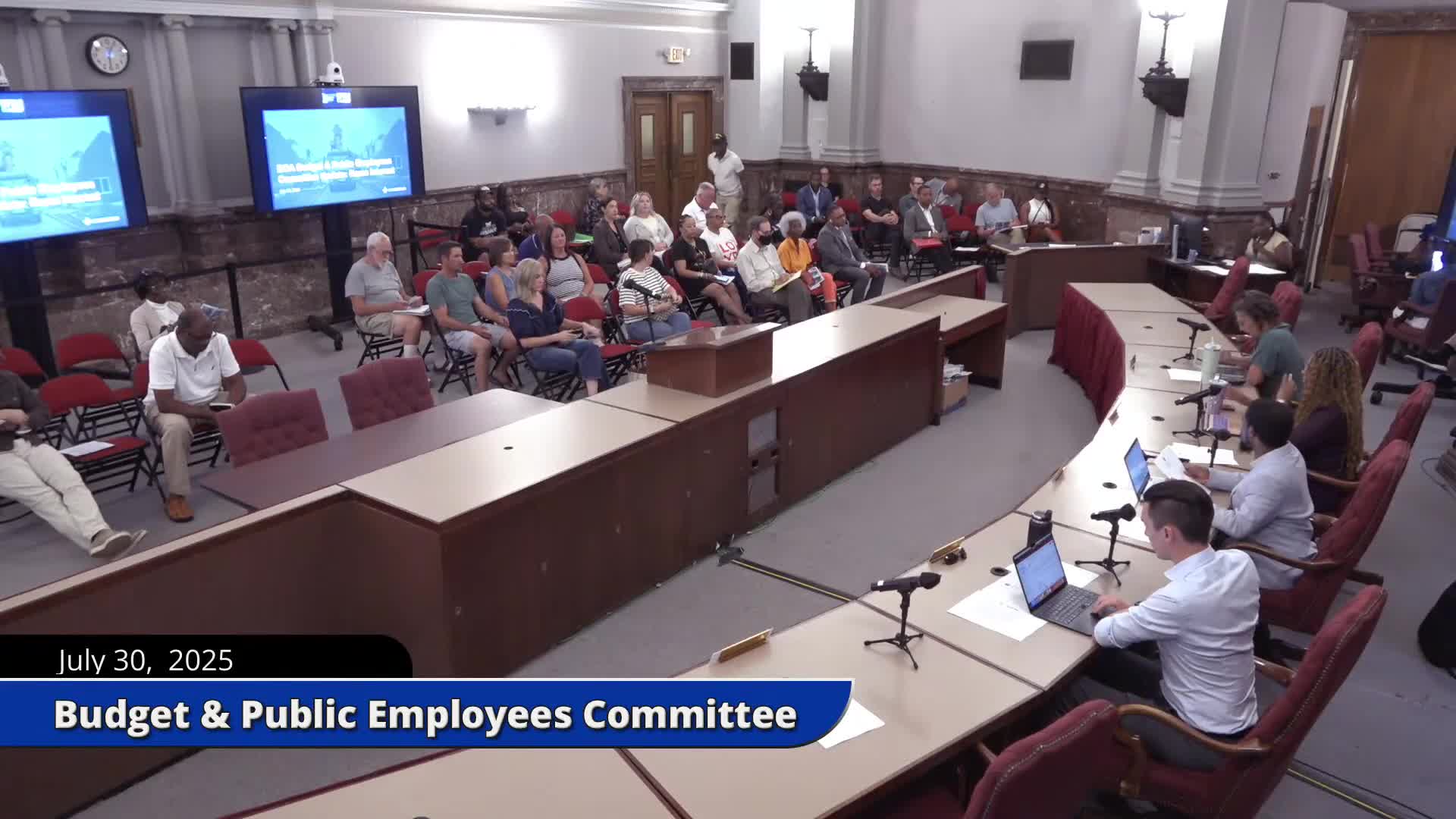
Summary
At a July 30 Budget & Public Employees Committee meeting the mayor’s recovery office outlined a phased plan to spend a $30 million Rams settlement for tornado relief. Presenters described multiple funding phases and programs; residents and nonprofit leaders pressed for faster spending, temporary housing, debris removal and clearer accounting.
At a July 30 meeting of the Board of Aldermen’s Budget and Public Employees Committee, Julian Nicks, the mayor’s chief recovery and neighborhood commission officer, presented the first monthly accounting and a phased rollout plan for the funds described in the Rams settlement and related recovery accounts.
Nicks told the committee the city is treating recovery in three stages—response, restore and rebuild—and described an initial, multi‑phase plan to distribute money from the Rams funds alongside other federal, state and philanthropic aid. He said some programs would begin in August and others would roll out through December, and he urged continued coordination with nonprofit partners and the city’s Board of Estimate and Apportionment on contracts and distributions.
Why this matters: The city faces urgent housing and public‑safety risks in neighborhoods damaged by the May tornado, and committee rules written into the ordinance that enacted board bill 31 require monthly public reporting on spending and outcomes. Community groups at the meeting said hundreds of residents remain displaced, argued that current programs move too slowly, and requested clearer, faster use of the settlement dollars so people can return to housing before winter.
Key elements of the mayor’s presentation
Julian Nicks said the city’s recovery office has broken the work into three phases: immediate response, a 1–2 year restoration period and a longer rebuild phase. He described a multi‑phase allocation tied to the Rams settlement funds and other sources:
- Phase 0 (under way): about $2.1 million for resource hub operations (procurement and distribution of supplies), cooling/hydration operations and essential equipment.
- Phase 1 (launching in August): approximately $5.75 million, including $3.75 million in emergency grants for nonprofits that have been providing direct aid and $2 million to stand up home‑repair programs.
- Phase 2 (planned later in the summer): about $9.15 million for disaster case management, legal supports, mental‑health services, additional home repair and related services.
- Phase 3 (target: December): an unmet needs fund linked to broader case management. Nicks also said roughly $12 million of the settlement remained under discussion for uses including intermediate housing, private‑property debris removal and staffing for the recovery office.
Nicks emphasized the limits of the Rams funds relative to assessed needs and described other funding sources being pursued or available: FEMA individual assistance and public assistance, SBA loans, a Missouri Department of Public Safety appropriation that the state had set aside for the city, a $25 million Missouri Housing Development Commission emergency housing allocation and $15–$20 million the city has already spent on emergency response operations (staff overtime, debris removal and warehousing), which the administration said it is still reconciling.
How funds will move and procurement
Nicks said city procurement rules apply to contracts and that, where appropriate, the administration is planning to use a fiscal agent to speed distribution and manage grants more quickly than standard city contracting alone would allow. Committee members pressed for a clearer schedule and an accounting of contracts and reimbursements; Nicks said ENA agenda items and procurement packages to distribute some grants would appear soon.
Public comments and demands
More than two dozen residents and nonprofit leaders spoke during the public‑comment portion. Themes included urgent requests for: faster debris removal on private property, clearer and earlier funding for transitional housing so residents do not leave the city, reimbursement for grassroots groups that have been using their reserves to operate hubs and immediate small grants for household stabilization.
"We are in a dire state where it has been 75 days since the tornado struck the city of St. Louis, and there is not a solution to keep people housed in city limits," said Kayla Reed, executive director of Action St. Louis, describing volunteers’ sustained work and urging quicker use of Rams funds for housing and nonprofit reimbursements.
Residents and contractors repeatedly described stalled or uneven debris services, removed dumpsters in some alleys, and long waits for city pickup; several speakers asked how nonprofit‑run hubs and grassroots organizations would be reimbursed for out‑of‑pocket expenses. Julian Nicks said portions of the announced grants will allow reimbursement of recent expenditures and that the city was building data‑sharing arrangements to coordinate case management and needs data with nonprofit partners.
Questions of transparency, timing and housing
Committee members and many public commenters asked for a more explicit schedule and a public accounting of money already spent. Nicks said the administration is working with the comptroller’s office to refine line‑item reporting and would provide more detailed figures at future committee meetings. He also acknowledged that FEMA and HUD support has not covered every need the city faces, and said the administration is pursuing federal and state options while planning to act in parallel—"doing both"—in case federal help is delayed or does not arrive.
Committee action and next steps
The committee did not vote on new grants or ordinances at this meeting. The agenda did include and the committee approved the minutes from the June 6, 2025 meeting (motion moved by "the alderwoman from the seventh," seconded by "the alderman for the ninth," roll call recorded five aye votes). Nicks said some contracts and the fiscal‑agent arrangement to distribute the $3.75 million in nonprofit emergency grants would be placed on ENA agendas imminently and that the recovery office would return monthly to this committee with updates.
Votes at a glance
- Approval of minutes from June 6, 2025 — Motion to approve moved by alderwoman from the Seventh Ward; second by alderman from the Ninth Ward. Tally recorded: 5 aye, 0 no; outcome: approved.
What residents said matters most
Speakers asked the city to prioritize: direct transitional housing options or placements, rapid private‑property debris removal, rapid reimbursement for grassroots organizations and simple, public reporting of spending and award decisions. Several speakers urged the administration and the Board of Aldermen to treat housing retention as the highest priority so residents can return and neighborhoods do not lose population during a multi‑year rebuild.
What to watch next
Nicks and others indicated the recovery office will post program details and that ENA will consider procurement and contract approvals in the coming days. The committee also established that it will receive monthly reports on Rams‑fund spending as required by the ordinance that enacted board bill 31.