
Students, developers and advocates press committee to prioritize battery storage and distributed procurement
Get AI-powered insights, summaries, and transcripts
Subscribe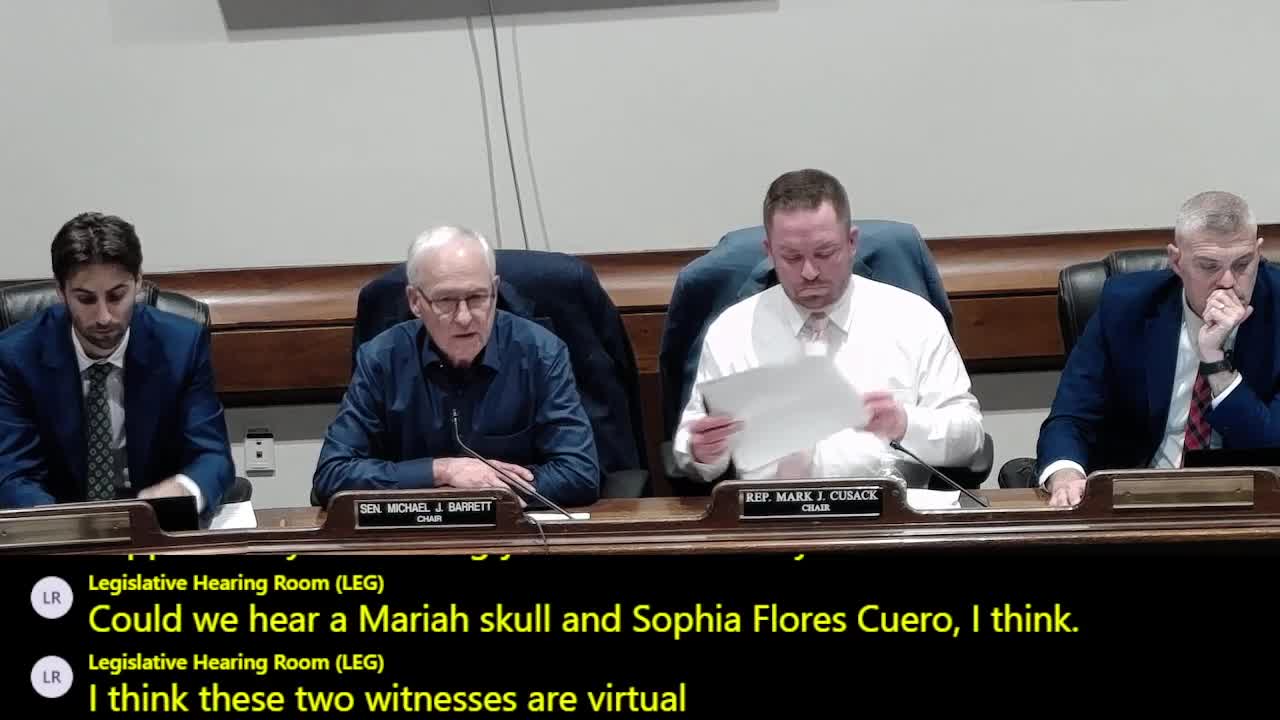
Summary
Witnesses supported S2325, a study for grid battery storage innovation, and urged policy to include distribution‑connected storage procurement and retail programs to capture local peak‑reduction benefits.
BOSTON — High school students, clean‑energy developers and industry groups told the Joint Committee on Telecommunications, Utilities, and Energy on July 9 that Massachusetts should study and deploy battery storage at scale and create procurement pathways for distributed storage.
“Battery storage allows us to store excess electricity when generation is high and deliver it when it’s most needed,” Mariah Eskel, a North Andover high school student, told the committee in support of S2325, which would authorize a study led by the Massachusetts Clean Energy Center. Eskel and Groton High School student Sofia Flores Cuero said the study should include researchers, utilities and private‑sector partners.
Developers and storage advocates said distribution‑connected storage can produce outsized ratepayer savings by reducing peak demand and lowering transmission and capacity charges. Jessica Robertson of New Leaf Energy and Sean Burke of BlueWave described a retail‑level storage model that would dispatch and compensate resources for performance during peak hours, similar to how SMART credits work for solar.
Robertson said a retail storage program could better capture localized grid benefits than current wholesale‑market options and the state 83E procurement alone, and that utility exclusion of distribution storage from the current procurement round leaves near‑term opportunities unrealized.
Industry trade witnesses argued that targeted procurement or a retail program could be structured as a shared‑savings mechanism, allowing developers to finance projects while returning a portion of savings to ratepayers. Kate Daniel of a community solar association and Valessa Sutterkline of the Solar Energy Industries Association urged rapid interconnection reform and temporary financing flexibility, such as allowing developers to bond interconnection payments to free cash for equipment purchases ahead of federal tax credit deadlines.
Committee members asked for a section‑by‑section analysis of H3542/S2282 to distinguish provisions that duplicate the governor’s energy affordability bill from standalone ideas — specifically calling out section 5, which would authorize a retail storage option and is not in the governor’s package.
No votes were taken. Witnesses asked the committee to report favorably on the study bill S2325 and on standalone measures enabling distribution storage procurement and interconnection reforms to accelerate projects and capture near‑term federal incentives.
Sources: testimony to the Joint Committee on Telecommunications, Utilities, and Energy, July 9, 2025. Quotations and program details from Mariah Eskel, Sofia Flores Cuero, Jessica Robertson (New Leaf Energy), Sean Burke (BlueWave), Kate Daniel (community solar association) and Valessa Sutterkline (SEIA).