
Cape Cod legislators and residents urge study of onshore impacts from offshore wind transmission
Get AI-powered insights, summaries, and transcripts
Subscribe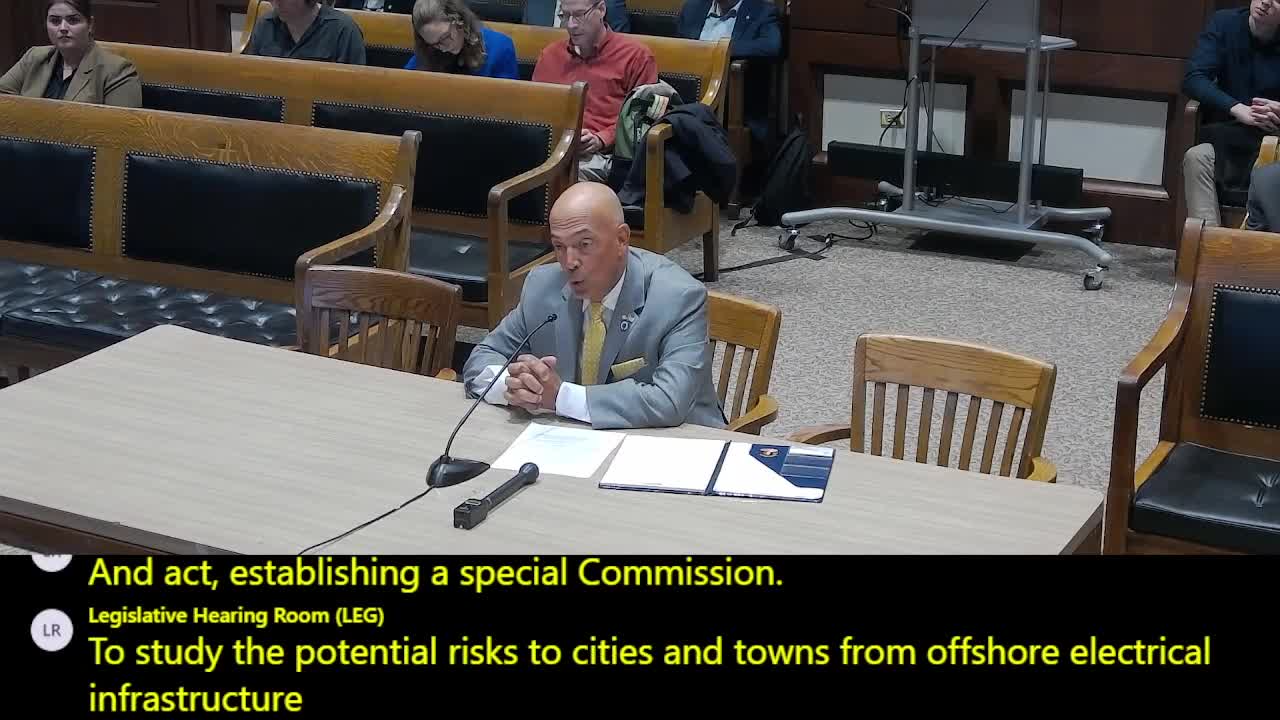
Summary
A state representative and local residents urged lawmakers to create a commission to study risks from onshore transmission and substations for offshore wind, citing concerns about siting near sole‑source aquifers, beaches, and villages.
BOSTON — A Massachusetts lawmaker representing Cape Cod and local residents urged the Joint Committee on Telecommunications, Utilities, and Energy on July 9 to approve legislation creating a special commission to study the onshore risks posed by transmission and substations needed to bring offshore wind to shore.
The representative who said they filed House Bill 3,585 described projects proposed in densely populated neighborhoods that would place high‑voltage infrastructure near drinking‑water protection zones. “The substations, one has already been built and others are proposed, are on top of our drinking water supply,” the representative told the committee, asking that the legislature establish a commission to analyze financial, environmental, public‑health and public‑safety risks.
Suzanne Conley, chair of the citizens group Save Greater Dossas Beach in Barnstable, testified she opposed current transmission plans that she said would bring multiple high‑voltage cables, splicing vaults and substations to Cape Cod beaches and village centers. She described monitoring work around the operational Vineyard Wind turbines and said local groundwater and coastal access would be affected.
Conley cited specific local concerns gathered by her group: multiple 400‑megawatt cables landing in public beach areas, large splicing vaults in parking lots, and diesel‑like dielectric fluid volumes in certain onshore stations. She asked the committee to advance two bills, H3479 and H3585, that would increase the legislature’s scrutiny of onshore siting and require greater local input.
Other witnesses in the hearing supported offshore wind generally but said onshore impacts merit special attention. Environmental groups that support offshore procurement recommended procedural safeguards and stronger wildlife mitigation, and cautioned against duplicative regulations that conflict with the 2024 Climate Act rulemaking.
Committee members asked proponents for clarifying technical details and for written testimony. No formal votes were taken at the hearing. Proponents requested that the committee create a formal study mechanism so that future siting decisions incorporate community and drinking‑water protections before contracts are finalized.
Sources: testimony to the Joint Committee on Telecommunications, Utilities, and Energy, July 9, 2025. Quotations come from the representative for Barnstable (testifying on House Bill 3,585) and Suzanne Conley, chair, Save Greater Dossas Beach.