
Council approves large northeast Oklahoma City PUD after debate over septic systems and environmental impacts
Get AI-powered insights, summaries, and transcripts
Subscribe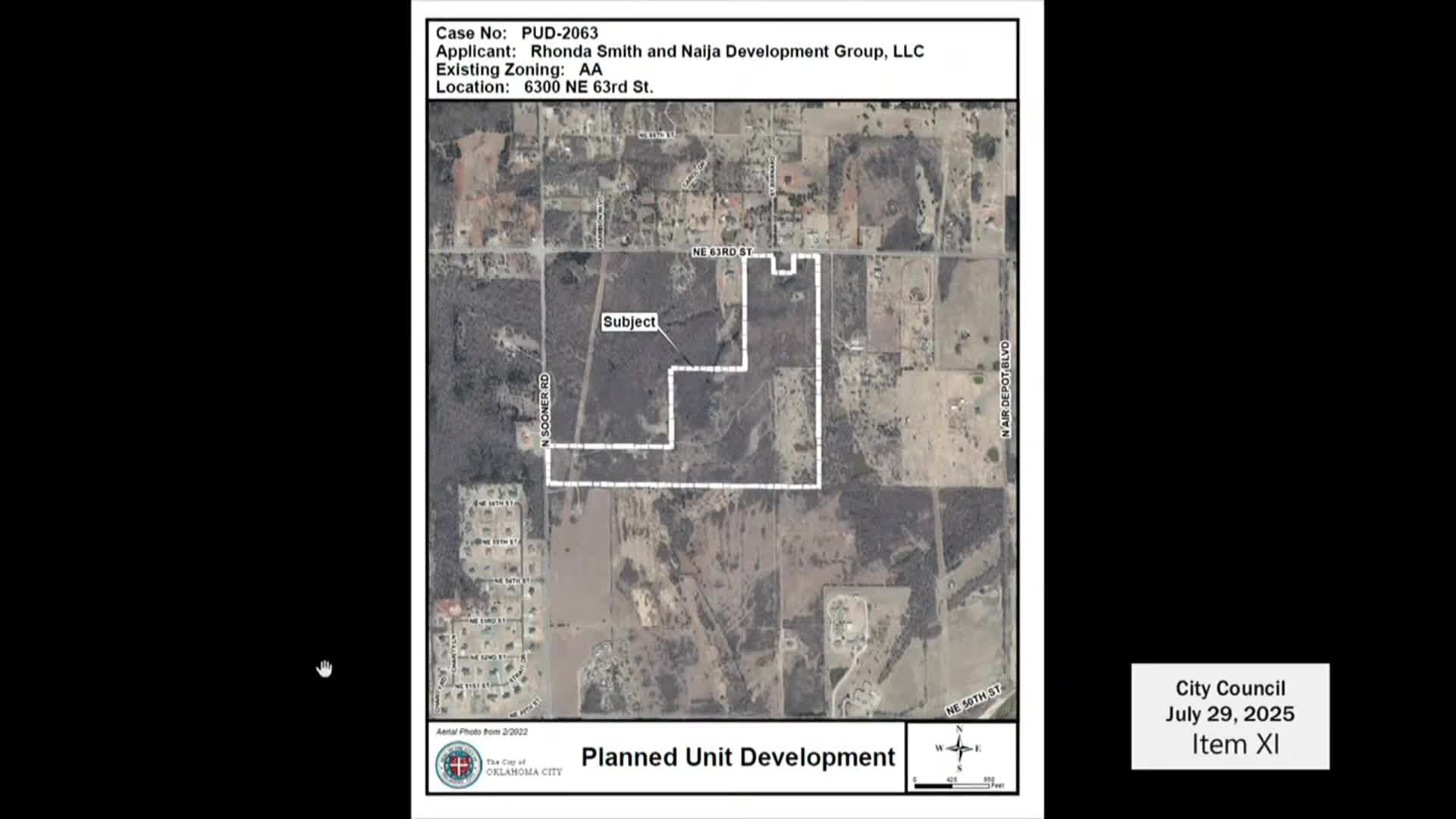
Summary
The council unanimously approved rezoning of a roughly 90-acre development (PUD 2063) after developer changes including larger minimum lot sizes, HOA-managed aerobic septic maintenance, and added buffer/easement; neighbors raised concerns about wildlife, cultural artifacts and proximity to a shooting range.
Oklahoma City — The City Council unanimously approved rezoning of a roughly 90-acre property to Planned Unit Development (PUD 2063) after questions from council members and public comment about septic (aerobic) wastewater systems, site density and environmental impacts. The ordinance clears a developer plan for about 86 lots and two tracks of housing, including a 55-plus community and a mix of single-family and multi-unit buildings. Developer Marcus (full name not provided in the record) told council the project’s minimum lot sizes were increased from half-acre to three-quarter-acre lots, and that the homeowners association will centralize semiannual maintenance for the site’s aerobic wastewater systems. Why it matters: Council members framed the project as part of efforts to add housing supply in northeast Oklahoma City but said they wanted clear assurances on environmental protections, system maintenance and long-term sewer access. What was debated: Neighbors raised several concerns during the public hearing. Resident Lori Turner said the development would “cut me completely off away from all the wildlife” and raised claims about Indian artifacts and proximity to a firearms range. The developer responded that the site had been surveyed, that no artifacts or building debris were found, and described design choices intended to preserve mature trees and wildlife, including a 35-foot tree buffer around the perimeter. The developer said roads and lot placement were planned to avoid large tree removal and pointed to a prior neighborhood development as an example of retaining mature canopy. On wastewater, Marcus said the HOA would be responsible for centralized maintenance of the aerobic systems and that each system is designed to handle the capacity of the units it serves. "These systems ... every single one of them had to do with the maintenance of the systems, particularly the lack of proper maintenance on the system. And our solution to that has been to centralize, the maintenance of these systems by the HOA," he told council. Council members also referenced the Oklahoma Department of Environmental Quality standard the developer cited, noting the Department’s minimum lot-size guidance for aerobic systems (half-acre) and that planning commissioners had asked the developer to increase lot sizes to three-quarter-acre lots. Outcome and conditions: Council voted to approve the rezoning unanimously. Council discussion and the planning commission record prompted the developer to incorporate changes — larger lot sizes, the HOA-maintenance commitment, a buffer and an easement for a potential future sewer line — and those items were discussed on the record as part of the approval. Discussion vs. decision: Council’s action was a final rezoning approval; the transcript shows extensive discussion and public comment but no separate motion to require additional environmental mitigations beyond those the developer described at the hearing. Ending: The developer said the project would offer a mix of housing types intended to meet demand across life stages; neighbors remain concerned about wildlife and cultural resources and the council noted the Department of Environmental Quality standards that govern septic/aerobic systems.